

The Mighty Gauls!
Images

Amphiteatre Trois Gaules Lyon




Origins and Cultural Identity
The Gauls represent a broad classification of Celtic peoples inhabiting mainland Europe during the Iron Age and Roman periods, spanning roughly from the 5th century BC to the 5th century AD. Their emergence around the 5th century BC is closely tied to the La Tène culture, a sophisticated material culture characterized by intricate metalwork, abstract art, and advanced ironworking techniques, which spread north and west of the Alps. The term 'Gaul' itself is a Latin exonym, with the Greeks referring to them as 'Galátai'.
Their homeland, known as Gallia, encompassed a vast territory that included much of modern France, Belgium, Switzerland, southern Germany, Austria, and the Czech Republic. Gaulish, their language, belonged to the continental Celtic branch of the Indo-European language family. It is crucial to understand that Gaul was not a unified political entity but a collection of numerous distinct tribes (toutās), each with its own leadership and customs, though they shared significant cultural and linguistic commonalities that allowed for inter-tribal cooperation and a sense of shared identity.
Expansion, Dominance, and Early Conflicts
By the 4th century BC, the Gauls had achieved a peak of influence, largely due to their strategic control over major European river systems such as the Rhône, Seine, Rhine, and Danube. These waterways served as vital arteries for trade and communication, facilitating their expansion across the continent. Their military prowess and migratory tendencies led them to push into Cisalpine Gaul (modern northern Italy) by the 4th and 3rd centuries BC, resulting in prolonged conflicts with the nascent Roman Republic, often termed the Roman–Gallic wars.
Simultaneously, Gallic migrations extended into the Balkans, leading to encounters and wars with Greek city-states. A notable offshoot of these migrations saw Gallic groups settling in Anatolia, becoming known as the Galatians, who even famously sacked Delphi in 279 BC. This period highlights the Gauls as a dynamic and expansionist force in ancient Europe, capable of projecting power across vast distances.
Societal Structure and Gallic Ingenuity
Gallic society was organized around numerous independent tribes, often united under charismatic leaders for specific military or political objectives, as exemplified by figures like Brennus and Vercingetorix. A defining feature of their civilization was the construction of large, fortified settlements known as oppida. These were not merely defensive strongholds but served as complex centers of administration, trade, and craft production, often strategically located on hilltops or near vital resources.
Sites like Bibracte showcase the advanced engineering and urban planning capabilities of the Gauls. Furthermore, the Gauls developed their own sophisticated economic systems, including the minting of their own coinage, which facilitated trade and demonstrated their autonomy. Their religious life was overseen by the druids, who held significant spiritual, judicial, and intellectual authority within their societies, preserving traditions and knowledge through oral transmission.
The creation of complex artifacts like the Coligny calendar also points to their advanced understanding of astronomy and timekeeping.
The Roman Conquest and the Dawn of Gallo-Roman Culture
The ascendancy of the Roman Republic marked a turning point in Gallic history. Following the conclusion of the First Punic War, Rome increasingly focused its expansionist ambitions towards Gallia. The Battle of Telamon in 225 BC, a significant Gallic defeat in Italy, foreshadowed the gradual erosion of Gallic power throughout the 2nd century BC.
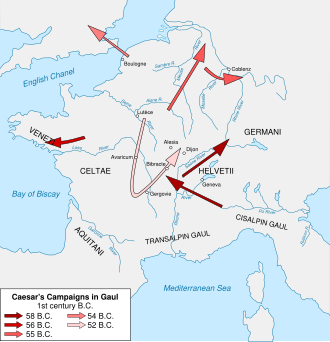
The decisive blow came with Julius Caesar's Gallic Wars (58–50 BC), a protracted and brutal campaign that resulted in the complete Roman conquest of Gaul. This conquest led to the integration of Gaul into the Roman Empire as a province, fundamentally altering its political and cultural landscape. While Gallic independence ceased, the ensuing period saw the development of a rich hybrid culture, known as Gallo-Roman culture, which blended Gallic traditions, language, and social structures with Roman governance, law, and infrastructure.
This fusion left an indelible mark on the subsequent history of Western Europe.
Go deeper
Frequently Asked Questions
What were the Gauls and where did they live?+
Why were the Gauls known for their metalwork?+
How did the Gauls use rivers?+
What were oppida?+
Who were the druids?+
Based on content from Wikipedia · Licensed under CC BY-SA 4.0