

The European Union: A Growing Family of Countries!
Images
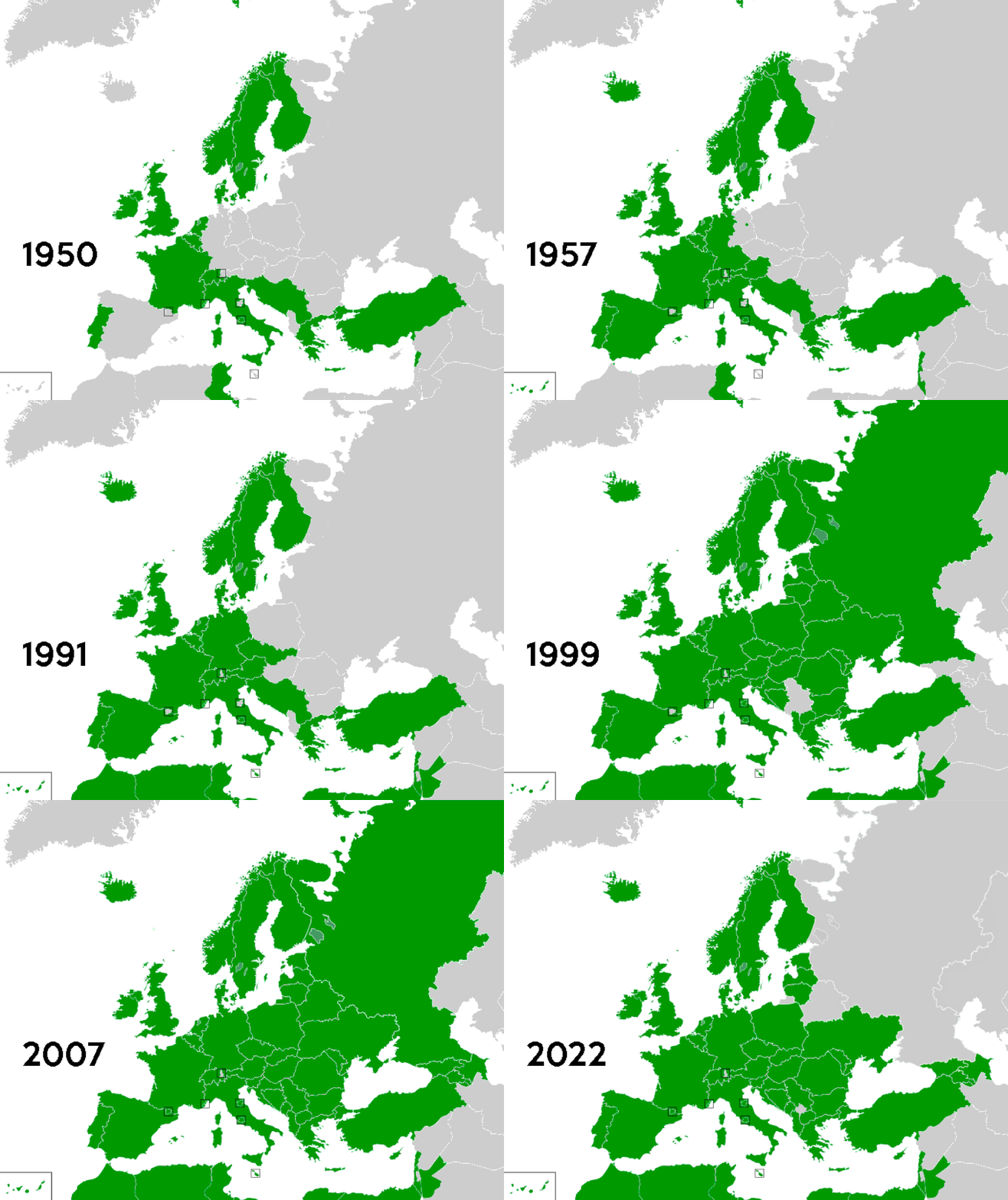
EBU enlargement animation




The Historical Trajectory of European Integration and Expansion
The journey of the European Union from its inception as the European Economic Community (EEC) in 1958 to its current form is a testament to evolving geopolitical aspirations. Founded by the 'Inner Six' – Belgium, France, Italy, Luxembourg, the Netherlands, and West Germany – with the Treaty of Rome, the EEC's primary goal was to foster economic cooperation and prevent future conflicts in post-war Europe.
This initial integration was driven by a desire for shared prosperity and political stability. Over subsequent decades, the community expanded through successive waves of enlargement, each driven by different historical contexts and political imperatives. The fall of the Berlin Wall and the collapse of communism in Eastern Europe in the late 20th century created a unique opportunity and a strong impetus for further expansion eastward.
Countries that had been under Soviet influence saw EU membership as a pathway to democracy, market economies, and security. This period marked the most significant geographical expansion of the Union, fundamentally reshaping the political and economic map of Europe. The process is not merely additive; it involves deep integration and harmonization of laws and policies across an increasingly diverse membership, a complex undertaking that continues to define the EU's identity.
The Rigorous Path to Membership
Gaining membership in the European Union is a meticulously regulated process, governed by the 'Copenhagen Criteria' established in 1993. These criteria are non-negotiable prerequisites for accession, ensuring that new member states align with the Union's core values and operational frameworks. Firstly, candidate countries must demonstrate 'stability of institutions guaranteeing democracy, the rule of law, human rights and respect for and protection of minorities.' This involves establishing robust democratic governance, an independent judiciary, and safeguarding fundamental freedoms.
Secondly, they must possess a 'functioning market economy' capable of withstanding competitive pressures within the EU. This often necessitates significant economic reforms, privatization, and liberalization. Thirdly, the candidate country must have the 'ability to take on the obligations of membership,' which includes adopting the entire body of EU law (the acquis communautaire) and demonstrating the administrative capacity to implement it effectively.
The accession process itself is lengthy, involving intensive negotiations on specific policy areas, and requires unanimous approval from all existing member states and the European Parliament. This rigorous vetting ensures that enlargement strengthens, rather than dilutes, the Union's coherence and effectiveness.
Current Accession Dynamics and Future Prospects
The European Union's enlargement agenda remains dynamic, with several countries actively pursuing membership. As of recent developments, Montenegro and Serbia have been engaged in accession negotiations for years, navigating complex chapters of legal and economic alignment. Albania, North Macedonia, Moldova, and Ukraine have been granted candidate status and are progressing towards formal negotiation talks, each facing unique challenges and reform requirements.
Bosnia and Herzegovina and Georgia are also candidates, tasked with implementing further reforms before negotiations can commence. Turkey's accession process, initiated in 2005, has been effectively frozen since 2016 due to significant concerns regarding democratic backsliding, the rule of law, and fundamental rights. The EU's approach to enlargement is increasingly strategic, balancing the desire to extend stability and democratic values with the need to maintain internal cohesion and the capacity to absorb new members.
Geopolitical events, such as the war in Ukraine, have also accelerated the political will for enlargement, particularly in Eastern Europe, signaling a renewed focus on the EU's role as a security and geopolitical actor.
Geopolitical Ramifications and Internal Cohesion Challenges
The enlargement of the European Union carries profound geopolitical implications, extending its influence and promoting stability across the continent. By integrating neighboring countries, the EU aims to foster democratic governance, economic development, and peaceful coexistence, thereby reducing the potential for conflict. For aspiring member states, EU accession offers significant benefits, including access to the single market, substantial financial aid, and enhanced political leverage on the international stage.
However, enlargement also presents considerable challenges for the Union itself. Absorbing new members, particularly those with less developed economies or different political traditions, can strain institutional capacity and lead to internal policy debates. Issues such as the distribution of voting power in the Council, the allocation of EU funds, and the harmonization of social and environmental standards become more complex with a larger membership.
Furthermore, the withdrawal of the United Kingdom (Brexit) in 2020 serves as a stark reminder of the potential for internal divergence and the complexities of maintaining unity within such a diverse bloc. The EU must continuously balance its outward-looking expansionist policy with the imperative of maintaining internal cohesion and functional effectiveness.
Territorial Adjustments and the Evolving EU Map
Beyond the accession of sovereign states, the European Union's geographical footprint has also been shaped by territorial adjustments. The most recent territorial enlargement occurred in 2014 with the incorporation of Mayotte, an overseas department of France, into the EU. Conversely, the EU and its predecessors have experienced territorial reductions. Algeria ceased to be part of the European Economic Community upon gaining independence in 1962. Greenland, a self-governing territory within the Kingdom of Denmark, left the EEC in 1985 following a referendum.
The most significant recent reduction was the withdrawal of the United Kingdom in 2020, a process commonly known as Brexit. These territorial changes, whether additions or subtractions, highlight the dynamic nature of the EU's borders and its evolving relationship with constituent territories and former members. The inclusion of territories like Mayotte, which has a unique status, demonstrates the EU's capacity to adapt its legal and political framework to accommodate diverse geographical and political realities within its broader framework of integration.
See also
Frequently Asked Questions
What is the European Union?+
How does a country become a member of the EU?+
Why did many countries join the EU after the Berlin Wall fell?+
Which countries are trying to join the EU right now?+
What does "acquis communautaire" mean?+
Based on content from Wikipedia · Licensed under CC BY-SA 4.0