

Crusader Castles and Kingdoms!
Images

Crusader states


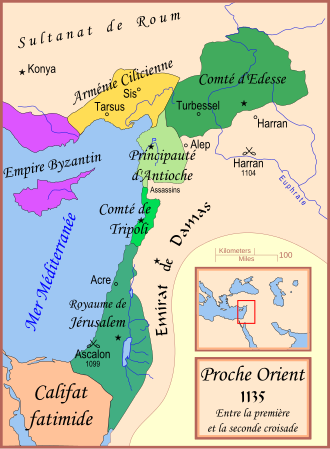


Forging Kingdoms from Conquest
The Crusader states, established in the wake of the First Crusade (1096-1099), represented a bold geopolitical experiment in the Eastern Mediterranean. These were not spontaneous formations but rather deliberate attempts to carve out and administer territories in a region already densely populated and politically complex. The primary entities included the Kingdom of Jerusalem, the County of Tripoli, the Principality of Antioch, and the County of Edessa.
Each was founded on conquest and initially ruled by prominent leaders of the Crusade, such as Godfrey of Bouillon and Bohemond of Taranto. These states adopted a European feudal structure, transplanting familiar systems of land tenure, vassalage, and military obligation into an alien environment. However, they operated under unique pressures: constant external threats from neighboring Muslim powers, a significant demographic imbalance between the Frankish rulers and the indigenous populations, and the logistical challenges of maintaining supply lines and reinforcements from distant Europe.
The very legitimacy of these states was tied to their religious mission, yet their survival depended on pragmatic political and military strategies, often involving alliances with or subjugation of local Christian and Muslim communities.
Architectural Marvels and Military Ingenuity
The Crusader presence in the Levant is indelibly marked by their formidable castles and fortifications. Driven by the necessity of defense in a hostile territory, the Crusaders developed and refined siege warfare and defensive architecture to an unprecedented degree. Castles like Krak des Chevaliers, a Hospitaller fortress, and the Belvoir Castle, a Templar stronghold, stand as testaments to their engineering prowess.
These were not merely defensive structures but sophisticated military installations designed to control strategic routes, protect agricultural lands, and serve as administrative centers. They featured multiple concentric walls, imposing towers, complex gatehouses, and advanced water management systems, all designed to withstand prolonged sieges. The Crusaders also adapted existing Byzantine and Islamic fortification techniques, creating a hybrid style that was highly effective.
The sheer scale and complexity of these fortresses, often built in challenging terrain, required immense resources, skilled labor, and sophisticated logistical planning, reflecting the high priority placed on security and territorial control by the Crusader leadership.
A Complex Tapestry
The social fabric of the Crusader states was exceptionally diverse and dynamic. The ruling elite, often referred to as 'Franks' regardless of their actual origin, constituted a minority within their domains. They coexisted, often uneasily, with a majority population comprising various Eastern Christian sects (Syriac, Armenian, Greek Orthodox), Jews, and Muslims.
This demographic reality necessitated a degree of cultural exchange and adaptation. While the Crusaders imposed their language (primarily Old French and Latin for official purposes) and legal systems, they also absorbed local customs, agricultural practices, and even culinary traditions. Trade flourished, connecting the Levant to both Europe and the wider Islamic world. However, relations were frequently strained by religious differences and the ongoing conflict.
The concept of 'outremer' (overseas) became a distinct identity for those born in the Levant, creating a generation with unique loyalties and perspectives, often different from their European ancestors. This intricate interplay of imposition, adaptation, and conflict shaped a unique cultural landscape.
The Long Decline
The Crusader states, despite their initial successes and formidable defenses, were ultimately unsustainable in the long term. Their decline was a gradual process influenced by a confluence of internal and external factors. Internally, political fragmentation, succession disputes, and a dwindling flow of European support weakened their resolve and resources.
The demographic imbalance persisted, with the Frankish population remaining a minority, making sustained military campaigns and territorial expansion increasingly difficult. Externally, the rise of powerful, unified Muslim leadership, particularly under figures like Zengi, Nur al-Din, and later Saladin, posed a significant and escalating threat. These leaders were adept at exploiting Crusader weaknesses and rallying Muslim forces under a common cause.
The loss of key territories, culminating in the fall of Acre in 1291, marked the definitive end of the Crusader presence in the Levant. Their legacy, however, endures in the monumental architecture, the historical narratives of East-West interaction, and the complex geopolitical lessons learned from this ambitious medieval endeavor.
Go deeper
Frequently Asked Questions
What were the Crusader states?+
Why did the Crusaders build big castles?+
How were the Crusader castles designed?+
Who lived in the Crusader kingdoms?+
What happened to the Crusader castles and kingdoms?+
Based on content from Wikipedia · Licensed under CC BY-SA 4.0