

Viking expansion
Images

Viking Expansion-fr




The Genesis of Viking Seafaring Prowess
The Viking expansion, spanning roughly from 793 CE (the raid on Lindisfarne) to 1066 CE (the Battle of Hastings), was not a monolithic movement but a complex series of migrations, raids, and trade ventures originating from Scandinavia. The development of the longship, a marvel of naval engineering with its clinker-built hull, flexible keel, and combination of sail and oar power, was fundamental.
This allowed Vikings to undertake voyages of unprecedented scale, navigating the open ocean and shallow rivers alike. Factors contributing to this expansion include population pressures, the desire for wealth and resources, political instability in their homelands, and opportunities presented by weaker defenses in neighboring regions. Their activities encompassed a spectrum from opportunistic raiding to systematic colonization and the establishment of sophisticated trade networks.
Mapping the Viking World
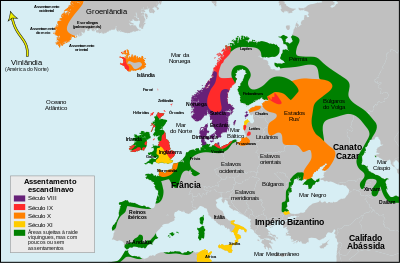
The geographical scope of Viking expansion was truly global for its era. To the west, they crossed the formidable North Atlantic, settling Iceland in the 870s and Greenland around 985 CE, establishing societies that persisted for centuries. Leif Erikson's voyage to North America, likely around 1000 CE, represents the furthest westward reach, with the short-lived settlement at L'Anse aux Meadows providing archaeological evidence.
Eastward, Viking explorers and traders, often referred to as Rus', traveled along the river systems of Eastern Europe, establishing principalities that would form the basis of modern Russia and Ukraine. They reached the Caspian Sea and the Black Sea, engaging in trade with the Byzantine Empire and the Abbasid Caliphate, reaching as far as Constantinople and the Middle East.
Their southern expeditions also extended into the Mediterranean, impacting regions like Sicily and North Africa.
Establishing Enduring Legacies
Beyond transient raids, the Vikings were prolific colonizers. Their settlements were not merely outposts but often evolved into significant political and economic centers. In the British Isles, they established the Danelaw in England and had a profound impact on Ireland, founding cities like Dublin.
In France, the Duchy of Normandy, granted to Viking leader Rollo in 911 CE, became a powerful entity, with its name directly referencing the Norsemen. They also established kingdoms in Sicily and southern Italy, integrating into the complex political landscape of the Mediterranean. These settlements facilitated extensive cultural exchange, leading to linguistic influences, legal reforms, and the adoption of new technologies and customs by both Vikings and the indigenous populations.
The Multifaceted Roles of the Vikings
The popular image of the Viking as solely a brutal raider is an oversimplification. Their expansion was characterized by diverse roles: as looters, they exploited vulnerabilities; as traders, they established vast commercial networks connecting Northern Europe with the Byzantine and Islamic worlds, exchanging goods like furs, slaves, and amber for silver, silk, and spices; as colonists, they founded new societies and agricultural communities; and as mercenaries, they served in foreign armies, most famously as the Varangian Guard for the Byzantine Emperors.
This multifaceted engagement meant that Viking expansion was a significant force in shaping the political, economic, and cultural landscape of medieval Europe and beyond, contributing to the interconnectedness of the medieval world.
See also
Based on content from Wikipedia · Licensed under CC BY-SA 4.0