

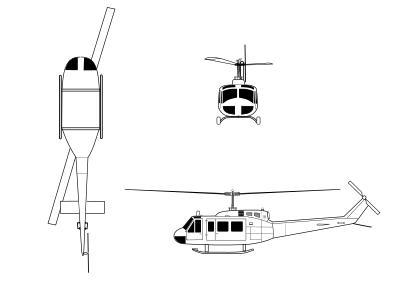
Bell UH-1 Iroquois
Images

Bell UH-1 Iroquois Huey 5D4 3606 (48706920071)




Genesis of the Iroquois
The development of the Bell UH-1 Iroquois, commonly known as the 'Huey,' was a direct response to the U.S. Army's requirement for a new generation of utility and medical evacuation helicopters in the early 1950s. Bell Helicopter's innovative design, designated the Bell 204, first flew on October 20, 1956. Its significance lay not just in its utility but in its powerplant: a single turboshaft engine.
This marked a pivotal moment as it was the first turbine-powered helicopter to enter service with the U.S. military, offering a substantial performance advantage over the piston-engine helicopters of the era. The initial production contract for 100 HU-1As in March 1960 underscored the Army's confidence. Bell's commitment to improvement was evident as they rapidly developed models with significantly more powerful engines; by 1966, engines producing 1,400 shaft horsepower were replacing the original 700 horsepower units.
Furthermore, recognizing the need for greater troop capacity, Bell introduced a stretched version in August 1961, demonstrating a keen responsiveness to operational demands and setting the stage for the Huey's legendary status.
The Huey in Combat
The Bell UH-1 Iroquois became inextricably linked with the Vietnam War, with the first examples deployed in March 1962. Its role transcended simple transport; it became a symbol of the conflict and a testament to helicopter adaptability. The Huey performed a vast array of missions: general support, air assault operations inserting troops into hostile territory, critical cargo transport, life-saving aeromedical evacuations, and vital search and rescue missions.
Its versatility extended to electronic warfare and even ground attack roles. Armed variants, often modified in the field, carried a formidable array of weapons, including rockets and machine guns, acting as formidable gunships. The U.S. Air Force also utilized Hueys for reconnaissance and psychological warfare operations.
The widespread deployment, with around 7,000 Iroquois operating in the Vietnam theater alone, highlights its indispensable nature, despite the significant losses of over 3,300 aircraft. Its combat legacy extends beyond Vietnam, with deployments in conflicts like the Rhodesian Bush War and the War in Afghanistan.
Evolution and Derivatives
The success of the UH-1 led to a prolific family of rotorcraft, both military and civilian. The original designation HU-1, from which the enduring nickname 'Huey' is derived, was officially changed to UH-1 in 1962, though the nickname persisted. Bell Helicopter leveraged the core design principles to create specialized variants.
Most notably, the dedicated attack helicopter, the Bell AH-1 Cobra, was developed with a high degree of commonality, showcasing how the Huey's airframe and systems could be adapted for offensive roles. Civilian versions, the Bell 204 and 205, brought the Huey's capabilities to a broader market. Recognizing the demand for enhanced performance and safety, Bell introduced twin-engine models, such as the UH-1N Twin Huey, and later, advanced four-bladed derivatives like the Bell 412 (which saw service in Canada) and the modern Bell UH-1Y Venom for the U.S.
Marine Corps. This continuous development underscores the fundamental strength and adaptability of the original Iroquois design.
Enduring Service and Global Impact
Despite the introduction of newer helicopter types, such as the Sikorsky UH-60 Black Hawk and Eurocopter UH-72 Lakota, the UH-1 Iroquois has demonstrated remarkable longevity. It was gradually phased out of U.S. Army service in the early 21st century, but hundreds remained operational more than 50 years after its introduction.
The sheer scale of production, exceeding 16,000 units since 1960, is a testament to its global demand and utility. The Huey continues to be produced, with ongoing orders from countries like Japan and the Czech Republic. Numerous export customers, including Canada, Germany, Taiwan, Japan, and Italy, have produced the type under license, establishing a truly worldwide operational footprint across the Americas, Europe, Asia, Africa, the Middle East, and the Pacific.
The Bell UH-1 Iroquois is not just a helicopter; it is a cornerstone of modern aviation history, whose influence continues to resonate.
See also
Based on content from Wikipedia · Licensed under CC BY-SA 4.0