

Canada's Awesome Places: Provinces and Territories!
Images

Unibicameral Map




Constitutional Foundations
Canada's administrative structure is defined by its ten provinces and three territories, each possessing a unique constitutional standing. Provinces are foundational entities, deriving their powers directly from the Constitution Act, 1867. This grants them significant autonomy and a status of co-sovereignty with the federal government.
Their legislative powers are extensive, covering areas such as education, healthcare, and property rights, with changes to this division of powers requiring complex constitutional amendments. Each province has a Lieutenant Governor, representing the Crown, underscoring their inherent authority within the Canadian federation. This constitutional bedrock ensures that provincial governments are not merely administrative arms of the federal state but integral partners in governance, reflecting a decentralized federal model.
Delegated Authority and Evolving Governance
In contrast to provinces, Canada's three territories-Yukon, Northwest Territories, and Nunavut-operate under a different constitutional paradigm. Their powers are not constitutionally entrenched but are delegated by the Parliament of Canada. This means their governments have authority granted to them by federal legislation, and this authority can be altered or revoked by the federal government.
Each territory is represented by a Commissioner, who acts as the federal government's representative. While territorial governments have evolved significantly, gaining more autonomy over time, their fundamental relationship with the federal government remains one of devolved power rather than inherent sovereignty. This distinction is crucial for understanding the varying degrees of self-governance across Canada.
A Historical Trajectory of Expansion and Consolidation
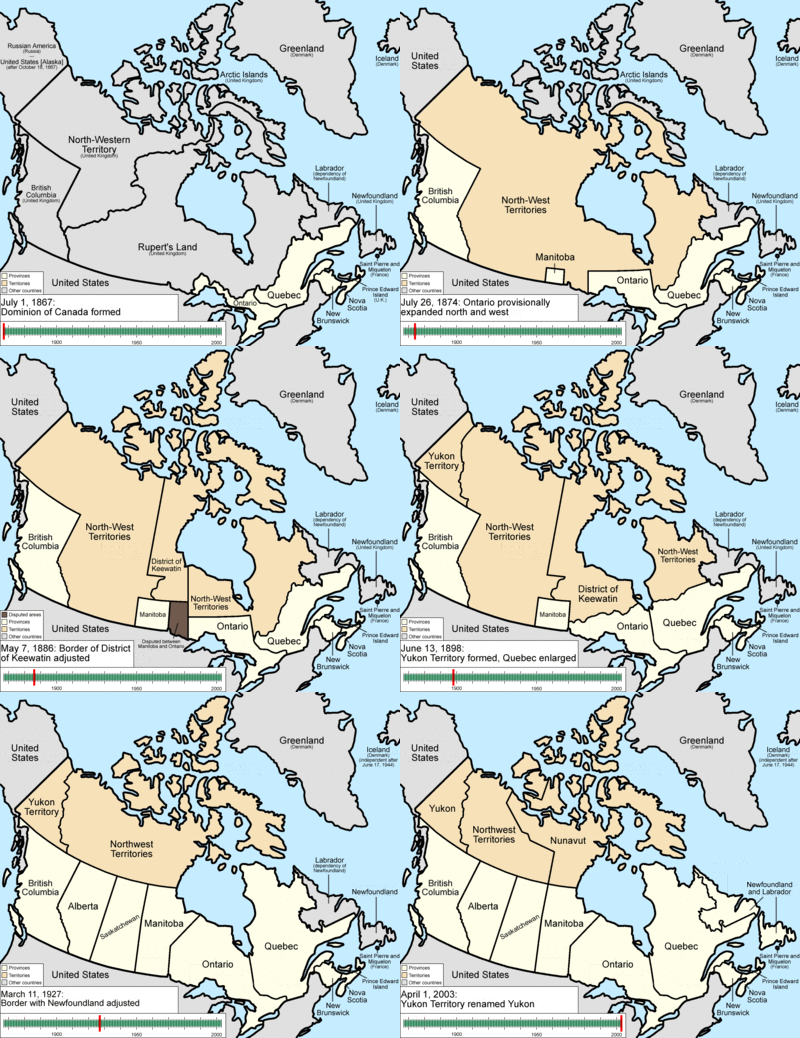
The formation of Canada's provincial and territorial landscape is a story of gradual expansion and consolidation. The initial Confederation in 1867 brought together Ontario, Quebec, Nova Scotia, and New Brunswick. Subsequent decades saw the admission of Manitoba, British Columbia, Prince Edward Island, Alberta, and Saskatchewan.
The creation of the territories, often encompassing vast, sparsely populated regions, followed a different path, driven by resource development and administrative necessity. The most recent addition, Nunavut, established in 1999, represents a significant milestone in Indigenous self-governance. This historical evolution highlights Canada's ongoing process of nation-building and its adaptation to changing demographic and political realities.
Regional Diversity
The ten provinces and three territories foster immense regional diversity, shaping distinct cultural identities and economic landscapes. From the resource-based economies of the western provinces and the North to the manufacturing and financial hubs of Central Canada, and the historically rooted economies of the Atlantic provinces, each region contributes uniquely to the national economy. Culturally, the linguistic duality of English and French, particularly in Quebec and parts of Ontario and the Maritimes, is a defining feature, alongside the profound and enduring presence of Indigenous cultures across the country.
This rich tapestry of languages, traditions, and economic specializations creates a complex and dynamic national identity, where regional distinctiveness is both preserved and celebrated within the broader Canadian framework.
Education and Governance
Education is a primary responsibility of provincial governments, leading to variations in curriculum, educational standards, and funding models across the country. While the federal government plays a role in post-secondary education and research funding, the day-to-day administration and policy direction for K-12 education rest with the provinces. This decentralized approach allows for regional adaptation but also raises questions about national educational equity.
Similarly, the governance structures, while sharing common democratic principles, reflect the constitutional differences between provinces and territories. Understanding these variations is key to appreciating the multifaceted nature of Canadian governance and public service delivery.
See also
Based on content from Wikipedia · Licensed under CC BY-SA 4.0