

The Big Vote: America Chooses a Leader!
Images
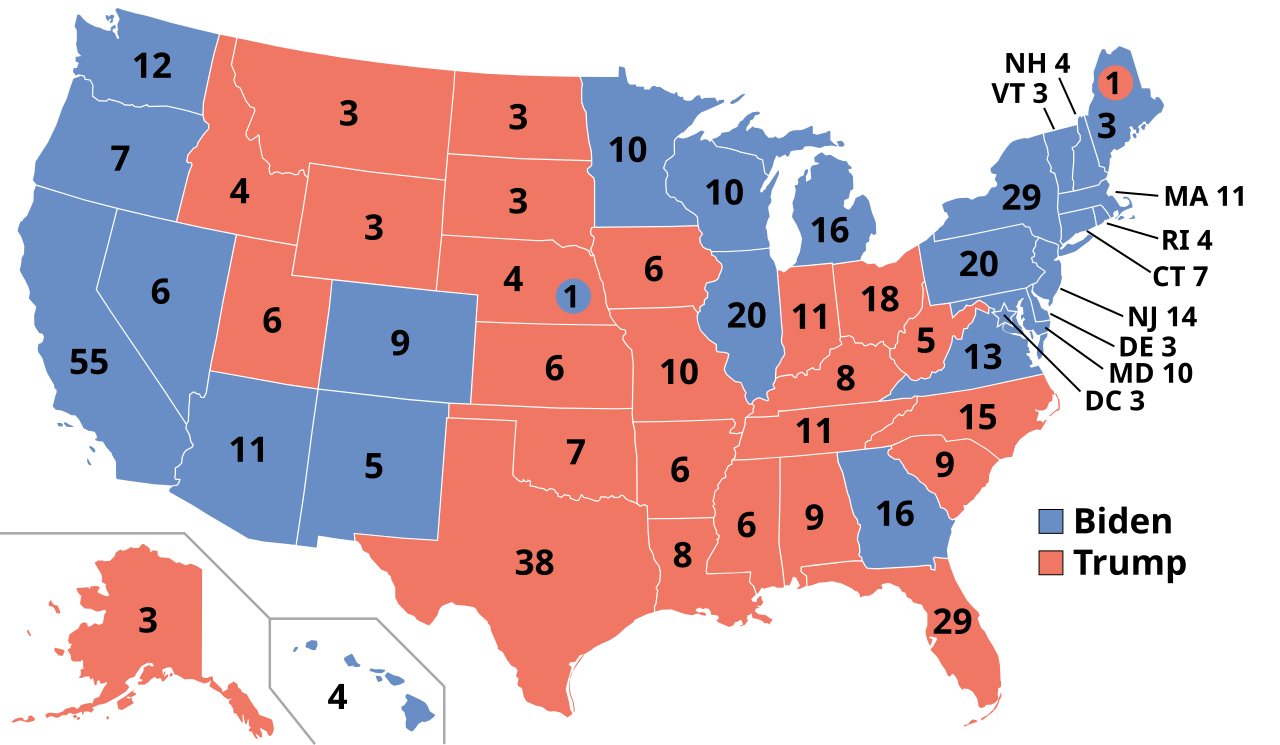
ElectoralCollege2020


The Electoral Landscape and the Path to Victory
The 2020 United States presidential election was a complex contest that ultimately saw Joe Biden and Kamala Harris defeat incumbent President Donald Trump and Vice President Mike Pence. The election's outcome was determined by the Electoral College, a system established by the U.S. Constitution, where each state is allocated a number of electors based on its total number of senators and representatives.
A candidate needs to secure a majority of these electoral votes, 270 out of 538, to win the presidency. In 2020, Biden achieved this by winning 306 electoral votes, while Trump received 232. A crucial element of Biden's victory was his success in reclaiming key 'Rust Belt' states like Michigan, Pennsylvania, and Wisconsin.
These states had narrowly voted for Trump in 2016, and their combined 46 electoral votes proved decisive in swinging the election back to the Democratic column. Trump's defeat marked the first time a sitting president had lost re-election since George H. W.
Bush in 1992, highlighting a significant shift in voter sentiment.
Unprecedented Voter Engagement and Record Turnout
The 2020 election was characterized by an extraordinary level of public participation, setting historical benchmarks for voter turnout. The percentage of eligible voters who cast ballots was the highest recorded since 1900, indicating a deeply engaged electorate. Joe Biden's campaign garnered over 81 million votes, a figure that shattered all previous records for a presidential candidate in U.S. history. This surge in voter activity can be attributed to a confluence of factors, including intense political polarization, a desire for change, and the heightened stakes surrounding the critical issues of the election.
The sheer volume of participation underscored the profound importance voters placed on the election's outcome and the future direction of the country.
The Pandemic's Shadow
The COVID-19 pandemic profoundly reshaped the electoral process in 2020, leading to a dramatic increase in early voting and voting by mail. Public health concerns prompted many states to expand access to these alternative voting methods to ensure the safety of voters and election workers. This resulted in a record number of ballots being cast before Election Day.
Thirty-eight states reported that over half of all votes were cast through these early or mail-in methods, with only three states seeing less than 25% of their votes cast this way. The widespread use of mail-in ballots, while crucial for accessibility, also led to delays in vote counting and reporting in several swing states. This logistical challenge meant that major news outlets delayed their projections of Biden and Harris as the president-elect and vice president-elect until the morning of November 7, 2020, adding to the suspense of the election.
Key Issues and the Political Discourse
The 2020 election was fought on a battleground of critical national issues that resonated deeply with the American public. Foremost among these was the public health and economic fallout from the COVID-19 pandemic, which dominated campaign discourse and voter concerns. Alongside the pandemic, widespread civil unrest and protests following the police killing of George Floyd brought issues of racial justice and police reform to the forefront.
The composition of the Supreme Court also became a significant point of contention, particularly following the death of Justice Ruth Bader Ginsburg and the subsequent confirmation of Amy Coney Barrett, raising questions about the future of landmark legislation like the Affordable Care Act. These multifaceted challenges created a highly charged political environment, shaping the priorities and decisions of voters.
Contested Results and the Aftermath
Following the election, President Donald Trump refused to concede, alleging widespread fraud and making unsubstantiated claims of irregularities. He and his allies initiated numerous legal challenges across various states, all of which were unsuccessful. These efforts to overturn the election results culminated in the January 6, 2021, attack on the United States Capitol, an event widely described as an attempted self-coup.
Trump was subsequently impeached for a second time by the House of Representatives for his role in inciting the insurrection. In the aftermath, on January 7, 2021, Trump released a video statement acknowledging the transition of power to a 'new administration,' though he notably did not name President-elect Biden directly.
See also
Frequently Asked Questions
Who won the 2020 U.S. presidential election?+
How many electoral votes does a candidate need to win the presidency?+
What new voting methods were used in 2020 because of the pandemic?+
Which states helped Joe Biden win the election?+
Why did so many people vote early or by mail in 2020?+
Based on content from Wikipedia · Licensed under CC BY-SA 4.0