

How the USA Got So Big!
Images

Canada change 1889-08-12


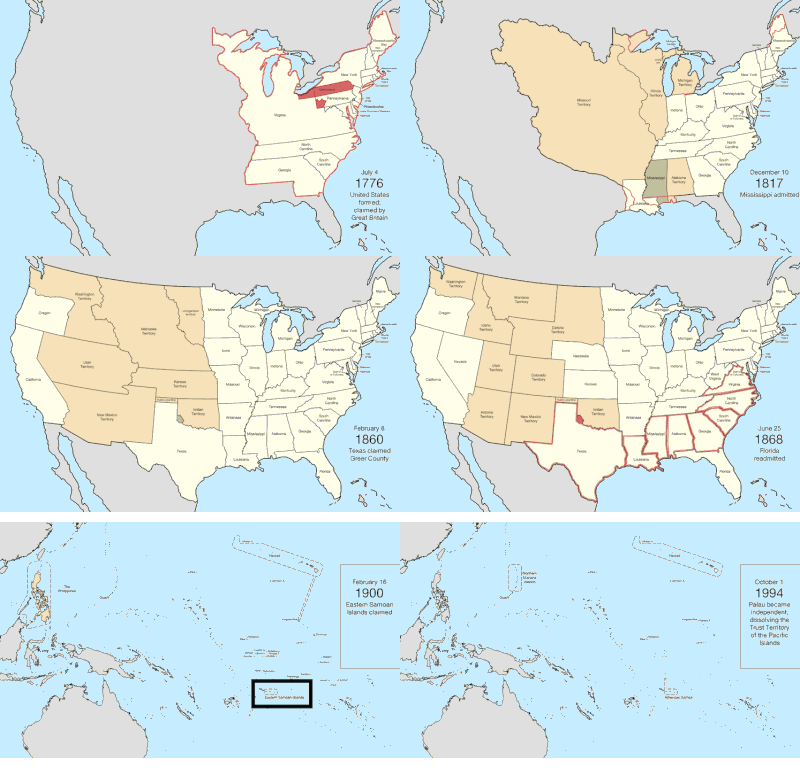


Foundational Expansion and Early Consolidation
The genesis of the United States as a territorial entity began with the thirteen British colonies declaring independence in 1776. The subsequent Treaty of Paris in 1783 formally recognized this independence and significantly expanded the nascent nation's domain, extending its western boundary to the Mississippi River. This acquisition effectively doubled the original colonial territory.
However, this expansion was complicated by overlapping 'sea-to-sea' grants claimed by some original colonies, leading to complex negotiations and eventual cessions of these claims to the federal government. This early period established a precedent for federal management of acquired lands, laying the groundwork for future territorial organization and statehood.
Continental Growth
The 19th century witnessed the most dramatic phase of continental expansion. The Louisiana Purchase in 1803 from France was a pivotal moment, nearly doubling the nation's size and opening vast territories for exploration and settlement. This was followed by diplomatic resolutions and, at times, conflict, leading to the acquisition of Florida and the Oregon Country, granting the U.S. access to the Pacific.
The annexation of the Republic of Texas in 1845 precipitated the Mexican-American War, resulting in the U.S. gaining significant territories in the Southwest, including California. These acquisitions, while fueling the idea of Manifest Destiny, also intensified the contentious issue of slavery in new territories, leading to significant political crises like the Missouri Compromise and Bleeding Kansas.
Internal Strife and the Civil War's Impact
The escalating debate over slavery in the expanding territories became a central and divisive issue. The question of whether new states would permit or prohibit slavery created deep political and social rifts. Events like the Missouri Compromise attempted to balance power between free and slave states, but ultimately proved insufficient.
The secession of Southern states in 1860-1861 and the ensuing Civil War (1861-1865) represented a profound challenge to the Union's territorial integrity. The Union victory led to the Confederacy's defeat and the eventual readmission of the Southern states, solidifying federal authority over the entire nation, though the legacy of these divisions continued to shape national identity and policy.
Overseas Expansion and Global Reach
In the latter half of the 19th century and into the 20th, the United States began to expand beyond the North American continent. The Guano Islands Act of 1856 marked an early foray into claiming remote islands for economic resources. The purchase of Alaska from Russia in 1867 was a significant territorial gain.
The Spanish-American War in 1898 dramatically shifted U.S. foreign policy, resulting in the acquisition of Puerto Rico, Guam, and the Philippines, and establishing a sphere of influence in the Caribbean and Pacific. Hawaii was annexed the same year. Post-World War II, the U.S. administered several islands under UN trusteeship, with some becoming independent nations while others, like the Northern Mariana Islands, remained U.S. territories.
The Panama Canal Zone also represented a unique form of territorial control until its return to Panama.
Statehood and Modern Territorial Status
The process of territorial evolution culminated in the admission of new states into the Union. Most states were formed from federally administered territories, with only a few exceptions like Kentucky, Maine, and West Virginia being carved directly from existing states. Some states, such as Louisiana and Pennsylvania, later expanded their borders by acquiring additional federal territory. Arizona was the last state admitted from the contiguous United States in 1912.
The admission of Hawaii in 1959 as the 50th state marked the final addition to the Union. Today, several U.S. territories, such as Puerto Rico and Guam, continue to exist with varying degrees of self-governance, representing the ongoing evolution of the United States' political geography.
See also
Frequently Asked Questions
What did the Treaty of Paris in 1783 do for the United States?+
How did the Louisiana Purchase make the USA bigger?+
Why did the U.S. get Florida, Texas, and California?+
How did the U.S. get Alaska, Hawaii, Puerto Rico, Guam, and the Philippines?+
What was the Panama Canal Zone and what happened to it?+
Based on content from Wikipedia · Licensed under CC BY-SA 4.0