

Congo Free State
Images

Congo Free State




Geographical Context
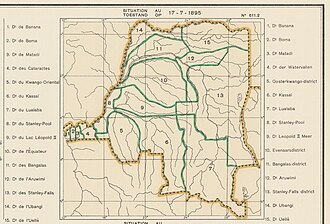
The Congo Free State encompassed the majority of the Congo River basin, a colossal geographical region in Central Africa. Its sheer scale, approximately 2.3 million square kilometers, made it one of the largest colonial territories in history, dwarfing many European nations. The basin is characterized by dense tropical rainforests, a humid climate with high rainfall, and a complex network of rivers, with the Congo River being the dominant artery.
This river is the second-largest in the world by discharge volume and is navigable in sections, making it a critical transportation route. The region's immense biodiversity and rich natural resources, particularly rubber and minerals like copper and diamonds, were the primary drivers of external interest and subsequent exploitation. The vastness and challenging terrain also presented significant logistical hurdles for administration and control.
The Genesis of a Personal Kingdom
Established in 1885 at the Berlin Conference, the Congo Free State was not a typical colonial venture but the personal property of King Leopold II of Belgium. Leopold skillfully navigated international politics, using philanthropic rhetoric about ending the Arab slave trade and promoting 'civilization' to gain recognition for his 'International Association of the Congo.' However, his true motive was economic gain. He envisioned a vast source of wealth, primarily from rubber, which was in high demand globally.
He implemented a brutal system of forced labor, employing concession companies that were granted vast tracts of land and tasked with extracting resources. The administration was characterized by extreme violence, including mutilation and murder, to enforce labor quotas and suppress any resistance, creating a regime of terror that decimated the indigenous population.
Economic Exploitation and Human Rights Atrocities
The economic engine of the Congo Free State was the relentless exploitation of its natural resources, particularly rubber. The 'Red Rubber' system, as it became known due to the widespread atrocities, involved forcing local populations into labor. Men were often taken from their villages to tap rubber trees, while women and children were held hostage to ensure compliance.
Failure to meet quotas resulted in horrific punishments, including the severing of hands, a chilling symbol of the regime's brutality. The immense profits generated by this system flowed directly to Leopold II and his associates, while the Congolese people endured unimaginable suffering, disease, and demographic collapse. The international community, initially misled by Leopold's propaganda, gradually became aware of the atrocities through reports from missionaries and journalists, leading to growing pressure for reform.
The Transition to Belgian Rule and the Path to Independence
The sustained international outcry and damning evidence of human rights abuses eventually forced the Belgian government to intervene. In 1908, the Congo Free State was annexed by Belgium and became the Belgian Congo, a formal colony. This transition aimed to bring the territory under more direct governmental control and ostensibly improve conditions, though exploitation continued in different forms.
The colonial administration focused more on infrastructure development and resource extraction for Belgian benefit. Following World War II, a wave of decolonization swept across Africa. The Belgian Congo, after a period of political awakening and unrest, gained its independence on June 30, 1960, becoming the Republic of the Congo (later renamed Zaire, and now the Democratic Republic of the Congo).
The legacy of the Congo Free State continues to shape the region's complex socio-political and economic landscape.
Go deeper
Frequently Asked Questions
What was the Congo Free State?+
Who owned the Congo Free State and why did he want it?+
Why was rubber so important in the Congo Free State?+
How did people in the Congo Free State suffer under the king’s rule?+
What happened to the Congo Free State after 1908?+
Based on content from Wikipedia · Licensed under CC BY-SA 4.0