

2012 United States Presidential Election
Images
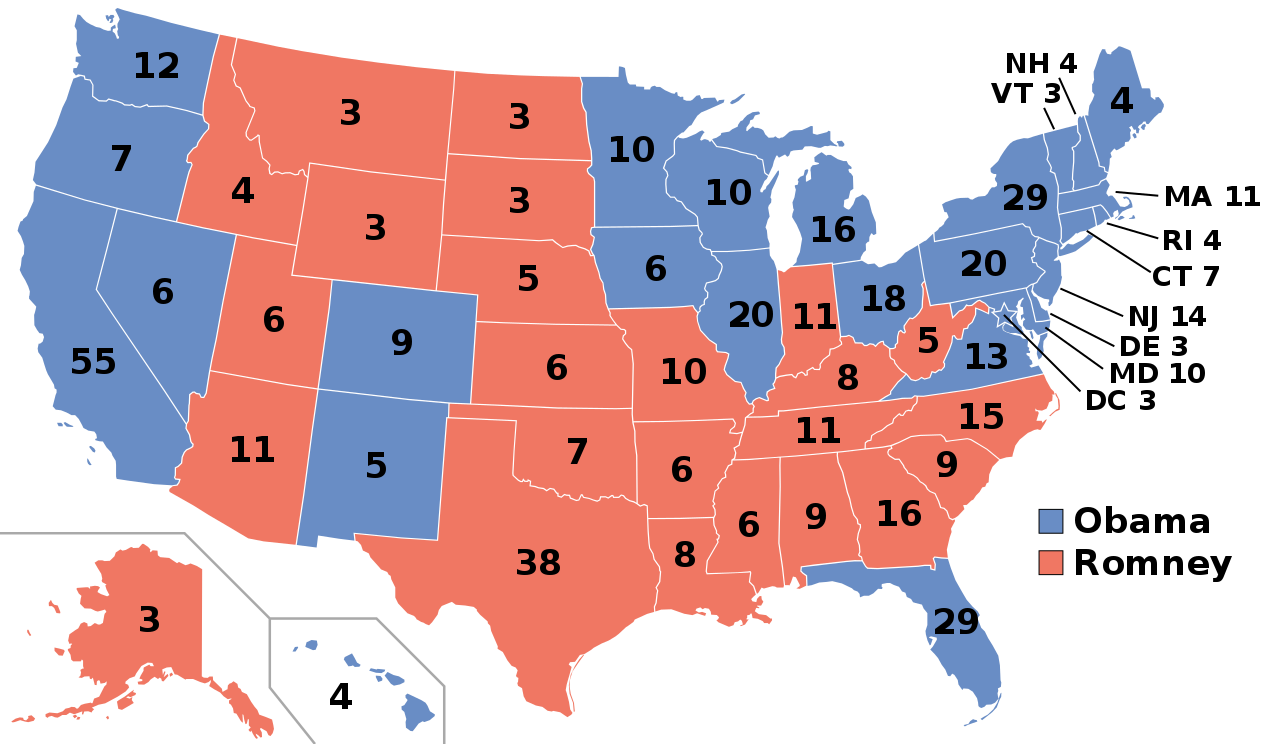
ElectoralCollege2012


The Electoral Landscape
The 2012 U.S. presidential election, held on November 6, 2012, was a contest that reaffirmed the incumbent Democratic administration of President Barack Obama and Vice President Joe Biden. Obama successfully defended his presidency against the Republican ticket led by former Massachusetts Governor Mitt Romney and Wisconsin Representative Paul Ryan. The election's outcome was largely shaped by Obama's ability to maintain the 'blue wall' states – typically Democratic strongholds in the Northeast and Midwest – while also securing victories in crucial swing states.
These included Colorado, Florida, Nevada, Ohio, and Virginia, many of which had previously leaned Republican in the 2000 and 2004 elections. Obama's victory was cemented by winning 332 Electoral College votes to Romney's 206, and a 51.1% share of the popular vote compared to Romney's 47.2%. This marked the third consecutive presidential election where an incumbent president won re-election, a trend initiated by Bill Clinton and continued by George W.
Bush.
Campaign Narratives
The campaigns were heavily focused on domestic policy, particularly the lingering effects of the Great Recession and long-term fiscal challenges. Obama's campaign sought to portray his administration's response as effective and to characterize Romney as an out-of-touch businessman whose policies would disproportionately benefit the wealthy. Romney's campaign, conversely, criticized Obama's economic stewardship, arguing his policies were fiscally irresponsible and ineffective.
Key policy debates revolved around the future of social insurance programs, the federal budget deficit, and the controversial Affordable Care Act, which Obama championed as a landmark achievement. Foreign policy discussions, though secondary, touched upon the conclusion of the Iraq War, military spending, and international security concerns like Iran's nuclear program and counter-terrorism efforts.
Primary Battles and Campaign Finance Innovations
While Obama secured the Democratic nomination with little opposition, the Republican primary season was notably competitive. Mitt Romney, despite consistent polling strength and support from party leaders, faced challenges from several more conservative candidates, including Rick Santorum, Newt Gingrich, and Ron Paul. Romney eventually clinched the nomination in May.
A significant feature of the 2012 election cycle was the dramatic increase in fundraising, particularly through nominally independent Super PACs. These organizations, allowed to raise and spend unlimited sums of money, played a substantial role in shaping campaign messaging and voter outreach, raising questions about the influence of money in politics.
Post-Election Analysis and Lasting Political Markers
Obama's victory was significant not only for securing a second term but also for its implications on the political map. He lost only one of the nine major swing states (North Carolina). Notably, as of 2025, this election remains the most recent instance of a Democratic presidential candidate winning Iowa, Ohio, and Florida, as well as Maine's 2nd congressional district.
Furthermore, it stands as the last time an incumbent president won re-election, the incumbent party retained the presidency, and a Democratic ticket did not include a woman. It also marked the most recent election where the party winning the presidency did not simultaneously control both chambers of Congress. The survival of all major party nominees (McCain, Cheney, Obama, Biden, Romney, Ryan) as of 2025 makes this the earliest presidential election where this is true.
See also
Based on content from Wikipedia · Licensed under CC BY-SA 4.0