

Bill Clinton
Images

Bill Clinton



Early Life and Education
William Jefferson Clinton was born on August 19, 1946, in Hope, Arkansas. His early life was shaped by the loss of his father, who died in an accident before Bill was born. Raised by his mother and grandparents, Clinton showed early signs of leadership and intellectual curiosity.
He was a dedicated student and a talented musician, playing the tenor saxophone in a jazz trio. His interest in law and politics was sparked during high school, particularly after a 1963 visit to the White House where he met President John F. Kennedy, and after watching Martin Luther King Jr.'s 'I Have a Dream' speech.
Clinton attended Georgetown University, where he studied foreign service, and later earned a law degree from Yale Law School. It was at Yale that he met Hillary Rodham, who would become his wife and partner in his future political endeavors. These formative years provided the foundation for his later career in public service.
Political Rise in Arkansas
After graduating from law school, Clinton returned to Arkansas to teach law and begin his political career. He was elected as the state's attorney general in 1976. In 1978, at the age of 32, he was elected governor of Arkansas, becoming the youngest governor in the country at that time.
His early years as governor were challenging, but he eventually secured a long tenure, serving from 1979 to 1981 and again from 1983 to 1992. During his time as governor, he prioritized educational reform, working with his wife, Hillary, to transform the state's school system. He also became a prominent figure in the Democratic Leadership Council, promoting a 'New Democrat' philosophy that sought to balance liberal social policies with more conservative fiscal approaches.
This experience on the state level prepared him for the national stage, as he gained a reputation for being a pragmatic and effective leader.
The Presidency (1993-2001)
In 1992, Clinton defeated incumbent President George H. W. Bush to become the 42nd president of the United States.
His presidency was defined by a period of significant economic growth, often cited as the longest peacetime economic expansion in U.S. history at the time. He signed several landmark pieces of legislation, including the North American Free Trade Agreement and the Brady Handgun Violence Prevention Act. While his efforts to pass national health care reform were unsuccessful, he did champion the State Children's Health Insurance Program.
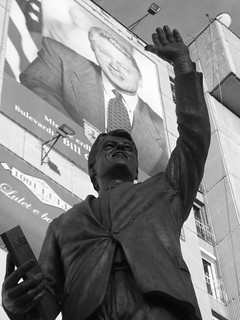
His foreign policy was equally active; he oversaw military interventions in the Bosnian and Kosovo wars and worked to expand NATO into Eastern Europe. He was also deeply involved in the Middle East peace process, participating in the Oslo I Accord and the Camp David Summit. Despite facing impeachment by the House of Representatives in 1998, he was acquitted by the Senate in 1999 and continued to serve until 2001, leaving office with high approval ratings.
Humanitarian Work and Legacy
Since leaving the White House in 2001, Clinton has remained a highly visible public figure, focusing his efforts on humanitarian and philanthropic work. He established the Clinton Foundation, an organization dedicated to addressing global challenges such as the HIV/AIDS epidemic, climate change, and economic inequality. His work has taken him across the globe, and he has been particularly involved in recovery efforts in Haiti, serving as a United Nations special envoy and co-founding the Clinton Bush Haiti Fund following the 2010 earthquake.
Clinton has also remained an influential voice in the Democratic Party, supporting his wife's presidential campaigns in 2008 and 2016. As of October 2026, he continues to engage in public speaking and advocacy. His legacy is complex, encompassing both his economic achievements and the controversies that occurred during his time in office, but his impact on American politics and global humanitarian efforts remains significant.
Historical Context and Current Status
As of October 2026, Bill Clinton holds the distinction of being the earliest-serving living former U.S. president and the last surviving president to have served in the 20th century. His life spans a period of immense change in American history, from the post-war era to the digital age. Throughout his career, he has navigated the shifting landscape of American politics, adapting his policies to meet the needs of a changing nation.
His career reflects the broader trends of the late 20th century, including the rise of the Baby Boomer generation in leadership and the increasing globalization of the world economy. By examining his life and career, students can gain insight into the complexities of governance, the importance of public service, and the evolving nature of the American presidency. His ongoing work through the Clinton Foundation ensures that his influence continues to be felt in various sectors of global society.
Go deeper
Based on content from Wikipedia · Licensed under CC BY-SA 4.0