

Swing State: The States Everyone Watches!
Images
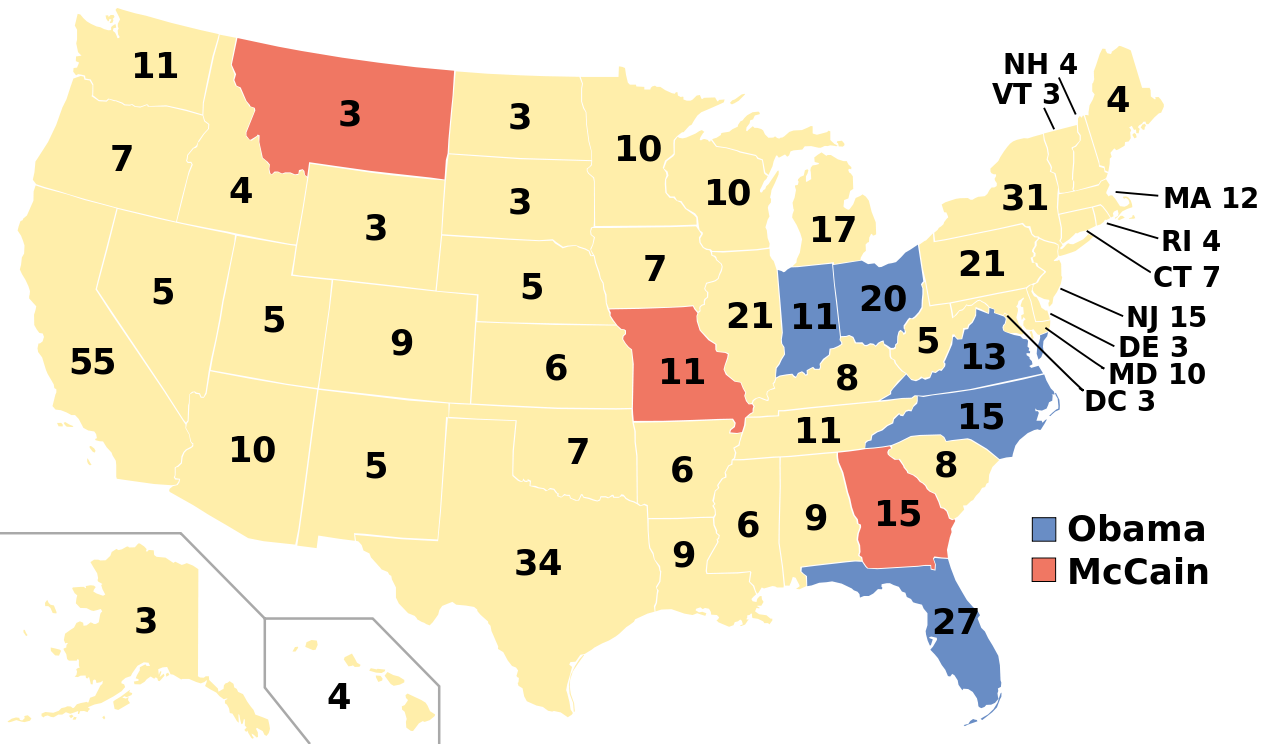
2008, Swing States


The Calculus of Competitiveness
In the complex landscape of United States presidential elections, a 'swing state' is defined by its electoral volatility. These are states where the margin between the Democratic and Republican candidates is typically narrow, making their outcome uncertain and highly contested. Unlike 'safe states,' which consistently lean towards one party, swing states are characterized by a more balanced distribution of partisan support, often influenced by demographic shifts, economic conditions, and the specific appeal of the nominees.
The term 'battleground state' or 'purple state' (a blend of the Republican 'red' and Democratic 'blue') aptly describes their pivotal role. Campaigns strategically allocate vast resources-financial, human, and media-to these states, recognizing that winning even a few of them can be decisive in securing the presidency. The focus on swing states is a direct consequence of the Electoral College system, where victory is determined by accumulating electoral votes rather than the national popular vote.
The Electoral College Imperative
The disproportionate influence of swing states is inextricably linked to the 'winner-take-all' (or 'unit rule') system employed by 48 states and the District of Columbia for allocating Electoral College votes. Under this system, the presidential candidate who wins the popular vote in a state, often by a slim margin, receives all of that state's electoral votes. This creates a powerful incentive for candidates to concentrate their efforts on states where victory is attainable, rather than diluting their resources across the entire nation.
A candidate can win the presidency without winning the national popular vote if they can secure victories in a sufficient number of swing states that collectively provide the required 270 electoral votes. This dynamic transforms states with relatively small populations into critical battlegrounds, as their electoral votes can be pivotal in close contests, leading to intense campaigning and targeted policy appeals.
Evolving Battlegrounds
The identity of swing states is not static; it evolves with each election cycle, reflecting changes in demographics, economic structures, and political ideologies. Factors such as urbanization, suburban growth, shifts in racial and ethnic composition, educational attainment, and economic diversification can alter a state's partisan leanings. For instance, states in the Sun Belt have become increasingly competitive as their populations have grown and diversified.
Conversely, some traditionally competitive states might become safer for one party due to long-term demographic trends. Polling data, voter registration trends, and analysis of past election results are crucial tools for campaigns in identifying and strategizing for current swing states. For the 2024 election, states like Arizona, Georgia, Michigan, Nevada, North Carolina, Pennsylvania, and Wisconsin were widely identified as key swing states, illustrating this dynamic nature.
Campaign Strategy and Policy Implications in Swing States
The strategic imperative of winning swing states profoundly shapes campaign messaging and policy platforms. Candidates often tailor their speeches, advertisements, and policy proposals to resonate with the specific concerns and demographics of voters in these competitive territories. Issues that might be peripheral in safe states can become central to national discourse when they are salient in swing states.
For example, debates around manufacturing jobs in the Rust Belt, immigration in border states, or energy policy in diverse economic regions often take center stage. This focus can lead to policies that are heavily influenced by the needs and preferences of swing state voters, potentially at the expense of issues more critical to voters in reliably partisan states. The intense scrutiny on swing states also means that their voters often feel a greater sense of political agency, aware that their collective decision can directly determine the nation's leadership.
The 'Purple' Phenomenon
The concept of 'purple states' highlights the nuanced political spectrum within the United States. While 'red' and 'blue' represent strong partisan loyalties, 'purple' signifies a state where neither party holds a consistent, overwhelming advantage. This ambiguity arises from a complex interplay of factors, including a relatively even distribution of registered Democrats and Republicans, a significant bloc of independent or unaffiliated voters, and diverse regional interests within the state.
The 'purple' nature of these states means that campaigns must appeal to a broader range of voters, often moderating their messages and seeking common ground. Understanding the specific demographic and socioeconomic characteristics of a purple state is crucial for deciphering its electoral behavior and predicting its future political trajectory. The existence and shifting nature of these purple states are fundamental to the competitive dynamics of American presidential elections.
Go deeper
Frequently Asked Questions
What is a swing state?+
Why are swing states important in elections?+
How do campaigns use swing states?+
Which states were swing states in 2024?+
Can a candidate win the presidency without winning the national popular vote?+
Based on content from Wikipedia · Licensed under CC BY-SA 4.0