

Serpens: The Winding Sky Snake!
Images

Serpens


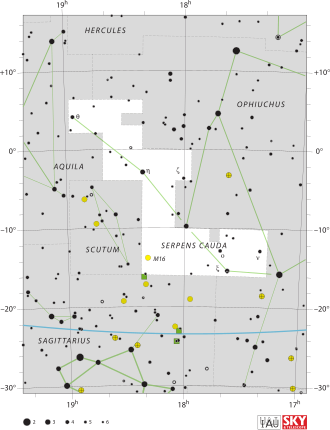

The Bisection of Serpens
Serpens stands out in the celestial sphere as the sole constellation divided into two distinct regions: Serpens Caput (the Serpent's Head) and Serpens Cauda (the Serpent's Tail). This unique division is caused by the constellation Libra, the Scales, which lies between the two parts. This cartographic anomaly arose from the historical development of constellation boundaries.
While ancient astronomers recognized the serpentine form, the formal delineation of constellation borders by the International Astronomical Union in the 1920s solidified this peculiar bisection. The two parts of Serpens are not contiguous in the sky, meaning observers must look at two separate areas to encompass the entire constellation. This makes Serpens a fascinating case study in how celestial maps evolve and how our understanding of the sky is structured.
Mythological Roots and Astronomical Evolution
The imagery of a serpent in the night sky is ancient, appearing in Babylonian and Greek astronomical traditions. Serpens is frequently associated with the myth of Ophiuchus, the Serpent Bearer, who is often depicted wrestling with or holding the serpent. This mythological narrative reflects early attempts to interpret and organize the cosmos, imbuing star patterns with stories of heroes, monsters, and divine interventions.
The constellation's enduring presence in star charts from antiquity to the present day underscores its role in navigation, calendrical systems, and cultural storytelling. Its mythological context provides a rich backdrop for understanding its astronomical significance and its place in human history.
Serpens as a Laboratory for Stellar Phenomena
The celestial territory of Serpens is a treasure trove for astronomical research, hosting several significant deep-sky objects. Serpens Cauda contains the Eagle Nebula (M16), a vibrant star-forming region renowned for its iconic 'Pillars of Creation' (though these are more famously associated with the nearby M17, the Omega Nebula, also within Serpens's vicinity). The Crab Nebula (M1), located in Serpens Caput, is a supernova remnant resulting from a star explosion observed by Chinese astronomers in 1054 AD.
At its heart lies a rapidly rotating pulsar, a neutron star that spins approximately 30 times per second, emitting powerful beams of radiation. This pulsar is a crucial object for studying extreme physics and the remnants of stellar death.
Galactic Neighbors and Stellar Life Cycles
Beyond nebulae and pulsars, Serpens also hosts extragalactic wonders. The Sombrero Galaxy (M104), a prominent spiral galaxy, is situated within Serpens's boundaries. Its distinctive appearance, characterized by a prominent dust lane and a bright bulge, makes it a popular target for both professional and amateur astronomers.
It offers insights into galactic structure and evolution. The brightest star in Serpens is Unukalhai (Alpha Serpentis), a K-type giant star. Its size and luminosity provide a tangible example of a star in a later stage of its life cycle, contrasting with the active star birth observed in the nebulae within the same constellation.
Serpens thus presents a diverse cosmic panorama, from the birth of stars to the death of galaxies.
Go deeper
Based on content from Wikipedia · Licensed under CC BY-SA 4.0