

The Crab Nebula: A Star's Explosive Goodbye!
Images

Crab Nebula


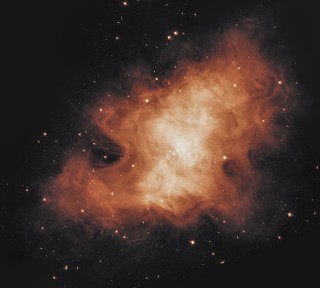


The Genesis of M1
The Crab Nebula, cataloged as M1, is a quintessential example of a supernova remnant, a celestial tapestry woven from the ejected material of a star's explosive demise. Its origin traces back to a Type II supernova observed in 1054 AD, a cataclysmic event so brilliant it was visible in daylight for weeks and recorded by astronomers across the globe, notably in China and the Arab world. This event marked the end of a massive star, likely exceeding 8-10 solar masses, whose core collapsed under its own gravity.
The resulting shockwave propagated outward, compressing interstellar gas and dust, and initiating the nebula's expansion. Located in the constellation Taurus, approximately 6,500 light-years distant, the Crab Nebula continues to expand at a rate of about 1,500 kilometers per second, offering a unique opportunity to study the immediate aftermath of stellar death and the processes that enrich the interstellar medium with heavy elements essential for future stellar generations and planetary formation.
The Pulsar
At the heart of the Crab Nebula lies its most remarkable feature: the Crab Pulsar (PSR B0531+21). This is a rapidly rotating neutron star, a remnant of the supernova core, with a diameter of only about 20 kilometers but a mass greater than our Sun. It spins at an astonishing rate, completing over 30 rotations per second.
This extreme rotation, coupled with intense magnetic fields, generates powerful beams of electromagnetic radiation that sweep across space like a lighthouse. When these beams intersect with Earth, we observe them as regular pulses, hence the name 'pulsar'. The pulsar is the primary energy source for the nebula, accelerating charged particles to near-light speeds, which then emit synchrotron radiation across a broad spectrum, from radio waves to gamma rays.
Studying the pulsar's spin-down rate and energy output provides crucial data for understanding neutron star physics and the mechanisms of particle acceleration in extreme astrophysical environments.
A Laboratory for High-Energy Astrophysics
The Crab Nebula is an indispensable natural laboratory for astrophysicists, particularly in the realm of high-energy phenomena. The synchrotron radiation emitted by relativistic electrons spiraling in the nebula's magnetic fields produces a continuous spectrum across virtually the entire electromagnetic range. This makes it an ideal target for multi-wavelength observations, from radio telescopes to gamma-ray observatories.
The nebula's complex magnetic field structure, the distribution of relativistic particles, and the interaction between the pulsar's wind and the surrounding supernova ejecta are subjects of intense study. Furthermore, the Crab Nebula is a significant source of high-energy gamma rays and X-rays, allowing scientists to probe fundamental physics, such as quantum electrodynamics in strong magnetic fields and the nature of dark matter annihilation signals, although the latter remains speculative.
Historical Significance and Ongoing Evolution
The historical record of the 1054 AD supernova provides an unparalleled anchor for studying the Crab Nebula's evolution. By comparing early observations with current data, astronomers can precisely measure the nebula's expansion, its changing morphology, and the evolution of its energetic processes. This long-term perspective is vital for validating theoretical models of supernova remnants and neutron star behavior.
The nebula's dynamic nature means it is constantly changing, offering new phenomena to observe and analyze. Its proximity and brightness have made it a benchmark object for calibrating astronomical instruments and testing astrophysical theories for decades. The Crab Nebula remains a cornerstone in our understanding of stellar death, cosmic ray origins, and the fundamental forces that govern the universe.
Go deeper
Based on content from Wikipedia · Licensed under CC BY-SA 4.0