

Stellar Magnetic Fields: Invisible Superpowers of Stars!
Images
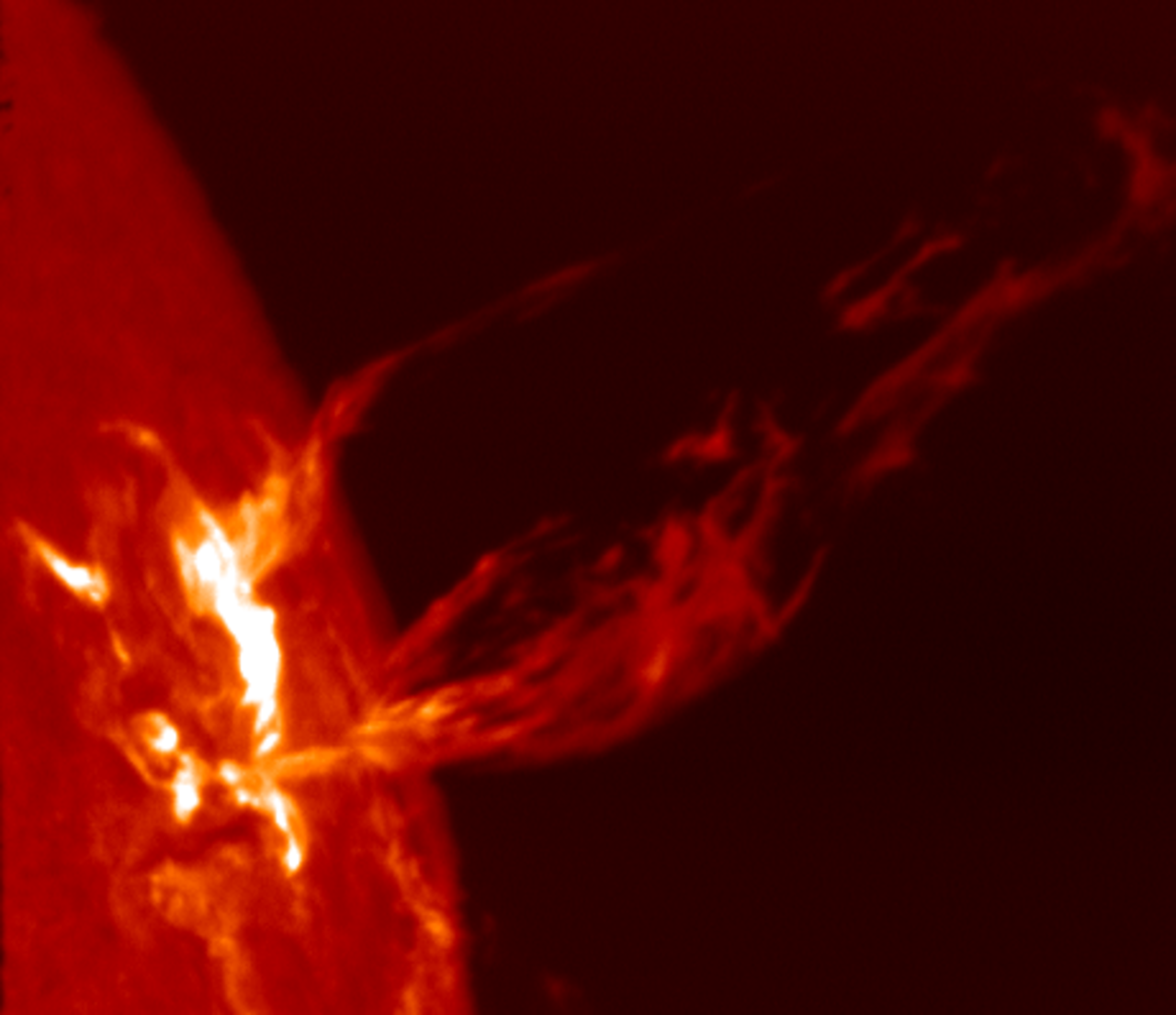
Stellar magnetic field


The Dynamo Theory
Stellar magnetic fields are primarily understood through the lens of the dynamo theory, a complex mechanism involving the interplay of rotation, convection, and electrical conductivity within a star's interior. The core of this theory posits that the turbulent motion of highly conductive plasma, driven by convection and amplified by the star's rotation, generates electrical currents. These currents, in turn, create and sustain the star's global magnetic field.
Different types of stars exhibit variations in their dynamo processes. For instance, fully convective stars, like red dwarfs, are thought to have simpler, more uniform magnetic fields, while stars with radiative cores and convective envelopes, like our Sun, can develop more complex, cyclical magnetic activity. The strength and geometry of the magnetic field are influenced by factors such as the star's rotation rate, internal structure, and age.
Understanding these dynamos is crucial for comprehending stellar activity, from sunspots to powerful flares.
From Internal Currents to External Influence
The magnetic field generated by the internal dynamo extends far beyond the star's photosphere, forming a magnetosphere that can encompass planets and influence the surrounding interstellar medium. This external magnetic field plays a critical role in regulating the stellar wind, the continuous outflow of charged particles from a star. The magnetic field lines can channel and accelerate this wind, shaping its density and velocity.
Furthermore, magnetic reconnection events, where stressed magnetic field lines suddenly break and reconfigure, are responsible for some of the most energetic phenomena observed in stars, including solar flares and coronal mass ejections (CMEs). These events release vast quantities of energy and particles, which can have significant impacts on planetary atmospheres, magnetospheres, and even the potential for life.
The Evolutionary Significance of Magnetic Fields
Stellar magnetic fields are not static features; they evolve over a star's lifetime and significantly influence its evolutionary path. For young, rapidly rotating stars, strong magnetic fields can lead to substantial magnetic braking, slowing down their rotation over time and altering the efficiency of their internal dynamos. In later stages, the magnetic field of a dying star can play a role in phenomena like planetary nebula formation and the ejection of stellar material.
For massive stars, strong magnetic fields can influence their eventual collapse into neutron stars or black holes, potentially affecting the properties of the resulting compact objects and the associated energetic outflows. The study of magnetic fields in different stellar types provides vital clues about stellar evolution and the processes that govern the birth and death of stars.
Observing the Invisible
Detecting and characterizing stellar magnetic fields is a challenging but essential aspect of astrophysics. Astronomers employ various techniques, primarily relying on the polarization of starlight. Magnetic fields can cause light to become polarized, meaning its waves vibrate in a specific direction.
By analyzing this polarization, scientists can infer the presence, strength, and structure of magnetic fields on distant stars. Spectropolarimetry, which combines spectroscopy (analyzing light's color) with polarization measurements, is a key tool. Furthermore, observations of phenomena like stellar flares, starspots, and the behavior of stellar winds provide indirect evidence of magnetic activity.
The discovery of highly magnetic stars, such as white dwarfs with fields exceeding 10^9 Gauss, has pushed the boundaries of our understanding of magnetic field generation and its extreme manifestations in the universe.
Magnetic Fields and Exoplanetary Systems
The magnetic fields of host stars have profound implications for the habitability of exoplanetary systems. A star's magnetosphere and its associated energetic particle flux can significantly impact the atmospheres of orbiting planets. For planets with their own magnetic fields, like Earth, the stellar magnetic field can create a protective magnetotail, deflecting harmful stellar wind particles.
However, planets lacking a strong magnetic field are more vulnerable to atmospheric erosion by stellar winds and energetic particles, potentially rendering them uninhabitable. The intensity and variability of a star's magnetic activity, particularly during its youth, can therefore be a critical factor in determining whether a planet can retain an atmosphere suitable for life. Studying stellar magnetic fields is thus integral to the search for life beyond our solar system.
Go deeper
Frequently Asked Questions
What are stellar magnetic fields and why are they important?+
How do stars create their magnetic fields?+
Why do some stars have simpler magnetic fields while others have complex ones?+
What happens when a star’s magnetic field changes suddenly?+
How do scientists find out if a star has a magnetic field?+
Based on content from Wikipedia · Licensed under CC BY-SA 4.0