

Ophiuchus: The Star Snake Charmer!
Images

Ophiuchus


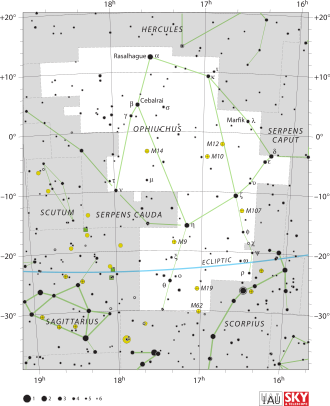


Ophiuchus
Ophiuchus, the Serpent Bearer, is a prominent constellation in the northern celestial hemisphere, distinguished by its depiction of a man grasping a serpent. This figure is widely identified with Asclepius, the Greek god of medicine and healing, whose serpentine companion symbolizes regeneration and wisdom. The constellation's unique characteristic is its embrace of Serpens, the Serpent constellation, which is bifurcated into Serpens Caput (head) and Serpens Cauda (tail) on either side of Ophiuchus.
This arrangement makes Ophiuchus the only constellation that visually 'interrupts' another. Its vast size and position near the celestial equator make it a significant landmark for both ancient and modern stargazers, serving as a crucial element in the celestial cartography that maps the night sky.
Historical and Mythological Context
The mythology surrounding Ophiuchus is rich, primarily revolving around Asclepius. His mastery over life and death, even raising the dead, led to his deification and association with the stars. The serpent motif is ancient, linked to healing cults and the concept of renewal through shedding skin.
Historically, Ophiuchus's placement along the ecliptic-the Sun's apparent annual path-has led to its classification as a zodiac constellation. However, it is not one of the traditional twelve signs used in Western astrology. This discrepancy arises from the precession of the equinoxes, which has shifted the Earth's axial tilt over millennia, causing the Sun to appear in different constellations than it did in antiquity.
The Sun currently spends approximately 18 days within Ophiuchus, from late November to mid-December.
Astronomical Features and Observational Significance
Beyond its mythological appeal, Ophiuchus hosts several notable astronomical objects. Its brightest star, Rasalhague (Alpha Ophiuchi), is a binary star system that shines with a blue-white hue and is a prominent navigational aid. The constellation also contains the Kepler-186f exoplanet system, known for hosting Kepler-186f, the first Earth-sized exoplanet discovered in the habitable zone of another star.
Furthermore, Ophiuchus is home to the Ophiuchus dwarf galaxy, a satellite galaxy of the Milky Way, and several globular clusters, such as NGC 6397, one of the closest globular clusters to Earth. These features make Ophiuchus a scientifically rich area for astronomical study and observation.
Locating Ophiuchus and Its Modern Relevance
Ophiuchus is best observed during the summer months in the Northern Hemisphere, typically from June to August. It is situated in a region of the sky bordered by constellations like Hercules, Aquila, and Scorpius. Its somewhat diffuse stellar pattern can make it challenging to identify compared to more distinctly shaped constellations.
However, its presence on the ecliptic and its rich mythological background continue to fascinate astronomers and amateur stargazers alike. The ongoing discovery of exoplanets and other celestial bodies within its boundaries underscores Ophiuchus's enduring importance in our quest to understand the universe and our place within it.
Go deeper
Frequently Asked Questions
What does the constellation Ophiuchus look like?+
Who is the figure in Ophiuchus?+
Why is Ophiuchus special among the zodiac constellations?+
What bright star can I find in Ophiuchus?+
When is the best time to look at Ophiuchus from the Northern Hemisphere?+
Based on content from Wikipedia · Licensed under CC BY-SA 4.0