

Runestone
Images

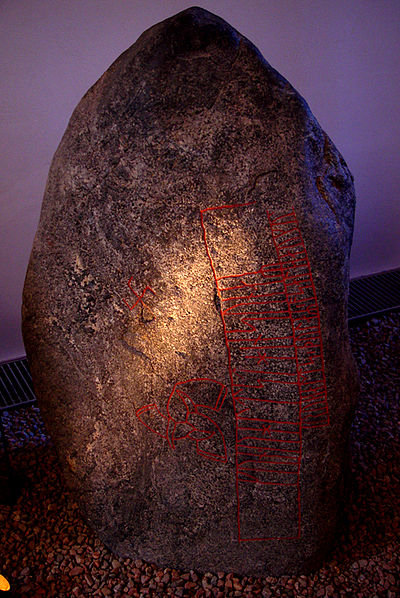
Kakbrinken Prastgatan runestone March 2007




The Genesis and Evolution of the Runestone Tradition
The practice of erecting runestones, monumental stones bearing runic inscriptions, emerged in Northern Europe around the 4th century CE, during the Migration Period. Initially, runic inscriptions were more commonly found on smaller objects like weapons, jewelry, and amulets, often with short, formulaic messages or personal names. The transition to large, upright memorial stones marks a significant development in the use of runes, indicating a shift towards public commemoration and the establishment of lasting markers.
The tradition flourished most intensely during the Viking Age (roughly 8th to 11th centuries), with the vast majority of extant runestones dating from this period. These stones served diverse functions, but their primary role was as memorials, often erected to honor deceased men, detailing their lineage, achievements, or the circumstances of their death. The geographic concentration of runestones, particularly in Scandinavia and especially Sweden, reflects the core areas of Norse settlement and cultural influence during this era.
However, their presence in regions like the British Isles, Eastern Europe, and even North America (though debated) attests to the extensive reach of Norse exploration, trade, and settlement.
Spatial Distribution and Cultural Diffusion
The distribution of runestones provides invaluable insights into the expansion and influence of Norse culture. While Scandinavia, particularly Sweden, Denmark, and Norway, hosts the overwhelming majority of these monuments, their scattered presence in areas like England (e.g., the Manx runestones on the Isle of Man, the runestones in Yorkshire), Scotland, Ireland, and even in Russia and Ukraine, serves as tangible evidence of Norse voyages and settlements.
These stones are not merely markers of presence but often reflect the integration of Norse populations into local societies, sometimes featuring bilingual inscriptions or adaptations of local artistic styles. The study of these geographically dispersed runestones allows scholars to map trade routes, migration patterns, and areas of cultural exchange. For instance, runestones found in Eastern Europe often bear inscriptions in Old Norse but are found in contexts suggesting Norse presence as traders, mercenaries, or rulers in Slavic territories.
The phenomenon of runestones outside Scandinavia underscores the dynamic and far-reaching nature of Norse interactions with other cultures during the High Middle Ages.
Epigraphic Significance
Runestones are indispensable primary sources for understanding the history, language, and society of the Norse world. Their inscriptions offer direct linguistic evidence of Old Norse dialects, providing crucial data for historical linguistics. They reveal personal names, patronymics, place names, and kinship terms, helping to reconstruct social structures and family relationships.
Many runestones detail heroic deeds, voyages, inheritances, and legal matters, offering glimpses into the values, beliefs, and legal practices of the time. The formulaic nature of many inscriptions, such as 'X raised this stone in memory of Y, his son/father/brother,' provides a consistent framework for interpreting the data. Furthermore, the very act of erecting a runestone was a significant social and economic undertaking, often commissioned by family members or associates, reflecting social status and community ties.
The evolution of runic forms and inscription styles also allows for relative dating, contributing to the chronological framework of the Viking Age and its preceding and succeeding periods. They are, in essence, the written records of a society that relied heavily on oral tradition.
The Art and Craft of Runecarving
The creation of a runestone was a deliberate and skilled craft. Typically, large, naturally occurring stones were selected and then shaped or erected. The inscriptions were carved into the stone using tools like hammers and chisels.
The choice of stone material varied regionally, with granite being common in many parts of Scandinavia. A fascinating aspect often overlooked is that runestones were not originally the drab grey monuments we see today. Historical accounts and archaeological evidence suggest that they were often brightly painted.
Pigments, likely derived from minerals and plants, were used to fill the carved grooves, making the runes and any accompanying imagery stand out vividly against the stone. This polychromy would have significantly enhanced their visual impact and readability. While these colors have long since weathered away, the surviving carved forms continue to speak volumes about the artistic sensibilities and communication strategies of the Norse people.
The artistic motifs, when present, often complement the runic text, depicting scenes from mythology, animal interlace patterns, or abstract designs.
Beyond Memorials
While the primary function of most runestones was commemorative, their role extended into broader cultural and symbolic spheres. They served as territorial markers, declarations of ownership or lineage, and even as propaganda or assertions of power by chieftains or prominent families. Some inscriptions contain curses or protective spells, hinting at the belief in the magical efficacy of runes and the written word.
The phenomenon of runestones also intersects with the development of literacy and the transmission of knowledge in pre-Christian and early Christian Norse societies. As Christianity spread, runestones began to incorporate Christian symbols and references, such as crosses, alongside runic inscriptions, illustrating the cultural and religious transitions of the era. The study of runestones, therefore, offers a multifaceted lens through which to examine the complex interplay of social structures, religious beliefs, linguistic evolution, artistic expression, and political dynamics that characterized the Norse world for centuries.
See also
Frequently Asked Questions
What is a runestone?+
Why did people put runes on big stones instead of small objects?+
Where are most runestones found?+
How do runestones help us learn about Viking life?+
Are runestones only in Scandinavia?+
Based on content from Wikipedia · Licensed under CC BY-SA 4.0