

The Great Big Move!
Images
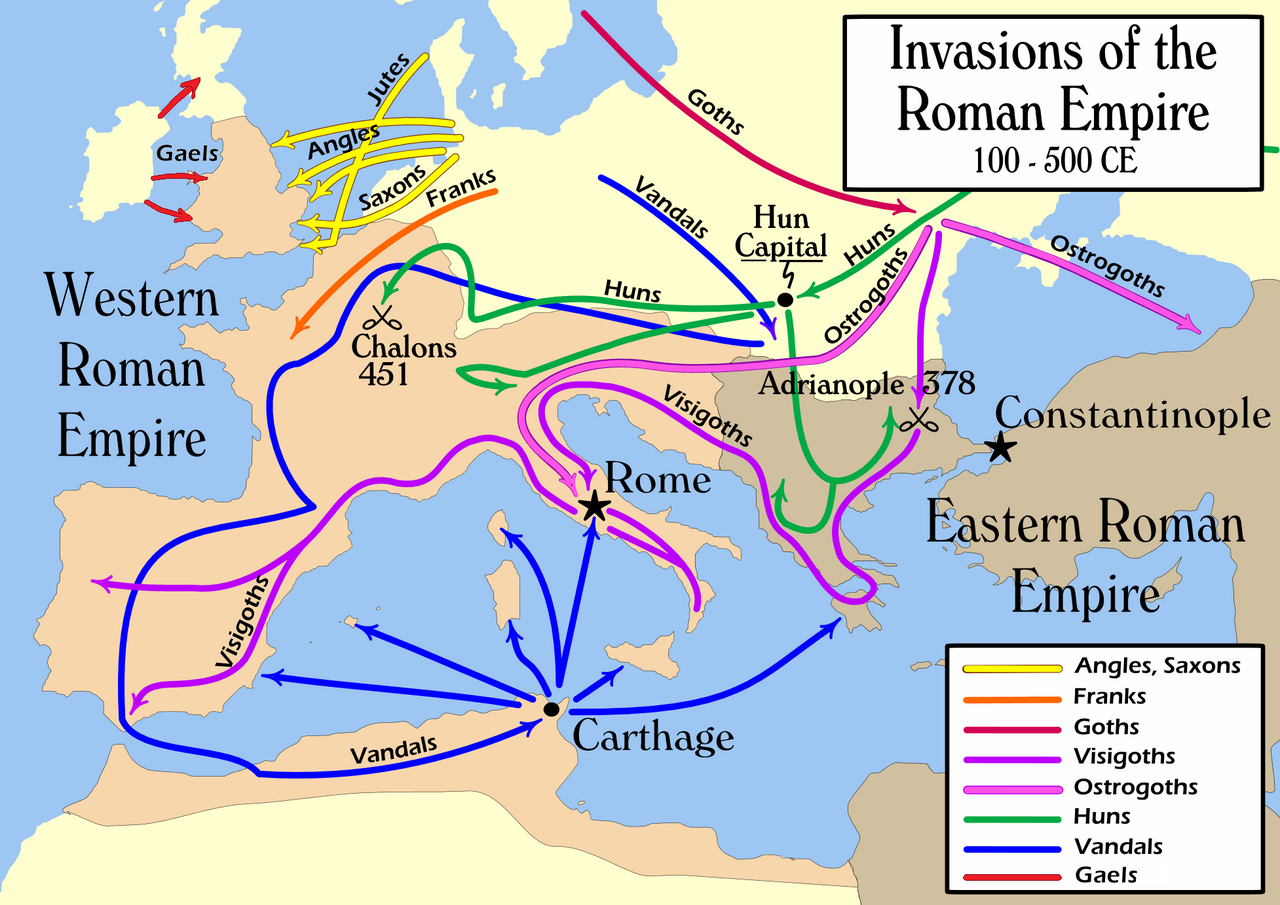
Migration Period
Defining the 'Völkerwanderung'
The Migration Period, often referred to by the German term 'Völkerwanderung' (meaning 'wandering of peoples'), is a pivotal era in European history spanning roughly from the 4th to the 6th centuries AD, though its roots extend earlier and its consequences linger later. This was not a single, unified event but a series of complex, overlapping migrations involving numerous Germanic, Slavic, and other groups. These movements were driven by a confluence of factors: environmental pressures, population growth, internal political dynamics, and crucially, the westward expansion of nomadic groups like the Huns.
The sheer scale of these movements, involving potentially millions of individuals, fundamentally challenged the existing political structures, most notably the Roman Empire, and set the stage for the emergence of medieval Europe.
The Hunnic Catalyst and the Shifting Sands of Power
The arrival of the Huns in Eastern Europe around the late 4th century AD acted as a significant catalyst for the Völkerwanderung. Their formidable military prowess, characterized by equestrian archery and rapid movement, displaced numerous Germanic tribes, including the Goths. The Visigoths, fleeing the Hunnic advance, famously crossed the Danube River into Roman territory in 376 AD, seeking refuge.
This event marked a critical turning point, as the Roman Empire's inability to effectively manage this influx led to conflict, culminating in the Visigothic victory at the Battle of Adrianople in 378 AD, a devastating blow to Roman military prestige. This set a precedent for other groups, such as the Vandals and Suebi, who would later cross the Rhine in 406 AD, further destabilizing the Western Roman Empire.
The Dissolution of the Western Roman Empire and the Rise of Successor Kingdoms
The cumulative impact of these migrations was a primary factor in the eventual collapse of the Western Roman Empire, traditionally dated to 476 AD. The constant pressure on the frontiers, the loss of territory and tax revenue, and the increasing reliance on federated (allied) barbarian troops weakened imperial authority. As Roman power waned, the migrating groups established their own kingdoms within former Roman provinces.
The Visigoths established a kingdom in Hispania, the Vandals in North Africa, the Franks consolidated power in Gaul, and the Anglo-Saxons migrated to Britain. These successor kingdoms, while often adopting Roman administrative structures and Latin language, represented a fundamental shift in political power and cultural identity across Western Europe.
Cultural Synthesis and the Foundation of Medieval Europe
Beyond the political upheaval, the Migration Period was a profound era of cultural interaction and synthesis. The incoming peoples brought their own languages, legal traditions, religious beliefs, and artistic styles, which interacted with and transformed the existing Greco-Roman and Celtic cultures. This fusion was not always peaceful, often involving conflict and subjugation, but it also led to innovation and the creation of new hybrid cultures.
The development of Romance languages from Vulgar Latin mixed with Germanic tongues, the codification of new legal systems, and the spread of Christianity (often facilitated by migrating groups who converted) are all testaments to this dynamic process. The legacy of the Völkerwanderung is thus not merely one of decline, but of transformation, laying the essential groundwork for the diverse cultural and political landscape of medieval and, ultimately, modern Europe.
Enduring Echoes
The Migration Period continues to fascinate historians and the public alike, offering insights into themes of identity, displacement, and cultural adaptation that resonate today. Modern scholarship moves beyond the simplistic 'barbarian invasion' narrative, emphasizing the complex interplay of push and pull factors, the agency of migrating groups, and the gradual processes of integration and conflict. Understanding this period is crucial for comprehending the origins of European nation-states, the development of its languages, and the evolution of its diverse cultural heritage.
It serves as a powerful historical parallel for contemporary discussions about migration, borders, and the challenges and opportunities presented by diverse populations interacting within established societies.
Go deeper
Frequently Asked Questions
What was the Migration Period and why is it called the Great Big Move!+
Why did the Huns push other tribes to move?+
How did the Roman Empire react to all the new groups?+
What happened to the places where the migrating groups settled?+
Did the Migration Period create new languages or cultures?+
Based on content from Wikipedia · Licensed under CC BY-SA 4.0