

Luxor Temple
Images

Luxor Temple Great Pylon


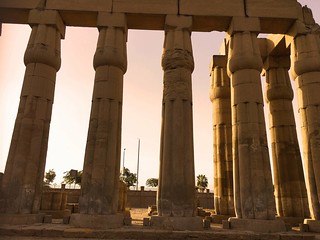
The Southern Sanctuary
Luxor Temple, known in ancient Egyptian as 'ipet resyt' or 'the southern sanctuary,' stands as a testament to the complex ideology surrounding Egyptian pharaonic rule. Constructed primarily during the New Kingdom, with significant additions and modifications spanning dynasties, its core purpose diverged from the typical mortuary or cultic temples. Rather than solely honoring a deceased pharaoh or a specific deity, Luxor Temple was intrinsically linked to the concept of 'rejuvenation of kingship.' This suggests it served as a crucial site for rituals aimed at reaffirming and symbolically renewing the pharaoh's divine mandate and authority.
It is widely believed to have been the location for coronation ceremonies, both literal and conceptual, including the famous, though possibly apocryphal, claim by Alexander the Great. Its strategic position on the east bank of the Nile, alongside the colossal Karnak Temple complex, highlights its importance as a central hub for religious and political power in ancient Thebes, the former capital of Egypt.
Architectural Palimpsest
The physical structure of Luxor Temple is a fascinating palimpsest, revealing the contributions of multiple pharaohs and the passage of subsequent civilizations. The earliest significant construction is attributed to Amenhotep III of the 18th Dynasty, who initiated the grand colonnades and courtyards. His work was later expanded upon by Tutankhamun and Ramesses II, both prolific builders who left their indelible marks on the temple's design and scale.
Ramesses II, in particular, added monumental pylons and obelisks, further enhancing its grandeur. The temple's history extends beyond the pharaonic era; during the Roman period, its strategic location led to its repurposing as a legionary fortress and administrative center. This era saw significant alterations, including the transformation of existing chapels.
A chapel originally dedicated to the goddess Mut was converted into a shrine for the Tetrarchy cult, reflecting Roman religious practices, and subsequently into a Christian church, demonstrating the site's enduring sacred significance across different belief systems.
The Ritual Significance
While the exact rituals performed at Luxor Temple remain subjects of scholarly debate, its connection to the Opet Festival is well-established. This annual festival involved the procession of divine statues from the Karnak Temple to Luxor Temple, symbolizing the union of the gods and the pharaoh, and reaffirming the divine source of royal power. The journey itself was a significant event, reinforcing the connection between the gods, the king, and the populace.
The temple's role in the 'rejuvenation of kingship' likely involved ceremonies that symbolically renewed the pharaoh's vitality and legitimacy, ensuring the continuity and stability of the Egyptian state. This focus on the ongoing process of kingship, rather than solely on mortuary cults, distinguishes Luxor Temple and offers unique insights into the political and religious mechanisms that sustained pharaonic authority for millennia.
Enduring Legacy
The enduring significance of Luxor Temple is underscored by its inscription on the UNESCO World Heritage List in 1979, alongside other archaeological sites in Thebes. This designation recognizes its outstanding universal value as a cultural monument that bears witness to a vanished civilization and its profound impact on human history. The temple continues to be a vital archaeological site, offering ongoing opportunities for research into ancient Egyptian religion, architecture, and political structures.
Its layered history, from its pharaonic origins through Roman occupation and subsequent religious transformations, provides a compelling case study in cultural continuity and adaptation. Luxor Temple remains a powerful symbol of ancient Egypt's ingenuity and spiritual depth, attracting visitors and scholars alike, and serving as a tangible link to one of the world's most influential ancient civilizations.
Go deeper
Frequently Asked Questions
What is Luxor Temple?+
Who built Luxor Temple?+
Why was Luxor Temple important?+
How did Luxor Temple change over time?+
Is Luxor Temple a UNESCO World Heritage site?+
Based on content from Wikipedia · Licensed under CC BY-SA 4.0