

Dynasty
Images

Qing Dynasty 1820


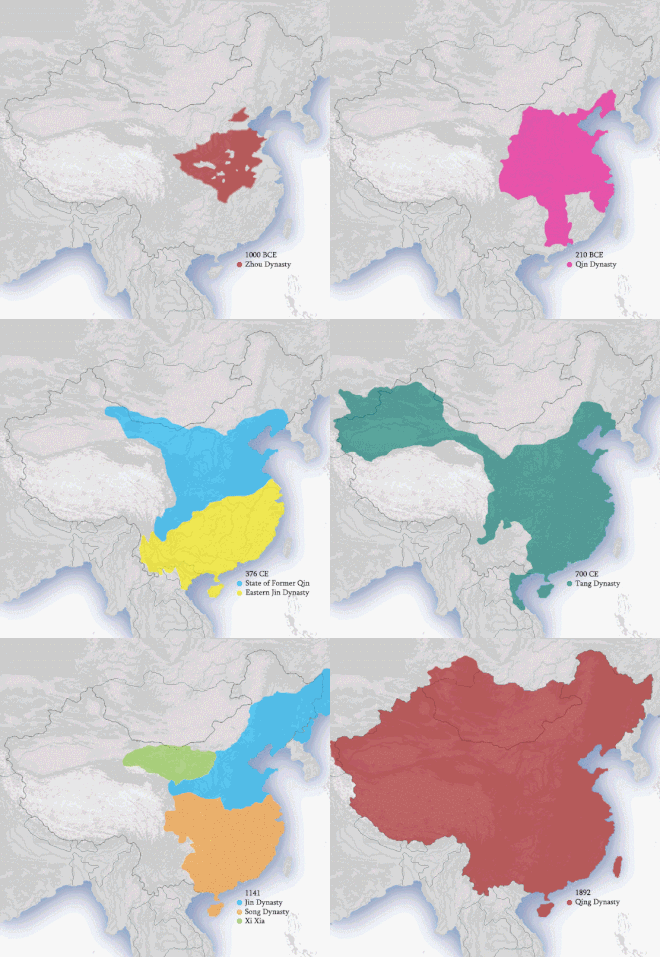

Dynasties as Historical Frameworks
The concept of a dynasty is fundamental to how historians understand and periodize the past, particularly in monarchical systems. A dynasty represents a sequence of rulers from the same family, often defining an entire era within a civilization's history. For example, the vast sweep of Imperial China's history, from 2070 BC to 1912 AD, is meticulously divided into distinct dynastic periods, each with its unique characteristics, achievements, and eventual decline.
Similarly, Ancient Egypt's timeline is structured around its numerous dynasties, charting the rise and fall of pharaonic power. This framework allows scholars to analyze political stability, cultural developments, and societal changes within specific family reigns, providing a coherent narrative for vast stretches of time that might otherwise seem chaotic or disconnected. The term 'dynasty' thus becomes a crucial analytical tool for understanding the ebb and flow of power and influence.
The Mechanics of Dynastic Succession
Historically, the continuity of a dynasty hinged on established rules of succession, which were predominantly patrilineal. This meant that leadership typically passed from father to son, ensuring a direct male lineage. In societies governed by laws like Salic law, succession through a daughter was often complex, potentially leading to the establishment of a new dynasty under her husband's family name.
This emphasis on male inheritance was deeply ingrained in many cultures, reflecting patriarchal social structures. However, this tradition has seen significant evolution. In contemporary European monarchies, succession laws have been reformed to permit female inheritance, allowing a monarch's daughter to ascend to the throne and maintain the dynastic name.
This shift reflects changing societal values and a move towards greater gender equality within even the most ancient of institutions.
Enduring Legacies and Societal Impact
The impact of dynastic rule extends far beyond the political sphere, profoundly shaping the cultural, economic, and social landscapes of civilizations. Dynasties often patronized arts and sciences, leading to periods of significant cultural flourishing, such as the Tang Dynasty in China or the Renaissance under various European ruling families. Grand architectural projects, from pyramids to palaces, were commissioned, leaving behind tangible legacies that continue to awe and inspire.
Furthermore, dynastic policies influenced trade routes, legal systems, and social hierarchies, the effects of which can persist for centuries. Even in the absence of monarchies, the historical narratives and cultural artifacts produced during dynastic eras remain integral to national identities and global heritage, offering insights into the long-term consequences of concentrated family power.
Dynasties in Republics and Modern Relevance
While the term 'dynasty' is most commonly associated with monarchies, its application can extend to republics, particularly in contexts where a single family or a closely connected group wields significant and sustained political influence over generations. Though not formal rulers, such families can exert control through political parties, economic power, or social networks, creating a de facto dynastic effect. This phenomenon highlights the enduring human tendency towards hereditary influence.
Understanding dynasties is not merely an academic exercise in ancient history; it provides a lens through which to analyze power dynamics in various political systems, including modern ones. The study of dynastic succession, its successes, and its failures offers valuable lessons about governance, stability, and the complex interplay between family, power, and society across different historical epochs.
Case Studies in Dynastic Longevity and Change
Examining specific examples illustrates the varied nature of dynastic rule. The Ptolemaic Dynasty in Egypt, for instance, though ruling for nearly 300 years (305 BC – 30 BC), was a Hellenistic dynasty established by a Macedonian Greek general, showcasing how foreign rulers could establish long-lasting dynasties. In contrast, the Han Dynasty in China (206 BC – 220 AD) is celebrated for its administrative innovations and cultural achievements, solidifying a distinct Chinese identity.
The transition from traditional patrilineal succession to more inclusive models, as seen in modern European monarchies, demonstrates that even deeply entrenched dynastic traditions are subject to adaptation and reform. These case studies underscore that while the core concept of family rule persists, its manifestation and acceptance are continually shaped by evolving social, political, and legal contexts.
Go deeper
Frequently Asked Questions
What is a dynasty?+
How do dynasties decide who becomes the next ruler?+
Why do dynasties build big things like pyramids and palaces?+
Can a dynasty have a queen instead of a king?+
How do dynasties help us learn about the past?+
Based on content from Wikipedia · Licensed under CC BY-SA 4.0