

Caucasus
Images

Caucasus




Geographical Determinants and Ecological Richness
The Caucasus is a region of immense geographical consequence, strategically positioned between the Black Sea and the Caspian Sea, effectively bisecting the Eurasian landmass. Its defining feature is the formidable Caucasus Mountain range, bifurcated into the Greater Caucasus in the north and the Lesser Caucasus in the south. The Greater Caucasus, predominantly shared by Russia and Georgia, boasts Mount Elbrus, Europe's highest peak at 5,642 meters, a stratovolcano that stands as a testament to the region's geological dynamism.
The Lesser Caucasus, encompassing areas of southern Georgia, Armenia, and Azerbaijan, includes significant highlands like the Javakheti Plateau. This mountainous terrain creates dramatic climatic variations, from subtropical coastal areas to alpine zones, fostering exceptional biodiversity. Historically, these mountains have served as both a formidable barrier and a conduit for migration and cultural exchange, profoundly shaping the region's development and its interactions with neighboring civilizations.
A Crucible of Linguistic and Ethnic Diversity
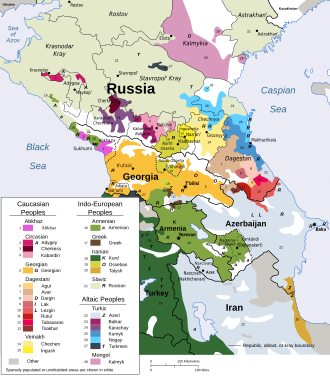
The Caucasus is globally renowned as one of the world's most linguistically diverse areas, often referred to as a 'linguistic hotspot.' Beyond the widespread Indo-European and Turkic language families, the region is the cradle of three indigenous language families: Kartvelian (including Georgian), Northwest Caucasian (such as Abkhaz and Circassian), and Northeast Caucasian (like Chechen and Avar). This extraordinary linguistic mosaic is a direct result of millennia of settlement, isolation within mountain valleys, and complex historical interactions.
The region is also ethnically diverse, with numerous distinct peoples, each possessing unique cultural traditions, histories, and identities. This rich tapestry of languages and ethnicities has led to a vibrant cultural landscape, characterized by unique art forms, music, cuisine, and social customs that reflect a deep and layered heritage.
Historical Trajectories and Geopolitical Significance
The Caucasus has been a pivotal region throughout history, serving as a strategic crossroads between major empires and civilizations, including the Persian, Greek, Roman, Byzantine, Arab, Turkic, and Russian spheres of influence. Its location has made it a perennial site of geopolitical competition and conflict. Ancient kingdoms like Urartu, Colchis, and Iberia flourished here, leaving behind significant archaeological and historical legacies.
The region has witnessed numerous invasions, migrations, and periods of both independence and subjugation. The division into North and South Caucasus has also played a role in its political evolution, with the North Caucasus largely integrated into Russia and the South Caucasus comprising independent nations. Understanding the Caucasus requires appreciating its long history of resilience, cultural adaptation, and its enduring strategic importance in global affairs.
Socio-Economic Landscape and Cultural Continuity
The economy of the Caucasus is diverse, influenced by its geography and history. Agriculture remains important, particularly in the fertile valleys and foothills, with products like grapes, fruits, and grains being significant. The region also possesses natural resources, including oil and gas, particularly in Azerbaijan. Tourism is a growing sector, drawn by the stunning natural landscapes, ancient historical sites, and unique cultural experiences.
However, economic development can be uneven, with challenges related to infrastructure, political stability, and regional disparities. Culturally, the Caucasus maintains strong traditions of hospitality, family, and community. Festivals, religious practices, and artisanal crafts are integral to daily life, demonstrating a remarkable continuity of cultural heritage despite centuries of external influences and internal transformations.
Education and Knowledge Transmission
Education in the Caucasus reflects the region's complex history and diverse populations. While formal education systems are in place, often modeled after European or Russian systems, the transmission of knowledge also occurs through strong oral traditions and cultural practices. Universities and research institutions exist in the major cities, contributing to academic and scientific development.
However, access to quality education can vary, particularly in rural or less developed areas. The preservation of indigenous languages and cultures is a significant aspect of the educational landscape, with efforts made to incorporate these elements into curricula. The region's rich history and unique cultural heritage provide a fertile ground for academic study in fields such as linguistics, anthropology, history, and archaeology, attracting scholars from around the world.
Go deeper
Frequently Asked Questions
What is the Caucasus?+
Where is Mount Elbrus?+
Why are there so many languages in the Caucasus?+
What kinds of people live in the Caucasus?+
What can people do in the Caucasus for fun?+
Based on content from Wikipedia · Licensed under CC BY-SA 4.0