

Cahokia: A Lost City of Giants!
Images
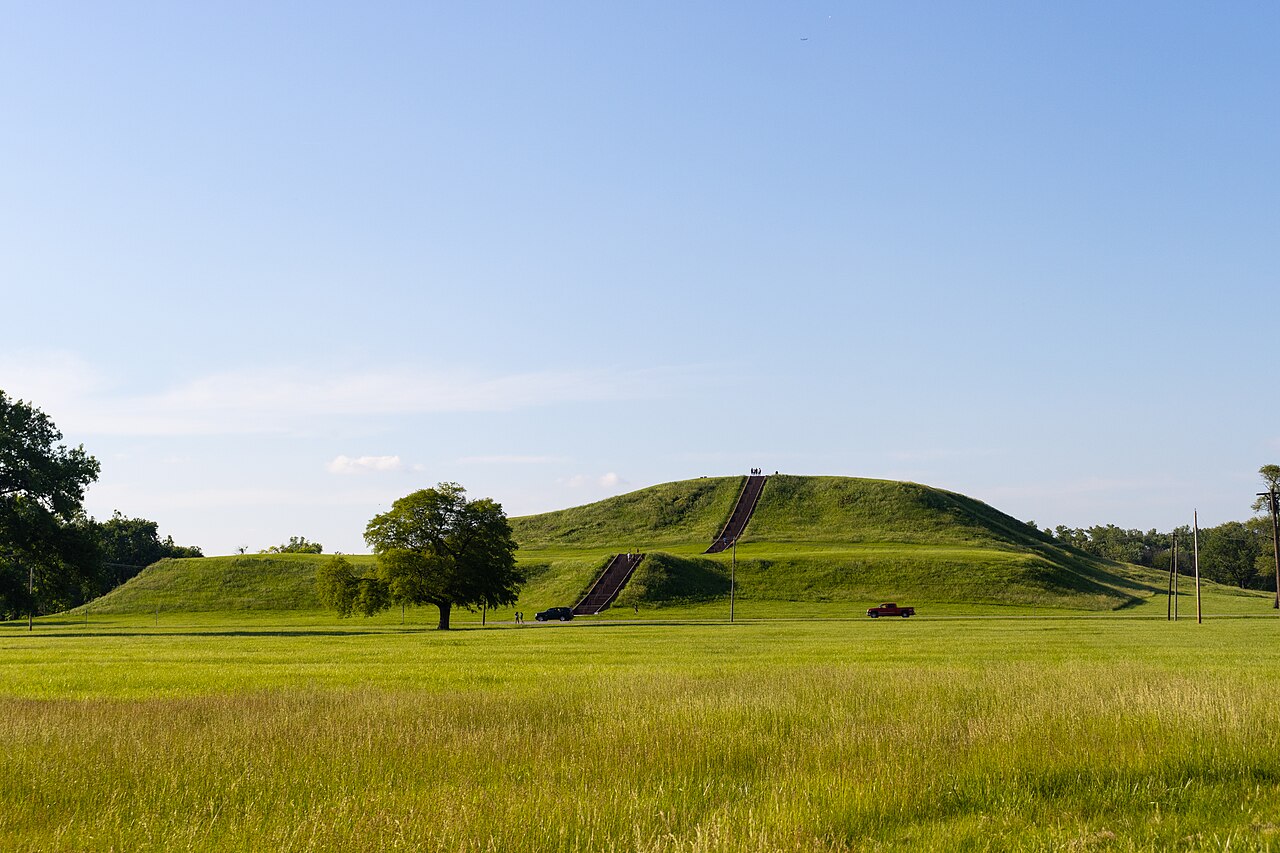
Cahokia
The Genesis and Zenith of a Mississippian Metropolis
Cahokia, situated in the fertile Mississippi River floodplain near present-day St. Louis, Illinois, stands as the most prominent and complex urban center of the Mississippian culture. Its rise, beginning around 1050 CE, marked a significant shift in North American prehistory, transforming a regional settlement into a sprawling metropolis that dominated the landscape for centuries.
At its zenith, estimated between 1100 and 1200 CE, Cahokia's population may have reached 20,000 or more, a figure comparable to or exceeding that of many contemporary European cities like London or Paris. This dense population supported a complex social hierarchy, specialized labor, and extensive trade networks that stretched across eastern North America. The city's layout, centered around a vast central plaza and dominated by monumental earthen mounds, reflects a highly organized society with a sophisticated understanding of urban planning and resource management.
Monumental Architecture as Social and Political Manifestation
The defining characteristic of Cahokia is its impressive array of over 100 earthen mounds, meticulously constructed without the aid of draft animals or wheeled vehicles. Monks Mound, the largest, is an unparalleled feat of engineering, covering approximately 14 acres and rising to a height of nearly 100 feet. Its four-terraced summit once supported a structure estimated to be as large as a 12-room house, serving as a paramount chief's residence or a ceremonial center. The sheer scale and labor required to build Monks Mound and other mounds, such as those shaped like animals or designed for burial, underscore the immense power and authority wielded by Cahokia's elite.
These mounds were not merely utilitarian; they served as potent symbols of social stratification, political power, and cosmological beliefs, physically manifesting the hierarchical structure of Mississippian society.
Socio-Economic Dynamics and Cosmological Frameworks
Life in Cahokia was intricately tied to agricultural cycles, particularly the cultivation of maize, which provided a stable food surplus necessary to support a large, non-food-producing population. This surplus facilitated trade, with Cahokia acting as a hub for the exchange of goods like shell beads, copper, mica, and exotic stones, indicating far-reaching connections. The discovery of 'Woodhenge,' a series of concentric circles of large timber posts, suggests a profound engagement with astronomical observation.
These structures likely served as sophisticated solar calendars, crucial for agricultural planning and the timing of important rituals and ceremonies that reinforced social cohesion and the authority of leaders. The city's layout, including the defensive palisade walls, points to a society that balanced communal living with concerns for order and perhaps conflict.
The Enigma of Cahokia's Abandonment
The decline and eventual abandonment of Cahokia, occurring primarily between 1300 and 1350 CE, remains one of North American archaeology's most compelling mysteries. While the exact causes are debated, a confluence of factors is likely responsible. Environmental degradation, including extensive deforestation for construction and fuel, may have led to soil erosion, flooding, and reduced agricultural productivity. Resource depletion due to a large population could have strained the carrying capacity of the surrounding region.
Furthermore, internal social stresses, political instability, or the emergence of new power centers elsewhere might have contributed to the city's demise. The abandonment was not a sudden collapse but a gradual process, with populations dispersing to smaller settlements. Today, the UNESCO World Heritage Site of Cahokia Mounds preserves these monumental remnants, offering invaluable insights into a complex, advanced civilization that profoundly shaped the pre-Columbian American landscape.
Go deeper
Based on content from Wikipedia · Licensed under CC BY-SA 4.0