

1066: A Year of Big Changes!
Images

King William I ('The Conqueror') From NPG


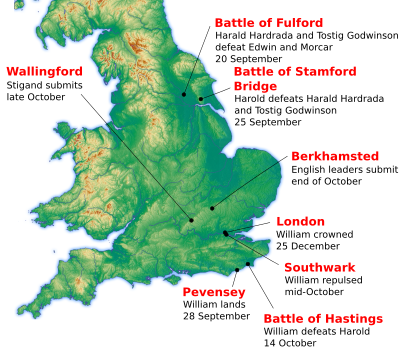


The Succession Crisis of 1066
The year 1066 began under a cloud of uncertainty following the death of Edward the Confessor, the childless King of England. His demise triggered a complex succession crisis involving multiple powerful figures, each with a plausible claim to the throne. Harold Godwinson, the Earl of Wessex and Edward's brother-in-law, was elected and crowned King by the Witenagemot (the Anglo-Saxon council). However, his claim was immediately challenged by Harald Hardrada, the formidable King of Norway, who asserted a claim based on a previous agreement, and William, Duke of Normandy, who alleged that Edward had promised him the throne and that Harold had sworn an oath to support his succession.
A Year of Pivotal Battles
The ensuing conflict unfolded across England in a series of decisive military engagements. Harald Hardrada, allied with Harold Godwinson's estranged brother Tostig, invaded northern England, culminating in the Battle of Stamford Bridge on September 25th. Harold Godwinson's forces achieved a stunning victory, annihilating the Norwegian army and killing both Hardrada and Tostig.
This triumph, however, was pyrrhic. While Harold was celebrating in the north, William of Normandy seized the opportunity, landing his invasion fleet unopposed at Pevensey Bay in Sussex on September 28th. Harold was forced to undertake a rapid and exhausting march south with his depleted army to confront this new, formidable threat.
The Norman Conquest and its Aftermath
The climax of 1066 arrived on October 14th with the Battle of Hastings. Fought on Senlac Hill, this epic clash pitted Harold's weary Anglo-Saxon army against William's well-equipped Norman forces, which included cavalry, archers, and infantry. The battle raged for an entire day, a testament to the resilience of the Anglo-Saxon shield wall.
Ultimately, Norman tactics, including feigned retreats and superior missile fire, proved decisive. Harold's death, famously depicted in the Bayeux Tapestry, marked the end of Anglo-Saxon rule. William marched on London and was crowned King William I on Christmas Day, 1066, initiating the Norman era.
Transformative Impact on English Society
The Norman Conquest initiated by 1066 was not merely a change of ruler; it was a fundamental restructuring of English society, governance, and culture. The Norman aristocracy replaced the Anglo-Saxon elite, leading to a dramatic shift in land ownership and power structures. The introduction of Norman French as the language of the court and administration profoundly influenced the English language, infusing it with thousands of new words and altering its grammatical structure.
This linguistic fusion is a primary reason why modern English is so distinct from other Germanic languages. The legal system, architecture, and feudal system were also significantly reshaped under Norman influence.
Legacy and Historiographical Significance
The year 1066 stands as a watershed moment in British history, a pivotal event whose consequences continue to resonate. It marked the last successful invasion of England and laid the foundations for the modern English state. The Domesday Book, commissioned by William in 1086, serves as an invaluable historical document, providing a detailed snapshot of England's economy and social structure two decades after the conquest.
The study of 1066 offers insights into medieval warfare, political maneuvering, and the complex processes of cultural assimilation and linguistic evolution, making it a perennially fascinating subject for historians and students alike.
See also
Frequently Asked Questions
What happened in England in 1066?+
Who were the main people fighting in 1066?+
Why did William of Normandy invade England?+
What was the Battle of Hastings?+
How did 1066 change the English language and society?+
Based on content from Wikipedia · Licensed under CC BY-SA 4.0