

Syrian Civil War
Images

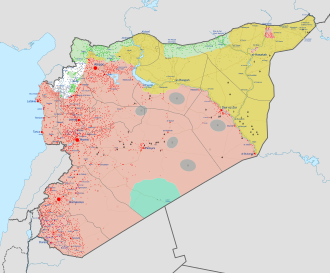
Syrian Civil War map (ISW-CTP)




Roots of Rebellion
The Syrian civil war, erupting in March 2011, was not an isolated incident but a culmination of deep-seated social, economic, and political grievances. Fueled by the wider Arab Spring movement, popular discontent against the authoritarian Ba'athist regime, led by President Bashar al-Assad, manifested in widespread pro-democracy protests. Decades of centralized power, economic inequality, and suppression of dissent created fertile ground for unrest.
The regime's brutal response, employing lethal force against largely peaceful demonstrators, catalyzed the transformation of protests into an armed insurgency, marking the tragic beginning of a protracted civil conflict that would engulf the nation.
A Proxy Battlefield
What began as an internal conflict rapidly evolved into a complex international proxy war. The Syrian opposition, fragmented into various factions like the Free Syrian Army, received external backing from states such as Qatar and Turkey. Conversely, the Assad regime secured vital military and financial support from Iran and Russia, with both nations intervening directly.
The rise of ISIS in 2014 further complicated the landscape, prompting a US-led coalition to engage in counter-terrorism operations while also supporting the Syrian Democratic Forces (SDF). Turkey's subsequent invasion in 2016, aimed at countering Kurdish influence and fighting ISIS, added another layer of geopolitical complexity, turning Syria into a battleground for regional and global powers.
Key Turning Points and Territorial Control
The war was punctuated by pivotal battles that dramatically altered territorial control and the conflict's trajectory. The fall of Aleppo in December 2016 to pro-Assad forces, after a brutal four-year siege, represented a significant strategic victory for the regime. The emergence and subsequent territorial gains of ISIS, particularly in eastern Syria and western Iraq, necessitated a major international military response.
Rebel groups, at times, established de facto governance in captured territories, such as Raqqa and Idlib, before facing counter-offensives. The conflict was characterized by shifting frontlines, sieges, and devastating urban warfare, leading to immense destruction and displacement.
The Endgame
After nearly fourteen years of devastating conflict, the Syrian civil war reached a dramatic conclusion in December 2024 with the collapse of the Assad regime. A swift and decisive offensive by rebel factions, including Hay'at Tahrir al-Sham (HTS) and the Syrian National Army, led to the rapid capture of major cities, culminating in President Bashar al-Assad fleeing the country. This marked the end of his long rule and the establishment of a new transitional government.
However, the aftermath is fraught with challenges, including the integration of various militias, the ongoing threat of localized insurgencies, and the immense task of national reconstruction and reconciliation in a country profoundly scarred by years of war.
Enduring Legacies
The Syrian civil war's legacy extends far beyond its immediate conclusion. It has created one of the most severe humanitarian crises of the 21st century, with millions displaced internally and externally, and widespread destruction of infrastructure. The conflict has fundamentally reshaped the geopolitical landscape of the Middle East, altering regional power dynamics and highlighting the complexities of international intervention.
The war's protracted nature and the involvement of numerous state and non-state actors serve as a stark case study in modern asymmetric warfare, the challenges of state-building, and the devastating human cost of prolonged internal conflict, leaving lasting scars on Syrian society and international relations.
Go deeper
Based on content from Wikipedia · Licensed under CC BY-SA 4.0