

Germany's Awesome States!
Images

Rhineland-Palatinate is a state of Germany. The largest wine producing area in Germany, it is home to 6 of the 9 wine-producing districts in Germany and is full of museums, exhibitions and castles.


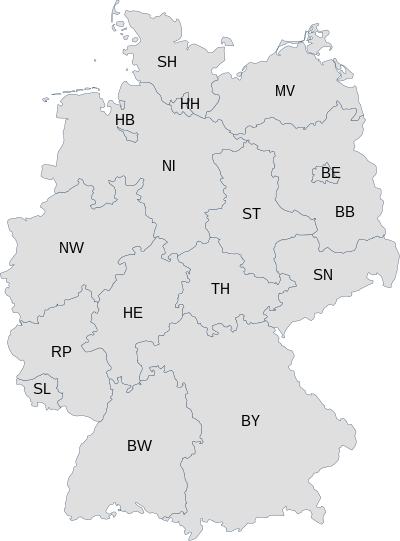


Geographical and Climatic Diversity Across the German States
Germany, situated in the heart of Europe, is comprised of sixteen federal states, or Länder, each possessing a unique geographical identity. These states exhibit a remarkable range of landscapes, from the coastal plains and marshlands of Schleswig-Holstein in the north, influenced by the North and Baltic Seas, to the rugged Alpine foothills in Bavaria to the south. Major river systems like the Rhine, Elbe, and Danube carve through various states, serving as vital arteries for transportation and commerce.
Climatically, Germany experiences a temperate seasonal climate, but variations exist. Northern states are generally milder and windier, while southern states experience warmer summers and colder, snowier winters, particularly in the mountainous regions. This geographical mosaic influences everything from agriculture and tourism to regional dialects and cultural practices, creating a rich tapestry across the nation.
Historical Trajectories
The current federal structure of Germany is a product of centuries of political evolution, significantly shaped by post-World War II developments. The Federal Republic of Germany was established in 1949, initially comprising eleven states formed from the Allied occupation zones. Key historical junctures include the merger of Baden, Württemberg-Baden, and Württemberg-Hohenzollern into Baden-Württemberg in 1952, and the accession of Saarland in 1957.
The most profound transformation occurred with German reunification in 1990, when the five re-established eastern states Brandenburg, Mecklenburg-Vorpommern, Saxony, Saxony-Anhalt, and Thuringia, along with the unified city of Berlin, joined the Federal Republic. This process of state formation and consolidation reflects shifting political landscapes, national aspirations, and the complex legacy of division and unity.
Cultural Tapestry and Societal Fabric of the Länder
The cultural landscape of Germany is as varied as its geography, with each state contributing distinct traditions, dialects, and historical narratives. While a shared German language forms the primary linguistic bond, regional variations in pronunciation, vocabulary, and even grammar are pronounced, fostering a strong sense of local identity. Festivals, culinary specialties, and historical landmarks differ significantly from one Land to another.
For instance, Bavaria is renowned for its Oktoberfest and traditional Lederhosen, while the Rhineland celebrates its Carnival traditions. The appellation 'Freistaat' used by Bavaria, Saxony, and Thuringia, though without legal distinction, signifies a historical emphasis on self-governance and republican ideals. This cultural diversity enriches the national identity, creating a dynamic interplay between regional uniqueness and federal unity.
Economic Engines
Germany's economic strength is distributed across its sixteen states, each playing a crucial role in the nation's industrial and technological prowess. Major economic powerhouses like North Rhine-Westphalia are centers for heavy industry, automotive manufacturing, and chemical production. Bavaria excels in high-tech industries, automotive engineering, and aerospace.
Baden-Württemberg is a global leader in mechanical engineering and automotive manufacturing, while states like Hamburg thrive as major port cities and service hubs. The economic activities are highly integrated, with complex supply chains and labor mobility facilitated by federal infrastructure policies. The states contribute significantly to Germany's export-oriented economy, making them vital components of both national prosperity and European economic integration.
Governance and Political Structure
Germany operates as a federal parliamentary republic, with power shared between the federal government and the sixteen state governments (Länder). Thirteen states are 'area-states' (Flächenländer), characterized by a multi-tiered administrative structure including local authorities like counties (Kreise) and independent cities (kreisfreie Städte). Berlin and Hamburg function as 'city-states,' where the municipal administration is integrated with the state government. Bremen presents a unique hybrid model.
Each state has its own constitution, parliament (Landtag), and government, responsible for areas such as education, police, and cultural affairs. This federal system, enshrined in the Basic Law (Grundgesetz), ensures regional autonomy while maintaining national cohesion and democratic principles. The concept of 'partly sovereign states' highlights their significant self-governing powers within the federal framework.
See also
Based on content from Wikipedia · Licensed under CC BY-SA 4.0