

Westphalia
Images

Westphalia x3


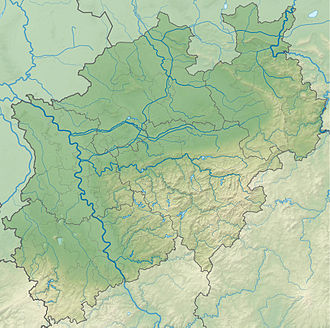


Cartography of Westphalia
Westphalia occupies a substantial territory in northwestern Germany, constituting one of the three principal historical components of the modern federal state of North Rhine-Westphalia. Its geographical footprint spans approximately 20,210 square kilometers, supporting a dense population of around 7.9 million individuals. This area is characterized by a varied topography, ranging from the fertile plains of the Westphalian Bight to the more rugged terrain of the Teutoburg Forest and the Sauerland hills.
These natural features have historically influenced settlement patterns and economic activities, from agriculture to resource extraction. The region's climate is temperate maritime, with moderate rainfall distributed throughout the year, fostering a rich biodiversity and supporting its agricultural output. The Rhine-Ruhr metropolitan area, though primarily associated with the 'Rhine' part of North Rhine-Westphalia, exerts a significant economic and cultural influence on the eastern parts of Westphalia, creating a dynamic interplay between urban centers and the more rural landscapes.
Chronicles of Westphalia
The historical identity of Westphalia is deeply rooted in its evolution from ancient tribal territories to a modern administrative entity. Initially, 'Westphalia' denoted the westernmost part of the vast Duchy of Saxony, a key territory in the Holy Roman Empire. Over centuries, it developed distinct political entities, including the Duchy of Westphalia, which was under the control of the Archbishopric of Cologne for a significant period.
A pivotal transformation occurred in 1815 when, following the Napoleonic Wars, the Congress of Vienna established the Province of Westphalia as part of the Kingdom of Prussia. This Prussian administration lasted for over a century, profoundly shaping the region's infrastructure, legal system, and identity. The post-World War II era brought further consolidation, with the Province of Westphalia merging with the former Rhine Province (North Rhine) in 1946 to form the state of North Rhine-Westphalia, later incorporating the Free State of Lippe in 1947.
This process reflects broader trends of German state formation and administrative rationalization.
The Westphalian Ethos
The cultural landscape of Westphalia is marked by a strong sense of regional identity, often intertwined with its historical experiences. While standard German is the lingua franca, the region is also a stronghold of Westphalian, a dialect group belonging to the Low German (Plattdeutsch) language family. This linguistic heritage is a significant marker of cultural distinctiveness, connecting Westphalia to a broader northern German cultural sphere.
The region's governance is structured through the Westphalia-Lippe Regional Association (Landschaftsverband Westfalen-Lippe), a unique public body comprising seventeen administrative districts (Kreise) and nine independent cities (kreisfreie Städte). This association plays a crucial role in cultural preservation, social services, and regional planning, embodying a decentralized approach to governance that respects historical administrative divisions while adapting to modern needs.
This structure fosters a sense of local autonomy and collective responsibility among its constituent municipalities.
Westphalia's Economic Trajectory
Historically, Westphalia's economy was heavily reliant on its rich coal deposits and associated heavy industries, particularly steel production, which fueled Germany's industrial revolution and subsequent economic growth. The Ruhr area, bordering Westphalia, was a global powerhouse of coal and steel. While these traditional sectors have experienced significant decline due to resource depletion and global market shifts, Westphalia has successfully navigated this transition.
The region has diversified its economic base, embracing advanced manufacturing, engineering, information technology, and the service sector. It remains a significant industrial region, but with a focus on high-value products and innovation. Agriculture continues to be important, particularly in the more rural eastern parts.
Its strategic location within Europe facilitates robust trade networks, making it a key player in both domestic and international commerce, demonstrating remarkable economic resilience and adaptability.
The Educational Fabric of Westphalia
Education in Westphalia is integral to its socio-economic development and cultural continuity. The region hosts a comprehensive educational system, from primary and secondary schools to vocational training centers and universities. Major universities, such as the University of Münster and the Technical University of Dortmund (though technically in the Rhine part, it serves the broader region), are centers of research and higher learning, attracting students from across Germany and internationally.
These institutions contribute significantly to scientific advancement and provide a skilled workforce for the region's diverse economy. Vocational education and training (Berufsbildung) are particularly strong, reflecting the historical importance of skilled trades and manufacturing. The Westphalia-Lippe Regional Association also plays a role in supporting educational initiatives and cultural institutions, ensuring that learning and knowledge dissemination remain central to the region's progress and identity.
Go deeper
Based on content from Wikipedia · Licensed under CC BY-SA 4.0