

Robert F. Kennedy
Images

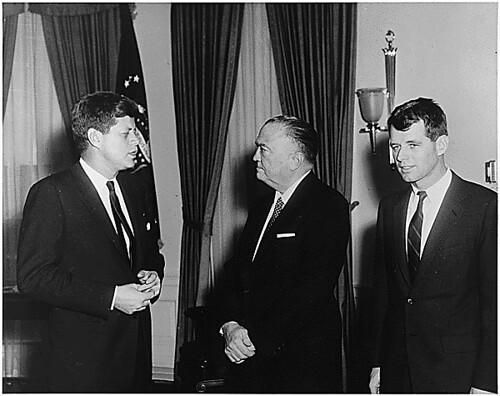
Four men, including Robert F. Kennedy, David Dubinsky, and Louis Stulberg


From Family Legacy to Independent Force
Robert F. Kennedy emerged from the shadow of his famous family to forge his own powerful political identity. After graduating from Harvard and the University of Virginia School of Law, he initially pursued a career in journalism before dedicating himself to public service.
His early political work involved managing his brother John F. Kennedy's successful campaigns for the U.S. Senate and the presidency. This experience provided him with invaluable insights into political strategy and the art of persuasion.
His appointment as Attorney General at the remarkably young age of 35, a position he held from 1961 to 1964, marked his ascent to national prominence. During this period, he served as his brother's closest confidant, playing a critical role in navigating the complexities of the Cold War, including authoring his account of the Cuban Missile Crisis in 'Thirteen Days'.
Champion of Civil Rights and Crusader Against Crime
Kennedy's tenure as Attorney General was characterized by a dual focus on combating organized crime and advancing the Civil Rights Movement. He aggressively pursued racketeering and corruption, earning a reputation as a formidable prosecutor. Simultaneously, he became a key figure in the struggle for racial equality.
While controversial decisions, such as authorizing the wiretapping of Martin Luther King Jr. and the Southern Christian Leadership Conference, were made, his overall commitment to civil rights was undeniable. He used the power of his office to challenge segregation and advocate for the rights of African Americans, working closely with leaders like King, Cesar Chavez, and Walter Reuther to foster social justice and economic opportunity.
Senator for the Disenfranchised and Voice Against War
Following his brother's assassination in 1963, Kennedy transitioned to the U.S. Senate, representing New York from 1965 to 1968. Despite facing accusations of being a 'carpetbagger,' he established himself as a dedicated senator deeply concerned with the welfare of his constituents.
He became a vocal opponent of the Vietnam War, a stance that resonated with a growing segment of the population. Furthermore, he championed initiatives aimed at alleviating poverty, such as the Bedford Stuyvesant Restoration Project, demonstrating a commitment to practical solutions for urban blight. His extensive travels abroad, to regions like Eastern Europe, Latin America, and South Africa, underscored his global perspective on human rights and his dedication to fostering international understanding and cooperation.
Presidential Aspirations and Enduring Legacy
In 1968, Robert F. Kennedy emerged as a leading contender for the Democratic presidential nomination, articulating a powerful message of hope and change that appealed to a broad coalition of voters, including the poor, African Americans, Hispanic Americans, Catholics, and young people. His campaign was marked by passionate speeches and a genuine connection with diverse communities.
However, his presidential aspirations were tragically cut short on June 5, 1968, when he was assassinated shortly after winning the California primary. His death sent shockwaves across the nation and the world, leaving a void in American politics. Despite the tragic end, RFK's legacy endures through his unwavering commitment to social justice, his empathy for the marginalized, and his vision of a more equitable and compassionate society, continuing to inspire activists and leaders today.
See also
Frequently Asked Questions
What did Robert F. Kennedy do when he was Attorney General?+
How did Robert F. Kennedy help people in Bedford Stuyvesant?+
Why was Robert F. Kennedy a good friend of Martin Luther King Jr.?+
What happened to Robert F. Kennedy during his presidential campaign?+
How did Robert F. Kennedy travel around the world?+
Based on content from Wikipedia · Licensed under CC BY-SA 4.0