

Pyramid of the Sun
Images

Teotihuacan, Pyramid of the Sun


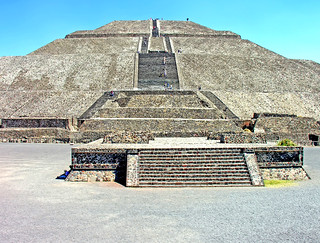


Architectural Grandeur and Urban Integration
The Pyramid of the Sun stands as the preeminent structure within the vast archaeological site of Teotihuacan, a city that once dominated Mesoamerica. Its construction, estimated to have occurred around 200 AD, places it at the zenith of the city's Classic period. This colossal edifice is not merely an isolated monument but an integral component of Teotihuacan's meticulously planned urban landscape.
Situated along the grand ceremonial thoroughfare known as the Avenue of the Dead, it forms a critical nexus with other significant structures, including the Pyramid of the Moon and the Ciudadela complex. The pyramid's immense scale, making it one of the largest structures of its kind in the ancient Americas, underscores the organizational capacity and labor mobilization capabilities of the Teotihuacan civilization. Its construction involved the aggregation and placement of millions of tons of volcanic rock, rubble, and earth, demonstrating sophisticated quarrying, transportation, and construction techniques that have baffled and impressed researchers for centuries.
The pyramid's stepped design and its alignment with celestial events further hint at a deep understanding of astronomy and cosmology integrated into its architectural conception.
Geographical Context and Environmental Setting
The Pyramid of the Sun is strategically located within the Teotihuacan Valley, part of the Basin of Mexico. This geographical setting provided the resources and environment for the development of one of the most influential ancient cities in Mesoamerica. The city's layout, with the Pyramid of the Sun as a central feature, reflects a deliberate design that likely served both practical and symbolic purposes.
The Avenue of the Dead, a defining feature of the site, runs north-south, with the Pyramid of the Sun positioned to the east of this axis. The pyramid's imposing presence is further amplified by its proximity to Cerro Gordo, a significant mountain that likely held cosmological or spiritual importance for the Teotihuacanos, potentially viewed as a sacred peak or a source of life-giving water. The region experiences a temperate climate with a pronounced dry season and a rainy season, influencing agricultural cycles and the daily rhythms of the ancient inhabitants.
Understanding this geographical context is crucial for appreciating how the Teotihuacanos interacted with their environment and how it shaped their civilization and monumental architecture.
The Enigmatic Builders and Their Society
The identity of the civilization responsible for constructing the Pyramid of the Sun remains one of archaeology's enduring mysteries. While the city is known as Teotihuacan, the actual name and ethnic identity of its original inhabitants are not definitively known. What is clear is that they were part of a highly complex and powerful society that exerted considerable influence across Mesoamerica for centuries.
The sheer scale of the pyramid implies a hierarchical social structure with a strong ruling elite capable of commanding vast resources and labor. The construction process would have required specialized knowledge in engineering, architecture, and logistics. The materials used, primarily volcanic rock and earth, were abundant in the region, but their systematic extraction and assembly into such a monumental form speak to advanced organizational capabilities.
The pyramid serves as a tangible legacy of this sophisticated culture, offering insights into their worldview, their technological achievements, and their capacity for large-scale, coordinated endeavors, even in the absence of written records detailing their specific history or rulers.
Socio-Religious Significance and Enduring Legacy
The Pyramid of the Sun was undoubtedly a focal point of religious and civic life in ancient Teotihuacan. While its precise function is subject to ongoing scholarly debate, its monumental scale and prominent placement strongly suggest a central role in the city's cosmology and ritual practices. Pyramids in Mesoamerica often served as platforms for religious ceremonies, astronomical observation, or as sacred mountains symbolizing the connection between the earthly realm and the divine.
Some theories propose it may have contained tombs or served as a dedication to a solar deity, given its name. The pyramid's enduring legacy lies in its ability to provoke questions about the past and inspire awe at human ingenuity. It stands as a powerful symbol of a lost civilization, prompting continuous research into their beliefs, social structures, and technological advancements.
The ongoing archaeological work at Teotihuacan continues to shed light on the pyramid's construction and its place within the broader cultural tapestry of ancient Mesoamerica, making it a vital site for understanding pre-Columbian history.
Modern Relevance and Archaeological Pursuit
Today, the Pyramid of the Sun is a UNESCO World Heritage site and a major tourist attraction, drawing visitors from around the globe who come to marvel at its scale and historical significance. Its preservation and study are crucial for understanding not only the history of Teotihuacan but also the broader trajectory of Mesoamerican civilizations. Archaeological investigations continue to uncover new details about its construction, potential internal chambers, and its astronomical alignments, offering fresh perspectives on the Teotihuacanos' knowledge and beliefs.
The pyramid serves as a constant reminder of the rich and complex human history that predates modern societies, prompting reflection on cultural achievements and the cyclical nature of civilizations. Its ongoing excavation and interpretation contribute to our global understanding of human heritage and the diverse ways ancient peoples interacted with their environments and the cosmos. The site's importance extends beyond its historical value, serving as a vital educational resource and a symbol of cultural continuity.
See also
Frequently Asked Questions
What is the Pyramid of the Sun?+
When was the Pyramid of the Sun built?+
Where is the Pyramid of the Sun?+
Why is the Pyramid of the Sun so big?+
How did the people build the Pyramid of the Sun?+
Based on content from Wikipedia · Licensed under CC BY-SA 4.0