

Pyramid
Images

Pyramids in Dublin (In Explore 02-02-2014)




More Than Just a Shape
Imagine a structure that looks like it's pointing to the sky, with sides that are all triangles meeting at a single point at the very top. That's the basic idea of a pyramid! The word 'pyramid' itself comes from ancient Egyptian, possibly meaning 'the height of the structure.'
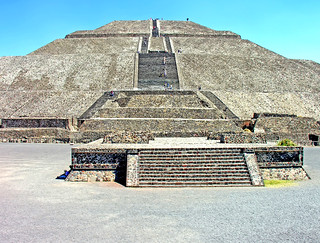
What's really cool is that the base of a pyramid doesn't have to be a square. It can be any shape, like a triangle or even a pentagon. The sides can be smooth, or they can be built in steps, like a giant staircase leading upwards.
This distinctive shape isn't just for looks; it's a clever design that helps keep the structure stable and strong, especially when built on a massive scale. The majority of the pyramid's weight is concentrated at the bottom, making it incredibly resistant to collapse, a testament to the ingenuity of early builders.
Ancient Architects and Their Masterpieces
Pyramids aren't just an Egyptian thing, though the Egyptian pyramids are probably the most famous. Ancient civilizations all over the world figured out how to build these incredible structures. Think about it – these were built thousands of years ago, long before we had cranes or modern construction equipment!
For a very long time, the biggest structures on Earth were pyramids. In Egypt, the Red Pyramid in Dashur and the Great Pyramid of Khufu were once the tallest buildings around. The Great Pyramid of Khufu is especially amazing because it's the only one of the Seven Wonders of the Ancient World that still stands today.
But it's not just Egypt! In Mesoamerica, the Great Pyramid of Cholula in Mexico is actually the largest pyramid in the world by volume, meaning it's the biggest in terms of how much space it takes up. This shows that different cultures, at different times, independently discovered the power and stability of the pyramid shape.
Why Did They Build Them?
The reasons behind building such massive structures are as varied as the pyramids themselves. In ancient Egypt, pyramids were primarily built as tombs for pharaohs and their consorts. The Egyptians believed in an afterlife, and these monumental structures were designed to protect the rulers' bodies and possessions for eternity, ensuring their journey to the next world.
The sheer scale and complexity of these tombs also served as a powerful symbol of the pharaoh's divine status and authority.
Beyond their role as tombs, pyramids also held significant religious and symbolic meaning. Their shape, pointing towards the heavens, was often associated with the sun's rays or a stairway to the gods. In other cultures, like in Mesoamerica, pyramids served as platforms for temples, where important religious ceremonies and astronomical observations took place.
They were central to the spiritual and civic life of these societies, acting as focal points for communities and demonstrating the power and organization of their rulers and priests.
How It Works
The pyramid's shape is its secret weapon for stability. Think about stacking blocks. If you stack them all in a tall, thin tower, it's easy to knock over. But if you spread the blocks out at the bottom and gradually make the tower narrower as you go up, it becomes much more stable. That's exactly what a pyramid does.
Its design means that most of its weight is concentrated near the ground. As you go higher up the pyramid, the structure gets smaller and smaller, meaning there's less weight pushing down. This clever distribution of mass makes pyramids incredibly strong and resistant to earthquakes and other natural forces.
The ancient builders understood this principle intuitively, even without modern physics. They used precisely cut stones, often weighing many tons, fitted together with incredible accuracy, further enhancing the structural integrity of these ancient giants. It's a perfect example of form following function in architecture.
Pyramids Around the World
When most people think of pyramids, they picture the iconic structures of Egypt, like the Great Pyramid of Giza. These are truly awe-inspiring, built with millions of stone blocks and standing for thousands of years. The Great Pyramid, for instance, was the tallest man-made structure in the world for over 3,800 years!
But the world of pyramids is much broader. In Mexico, the Great Pyramid of Cholula is a massive structure that, from a distance, might even look like a natural hill because it's covered in vegetation. It's so enormous that it's the largest pyramid by volume ever built.
Other cultures also created pyramid-like structures. For example, in Sudan, there are hundreds of pyramids, though they are generally smaller and steeper than the Egyptian ones. There are also pyramid-shaped mounds and structures found in parts of Asia and even North America, showing how this fundamental shape has been adopted and adapted by different civilizations across the globe for various purposes.
See also
Frequently Asked Questions
What is a pyramid?+
Why do pyramids have a pointy top?+
Can pyramids have different shapes at the base?+
Why did ancient Egyptians build pyramids?+
Are pyramids only found in Egypt?+
Based on content from Wikipedia · Licensed under CC BY-SA 4.0