

Muisca
Images

Balsa Muisca BOG 03 2018 8506


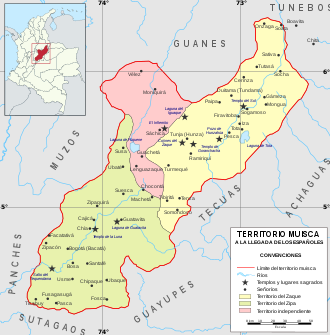


The Muisca Confederation
The Muisca were not a single unified empire but rather a confederation of chiefdoms that flourished in the Altiplano Cundiboyacense of modern-day Colombia prior to European arrival. Their society was highly stratified, with distinct social classes and a complex political structure centered around powerful caciques (chiefs). Economically, they were skilled agriculturalists, cultivating maize, potatoes, and quinoa, and were renowned for their exceptional metallurgical skills, particularly in working with gold and tumbaga (a gold-copper alloy).
Their religious beliefs were deeply intertwined with nature, astronomy, and the sun. A pivotal ritual, often cited as the origin of the El Dorado legend, involved a new chief being covered in gold dust and offering precious items into Lake Guatavita. This practice underscores the profound symbolic and spiritual significance of gold within Muisca culture, far beyond mere material wealth.
Their language, Muysccubun, belongs to the Chibchan language family, indicating broader cultural connections across the region.
The Impact of Spanish Colonization
The arrival of Spanish conquistadors in 1537 marked a profound turning point for the Muisca. The Spanish conquest, driven by desires for land, labor, and precious metals, led to significant demographic decline due to disease, warfare, and exploitation. Spanish clerics and civil officials actively sought to Christianize the Muisca and integrate them into the Spanish Empire as subjects, fundamentally altering their social, religious, and economic systems.
The establishment of the Viceroyalty of New Granada imposed new administrative structures and legal frameworks. Despite these pressures, Muisca culture demonstrated remarkable resilience. While their pre-Hispanic political and religious structures were dismantled, aspects of their customs, social organization, and artisanal traditions persisted into the colonial era, often adapting to new circumstances and syncretizing with European influences.
This period highlights the complex dynamics of cultural imposition and indigenous adaptation.
Identity and Revitalization
During the colonial period, the Muisca were often designated as the 'official tribe' of the nascent Colombian nation, serving as a historical and cultural reference point, akin to how the Aztecs and Incas were viewed in Mesoamerica. This designation, however, was often based on colonial perceptions rather than a full understanding of their complex history. As Colombia moved towards independence in the early 19th century, the Muisca communities continued to exist, though their distinctiveness was often subsumed within broader national identity.
In contemporary times, there is a significant process of cultural redefinition and revitalization among Muisca descendants. Archeological and anthropological research is continuously revising our understanding of their past, moving beyond simplistic interpretations. Furthermore, concerted efforts are being made to revive the Muysccubun language, a crucial element in reclaiming and asserting cultural identity in the modern era, demonstrating the enduring spirit of this ancient people.
Enduring Legacy
The Muisca's legacy is multifaceted, extending from the enduring myth of El Dorado to their tangible contributions to Colombian heritage. Their sophisticated understanding of metallurgy and their intricate gold artifacts are not only historical treasures but also testaments to a highly developed artistic and technological tradition. The Muisca's story is crucial for understanding the broader narrative of indigenous peoples in the Americas and their interactions with European colonial powers.
Their experience exemplifies the profound and lasting impacts of colonization, but also the remarkable capacity for cultural survival and adaptation. Today, the Muisca are recognized as an integral part of Colombia's rich cultural tapestry. The ongoing efforts in language revitalization and cultural preservation underscore a commitment to honoring their ancestors and ensuring their heritage continues to inform and enrich the nation's identity for future generations.
Go deeper
Frequently Asked Questions
Who were the Muisca people?+
Why was gold so special to the Muisca?+
How did the Muisca grow their food?+
What changed when the Spanish arrived?+
Do Muisca descendants exist today?+
Based on content from Wikipedia · Licensed under CC BY-SA 4.0