

London Boroughs: London's Super Neighborhoods!
Images

Coat of arms of the London Borough of Richmond upon Thames

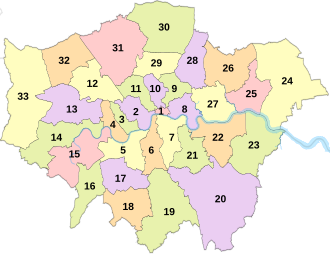


Geographical Mosaic
The 32 London Boroughs, along with the City of London, form the administrative and geographical framework of Greater London. This vast urban area, situated in the Thames Valley in South East England, exhibits significant geographical diversity. From the densely populated, historically rich inner boroughs like Westminster and Camden, characterized by iconic landmarks and high-rise development, to the more suburban outer boroughs such as Bromley and Havering, featuring extensive green belts and lower population densities, the landscape varies dramatically.
The River Thames acts as a central artery, influencing the development and connectivity of many boroughs. London's climate is temperate maritime, with mild winters, warm summers, and rainfall distributed throughout the year, though often perceived as more frequent due to its persistent cloud cover. This geographical variation impacts everything from housing types and transportation networks to local economies and community identities within each borough.
Evolution of Governance
The concept of London's administrative divisions has evolved over centuries. Initially, the area was governed by a patchwork of ancient parishes and local authorities. The creation of the County of London in 1889 was a significant step towards centralized governance, but it didn't encompass the entire growing metropolis.
The modern system of 32 London Boroughs was established in 1965 under the London Government Act 1963, consolidating numerous smaller local government districts into larger, more uniform units. This reform aimed to create more efficient and effective local administration capable of managing the expanding city's complex needs. The City of London, with its unique historical status, remains a separate entity.
This layered history means that each borough often retains echoes of its past, with distinct historical cores and varying degrees of urban development reflecting their independent origins.
Cultural Tapestry
London's status as a global city is inextricably linked to the immense cultural diversity found within its boroughs. With a population exceeding 8.7 million, it is one of the most multicultural cities on Earth, boasting over 300 languages and a rich array of ethnicities and nationalities. This diversity is not uniformly distributed; certain boroughs are renowned for specific diasporic communities, creating vibrant cultural enclaves.
For instance, areas like Brent are celebrated for their South Asian heritage, while Hackney has a strong Caribbean influence. This cultural richness manifests in diverse culinary scenes, religious institutions, festivals, and artistic expressions. The interplay between these diverse communities shapes London's unique identity, fostering innovation and cross-cultural exchange, making it a dynamic hub of global culture.
Economic Engines
The economic landscape of London's boroughs is a complex ecosystem supporting its position as a leading global financial and service center. While central boroughs like the City of London and Westminster are dominated by finance, insurance, and professional services, other boroughs host significant economic activity in different sectors. Tower Hamlets, for example, is home to Canary Wharf's financial district but also has a growing tech scene.
Outer boroughs often have a mix of retail, light industry, and residential populations that commute to central areas. The creative industries, technology, tourism, and education are significant employers across many boroughs. The interconnectedness of these economies, facilitated by London's extensive transport network, allows for specialized economic development within individual boroughs while contributing to the overall strength of the Greater London economy.
Governance and Civic Life
The governance of London is a multi-layered system comprising the Greater London Authority (GLA) and the individual borough councils. Each of the 32 London Boroughs operates with its own elected council, responsible for delivering a wide array of local public services, including education, social care, waste management, housing, and local planning. These councils are the primary interface between residents and local government.
The GLA, headed by the directly elected Mayor of London, focuses on strategic issues affecting the entire city, such as transport (Transport for London), policing (Metropolitan Police Service), and strategic planning. This dual system allows for both localized responsiveness to community needs and coordinated strategic direction for the metropolis as a whole, navigating the complexities of managing such a large and diverse urban area.
Educational Landscapes
London's boroughs provide a comprehensive educational infrastructure catering to a diverse student population. Each borough council is responsible for managing state-funded primary and secondary schools within its boundaries, ensuring access to education for all children. The quality and specialization of these schools can vary, leading to significant differences in educational outcomes across boroughs.
Beyond compulsory education, London is a global center for higher education, hosting numerous world-renowned universities and colleges spread across various boroughs. Institutions like University College London (UCL) in Camden, King's College London with campuses in several boroughs, and the London School of Economics (LSE) in Westminster attract students from around the globe. This concentration of educational institutions, from local schools to elite universities, makes London a vital hub for knowledge creation and dissemination.
Go deeper
Frequently Asked Questions
What are London boroughs?+
Why are some boroughs called inner and others outer?+
How does the River Thames affect London boroughs?+
What makes London a very diverse city?+
When were the 32 boroughs created?+
Based on content from Wikipedia · Licensed under CC BY-SA 4.0