

University College London
Images

File:Portico and steps, University College, London - geograph.org.uk - 364428.jpg


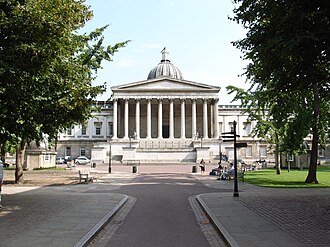

Founding Principles and Evolving Status
Established in 1826 as London University, UCL was born from radical Enlightenment ideals, notably influenced by Jeremy Bentham. Its founders envisioned a modern, accessible institution, breaking from the religious exclusivity of Oxford and Cambridge. UCL was England's first university to be entirely secular and to admit students irrespective of their religious background, a groundbreaking move that challenged the status quo.
It was also among the first to admit women on equal terms with men in 1878. Despite its progressive origins, political realities led it to become a college within the federal University of London in 1836, a status it held for over 150 years before achieving de facto university recognition in the 1990s and formal university status in 2023. This evolution reflects a continuous adaptation to societal changes and academic advancements, solidifying its position as a leading independent university.
The UCL Ecosystem
UCL's primary campus is strategically located across the central London districts of Bloomsbury and St Pancras, a hub for academic and cultural exchange. However, its reach extends far beyond this core, encompassing numerous specialized institutes and teaching hospitals throughout London, fostering interdisciplinary collaboration and real-world application of knowledge. A significant expansion has occurred with the establishment of UCL East at Queen Elizabeth Olympic Park in Stratford, East London.
This new campus represents a forward-looking investment in innovation and community engagement. The university is structured into 11 constituent faculties, housing over 100 departments, institutes, and research centers, creating a vast and interconnected network of academic disciplines. UCL also curates significant museum collections, including the Petrie Museum of Egyptian Archaeology and the Grant Museum of Zoology, enriching the academic and public experience.
Pioneering Research and Enduring Global Influence
UCL is a formidable force in global research, consistently ranked among the world's top universities. Its academic staff and alumni boast an extraordinary record of achievement, including 33 Nobel Prize laureates and three Fields Medalists. Landmark discoveries associated with UCL include five naturally occurring noble gases, the fundamental understanding of hormones, the invention of the vacuum tube, and foundational advances in modern statistics. The university's research output is substantial, with £538.8 million from research grants and contracts in 2023/24 alone.
This research, alongside the knowledge dissemination through initiatives like UCL Press and UCL Business, generates an estimated £10 billion annually for the UK economy, underscoring its critical role in national prosperity and innovation. Its membership in prestigious groups like the Russell Group and the League of European Research Universities highlights its commitment to academic excellence and collaborative advancement.
A Diverse Community
The tapestry of individuals associated with UCL is remarkably diverse and influential. Its alumni have shaped nations and industries, including the founder of Mauritius and the first prime minister of Japan. In the realm of science, UCL alumni were instrumental in co-discovering the structure of DNA, a pivotal moment in biological understanding.
Culturally, the university's influence extends to the arts, with members of the globally renowned band Coldplay being notable alumni. This broad spectrum of achievement demonstrates UCL's capacity to foster talent across a wide array of fields, producing individuals who not only excel academically but also leave an indelible mark on society, politics, science, and culture worldwide.
Go deeper
Frequently Asked Questions
What is University College London?+
Why was UCL started?+
Where is UCL's main campus?+
How many Nobel prizes are linked to UCL?+
What new campus did UCL open?+
Based on content from Wikipedia · Licensed under CC BY-SA 4.0