

Lagash: A Super Old City!
Images

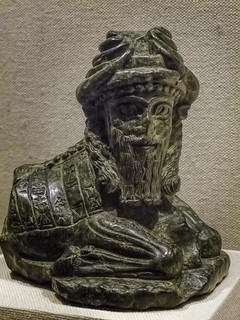
Ur-Ningirsu ruler of Lagash portrait circa 2110 BCE




The Genesis of Urbanism
Lagash, an ancient city-state situated in southern Mesopotamia, emerged as a significant power in the region around the 4th millennium BCE. Its strategic location, northwest of the confluence of the Euphrates and Tigris rivers and east of the prominent city of Uruk, provided fertile ground for agricultural development and facilitated trade routes. The Lagash state was not a monolithic entity but a complex aggregation of urban centers, most notably the primary city of Lagash itself (modern Al-Hiba), the crucial religious and administrative hub of Girsu (modern Telloh), and the southern city of Nina (modern Tell Zurghul).
This hierarchical structure, with Girsu serving as the spiritual and likely economic core, housing the monumental E-ninnu temple dedicated to the god Ningirsu, exemplifies the sophisticated organization characteristic of early Sumerian civilization. The incorporation of these distinct settlements into a unified state highlights early attempts at regional governance and resource management, laying groundwork for future Mesopotamian polities.
The E-ninnu Temple
The E-ninnu temple in Girsu stands as a testament to the profound integration of religion and state power in Lagash. Dedicated to Ningirsu, a principal deity of the Lagash pantheon, this temple was far more than a place of worship; it was the socio-economic and political heart of the state. Archaeological evidence suggests that temples in ancient Mesopotamia often functioned as major landholders, employers, and centers for redistribution of goods.
The E-ninnu, as the primary religious edifice, would have been instrumental in legitimizing the ruling elite, organizing labor for public works, and managing agricultural surplus. Its grandeur and central role reflect the Sumerian worldview, where divine favor was paramount to the prosperity and stability of the city-state. The existence of such a monumental structure underscores Lagash's advanced architectural capabilities and its deep-seated religious convictions.
Lagash's Enduring Significance
The historical importance of Lagash cannot be overstated; it represents one of the earliest and most enduring examples of a complex urban civilization. As one of the oldest cities in the Ancient Near East, Lagash provided a foundational model for subsequent Mesopotamian city-states and beyond. Its sophisticated administrative structure, encompassing multiple settlements with specialized functions, demonstrated an advanced capacity for governance and social organization.
The development of its religious institutions, epitomized by the E-ninnu temple, illustrates the critical role of religion in unifying populations, legitimizing authority, and shaping cultural identity. Studying Lagash offers invaluable insights into the origins of urbanism, state formation, and the complex interplay between religious belief, economic activity, and political power that characterized the dawn of human civilization. Its legacy is etched in the very foundations of societal development.
From Ancient Ruins to Modern Understanding
The contemporary understanding of Lagash is almost entirely derived from extensive archaeological excavations conducted at sites like Al-Hiba and Telloh. These investigations have unearthed a wealth of information, including architectural remains, administrative texts written in cuneiform, and artifacts that illuminate the daily lives, economic practices, and religious beliefs of its inhabitants. The decipherment of cuneiform tablets has provided direct access to the administrative and economic workings of the Lagash state, revealing details about land ownership, labor organization, and temple economies.
The physical remains of the E-ninnu temple and other structures offer tangible evidence of their architectural prowess and urban planning. Through these archaeological endeavors, Lagash transforms from a forgotten name into a vivid historical entity, allowing us to reconstruct and appreciate the complexities of one of humanity's earliest urban experiments and its lasting impact on the trajectory of civilization.
Go deeper
Frequently Asked Questions
What is Lagash?+
Where was Lagash located?+
Why was the E‑ninnu temple so special?+
How did Lagash influence later city-states?+
How do we know about Lagash today?+
Based on content from Wikipedia · Licensed under CC BY-SA 4.0