

Uruk: The Super City of Ancient Times!
Images

Limestone foundation peg of Lugal-kisal-si, from Uruk, Iraq. C. 2380 BCE. Pergamon Museum




The Emergence of Uruk
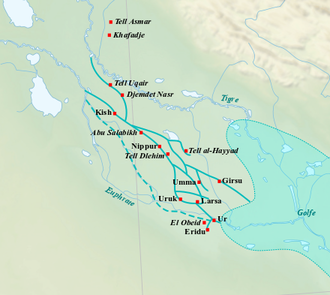
Uruk, situated in southern Mesopotamia along the Euphrates River, stands as a monumental testament to the dawn of urbanism. Flourishing from the Uruk period (c. 4000–3100 BCE), it transitioned from a modest settlement to one of the largest and most influential cities of the ancient world, with estimates of its peak population ranging from 50,000 to over 100,000 inhabitants. This unprecedented scale necessitated sophisticated social, economic, and political organization.
The development of monumental architecture, such as the Eanna precinct dedicated to the goddess Inanna and the Anu ziggurat, required immense labor coordination and resource management. These structures were not merely religious sites but also served as administrative and economic hubs, reflecting a complex interplay between divine authority and civic power. The city's expansion also spurred advancements in irrigation and agricultural techniques to support its burgeoning population, laying the foundation for subsequent Mesopotamian civilizations.
Cuneiform
Perhaps Uruk's most enduring legacy is the invention of cuneiform, the earliest known system of writing, emerging around 3200 BCE. Initially pictographic, it evolved into a complex system of wedge-shaped impressions on clay tablets, used for a vast array of purposes. The primary driver for its development appears to have been administrative and economic necessity.
Early cuneiform tablets are replete with records of goods, labor, and transactions, indicating that writing was crucial for managing the complex economy of a large urban center like Uruk. This innovation facilitated the administration of resources, the codification of laws, the dissemination of knowledge, and the preservation of historical and literary traditions. The ability to record and transmit information across time and space fundamentally altered human cognitive processes and societal structures, enabling the development of more complex governance and cultural expression.
Socio-Economic Structures and Ideological Frameworks
The societal structure of Uruk was characterized by a pronounced hierarchy, with a priestly class and ruling elite at the apex, overseeing the vast economic and religious activities. The monumental temples were central to this structure, acting as redistributory centers for agricultural surplus and as focal points for ideological cohesion. The elaborate iconography and monumental scale of Uruk's architecture served to reinforce the power of the ruling elite and the divine order they represented.
The development of specialized crafts, such as pottery production (evidenced by the mass production of standardized bevel-rimmed bowls) and metalworking, further contributed to the city's economic complexity and social stratification. Uruk's influence extended far beyond its physical boundaries, with evidence of its material culture and administrative practices found throughout Mesopotamia, suggesting a significant degree of cultural and economic hegemony.
Uruk's Enduring Influence on Civilization
The innovations born in Uruk reverberated through millennia, shaping the trajectory of human civilization. The very concept of the city as a locus of power, culture, and economic activity was profoundly influenced by Uruk's model. Its pioneering work in writing laid the groundwork for all subsequent alphabetic and syllabic scripts, revolutionizing human communication and the storage of knowledge.
The administrative and organizational principles developed in Uruk provided blueprints for state formation and governance in subsequent empires. Furthermore, Uruk's advancements in technology, from irrigation to metallurgy, contributed to the broader technological development of early civilizations. Studying Uruk is not merely an academic exercise; it is an exploration of the foundational elements of our modern world, offering insights into the origins of urban living, complex societies, and the power of the written word.
Go deeper
Frequently Asked Questions
What was Uruk and where was it located?+
Why is Uruk famous for writing?+
How did Uruk grow so big?+
Who lived in Uruk and what did they do?+
Did Uruk influence other places?+
Based on content from Wikipedia · Licensed under CC BY-SA 4.0