

Mesopotamia
Images
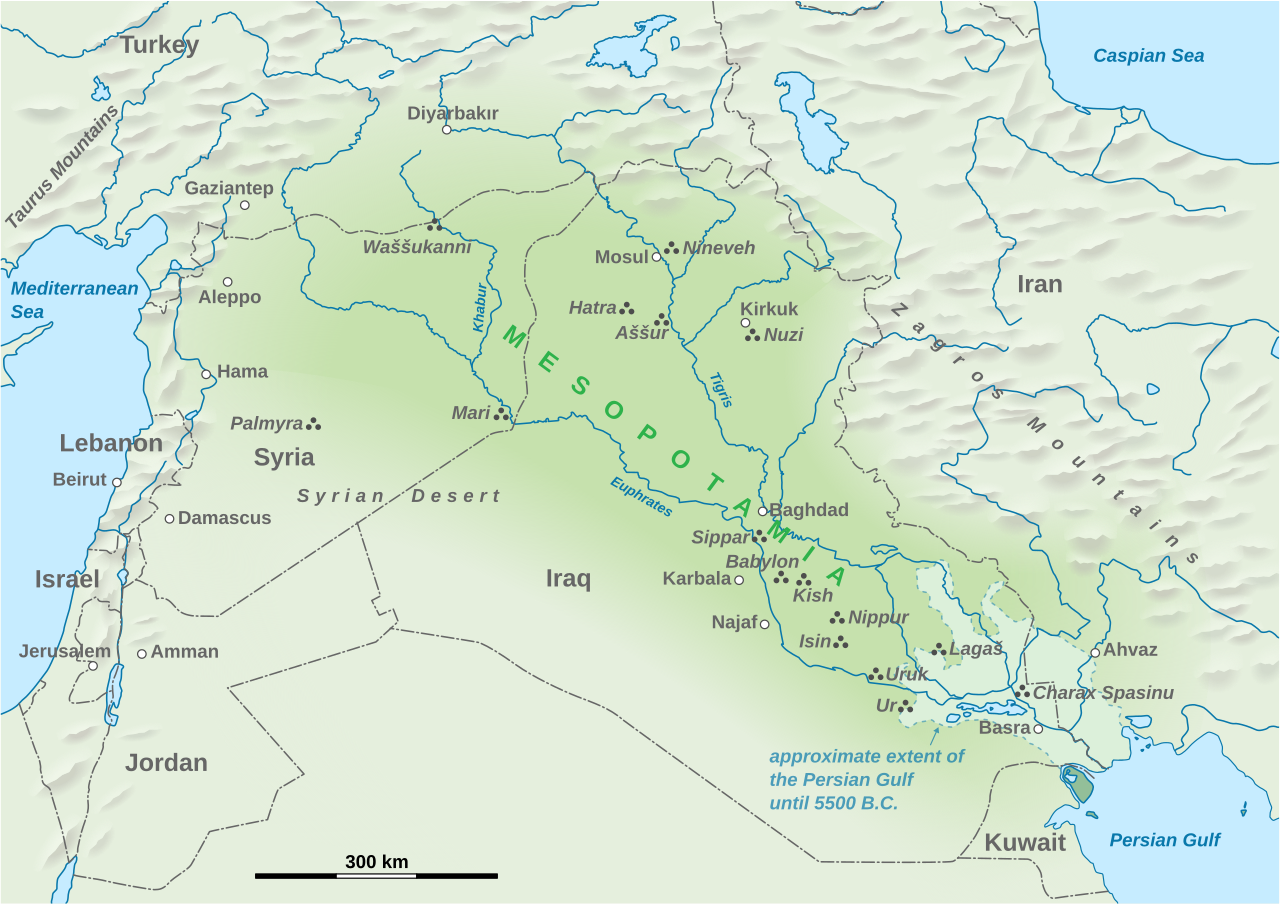
Mesopotamia
The Alluvial Plain
Mesopotamia, derived from the Greek for 'land between the rivers,' refers to the fertile alluvial plain situated between the Tigris and Euphrates rivers, largely corresponding to modern-day Iraq. This geographical setting was instrumental in the development of early complex societies. The rivers provided not only a vital source of water for irrigation, enabling sophisticated agricultural practices like canal building and flood control, but also served as natural transportation routes.
The annual inundation deposited nutrient-rich silt, creating a highly productive agricultural environment. This sustained surplus of food was the bedrock upon which Mesopotamian civilization was built, freeing a significant portion of the population from subsistence farming and allowing for specialization in crafts, administration, religion, and warfare, thus paving the way for urbanization.
The Rise of City-States and Empires
The agricultural surplus generated in Mesopotamia facilitated the emergence of the world's first true cities, such as Uruk, Ur, and Eridu, around the 4th millennium BCE. These were not merely large settlements but independent city-states, each with its own governing structure, religious hierarchy, and economic system. The Sumerians, an early inhabitants, are credited with developing many of these foundational urban structures and social organizations.
Over millennia, these city-states coalesced into larger political entities and empires, including the Akkadian, Babylonian, and Assyrian empires. These empires expanded their influence through military conquest and sophisticated administration, spreading Mesopotamian culture, technology, and ideas across a vast region and leaving a lasting imprint on subsequent Near Eastern civilizations.
Pioneering Innovations
Mesopotamia stands as a testament to human ingenuity, being the origin point for numerous transformative inventions. The invention of the wheel, initially used for pottery and later for transportation (chariots and carts), fundamentally altered logistics and commerce. Perhaps most significantly, Mesopotamians developed cuneiform, one of the earliest known systems of writing, around the late 4th millennium BCE.
This system, employing wedge-shaped marks impressed on clay tablets, allowed for detailed record-keeping, the transmission of literature, and the codification of laws. The Code of Hammurabi, dating to the 18th century BCE, is a prime example, representing a comprehensive legal framework that influenced judicial systems for centuries. Their contributions also extended to mathematics, with the development of a sexagesimal (base-60) number system, and astronomy, with detailed celestial observations and the creation of early calendars.
Enduring Legacies
The impact of Mesopotamian civilization resonates profoundly in the modern world. Their innovations in agriculture, urban planning, and governance provided foundational models for subsequent societies. The concept of organized religion, with elaborate temple complexes like ziggurats, and the development of complex bureaucracies were crucial steps in societal evolution.
Furthermore, their advancements in mathematics, particularly the base-60 system, directly influence our measurement of time (60 seconds/minute, 60 minutes/hour) and angles. The very notion of codified law, establishing societal norms and justice, has roots in Mesopotamian legal traditions. By studying Mesopotamia, we gain critical insights into the origins of many of our own societal structures, scientific principles, and technological advancements, underscoring its status as a true cradle of civilization.
Go deeper
Frequently Asked Questions
Where was Mesopotamia located?+
What made Mesopotamia a good place for farming?+
What are some inventions that came from Mesopotamia?+
What was the Code of Hammurabi?+
What were the first cities in Mesopotamia?+
Based on content from Wikipedia · Licensed under CC BY-SA 4.0