

Kingdom of Romania
Images

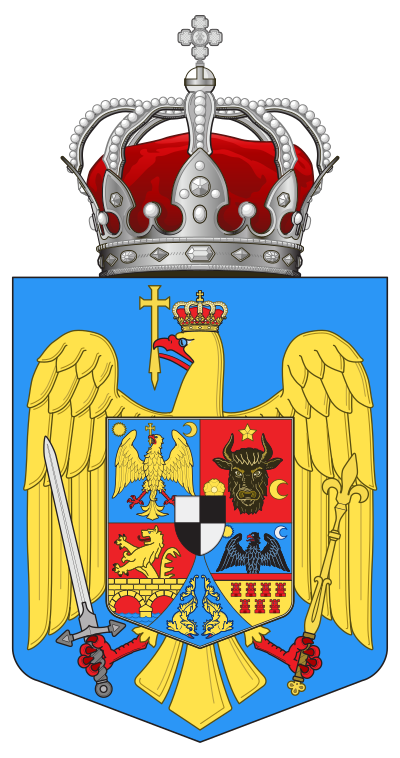
Kingdom of Romania Coat of Arms Big 1881-1921




Forging a Nation
The genesis of the Kingdom of Romania lies in the strategic unification of the principalities of Moldavia and Wallachia, initially under a personal union governed by a single prince. This foundational step, often termed 'The Little Union,' began in 1859 and laid the groundwork for a unified Romanian state. The subsequent decades were marked by efforts to consolidate this union and assert greater autonomy.
The pivotal moment arrived in 1881 with the coronation of Prince Karl of Hohenzollern-Sigmaringen as King Carol I. This act formally established the Kingdom of Romania, transforming it from an autonomous principality into a full-fledged monarchy. This period, from 1881 to 1914, is often referred to as the 'Romanian Old Kingdom,' a distinct territorial and political entity that navigated the complex geopolitical landscape of late 19th and early 20th century Europe, seeking to modernize and secure its position.
Independence, Expansion, and the Dream of Greater Romania
Romania's quest for genuine sovereignty culminated in the Russo-Turkish War of 1877-1878, locally recognized as the Romanian War of Independence. Emerging victorious from this conflict against the Ottoman Empire, Romania achieved full independence. However, this triumph came with territorial concessions; southern Bessarabia was ceded in exchange for Northern Dobruja.
The most significant territorial expansion occurred in the aftermath of World War I. The dissolution of empires and the principle of self-determination allowed Romania to incorporate vast territories, including Bessarabia, Banat, Bukovina, and Transylvania. This expansion created 'Greater Romania,' a significantly larger and more populous state, fundamentally altering the ethnic and political map of Eastern Europe and fulfilling a long-held national aspiration, though it also introduced new internal challenges and minority issues.
Interwar Instability and the Shadow of World War II
The interwar period was characterized by political volatility and the consolidation of the 'Greater Romania' state. In 1938, King Carol II attempted to centralize power by abolishing the 1923 constitution, ushering in a brief period of absolute monarchy. This move proved short-lived, as political and military pressures led to his forced abdication in 1940.
A military dictatorship was established under Ion Antonescu, with his son, King Michael I, assuming the throne as a figurehead. The country's name was altered to Legionary Romania, reflecting the influence of far-right movements. Romania's alignment with the Axis powers during World War II proved disastrous.
Facing military defeats and territorial losses under duress from Nazi Germany and the Soviet Union, the kingdom's future hung precariously in the balance.
The King's Coup, Shifting Alliances, and the End of the Monarchy
A dramatic turning point occurred in August 1944 when King Michael I, with the support of various political factions, orchestrated a coup against Ion Antonescu. This bold action led to Romania's immediate switch from the Axis to the Allied powers. The country played a role in the liberation of territories, including the recovery of Northern Transylvania.
The Kingdom of Romania was re-established as a constitutional monarchy, albeit under the shadow of the advancing Soviet army. The post-war years saw the increasing influence of the Soviet Union and the rise of Communist-dominated coalition governments. Despite attempts to maintain a semblance of democratic governance, the political landscape was irrevocably shaped by Soviet hegemony.
Ultimately, the monarchy was abolished on December 31, 1947, with King Michael I forced to abdicate. Romania was proclaimed the People's Republic of Romania, transitioning into a Soviet satellite state and marking the definitive end of its monarchical era.
See also
Based on content from Wikipedia · Licensed under CC BY-SA 4.0