

Joan Baez
Images

Bob Dylan and Joan Baez perform at March on Washington


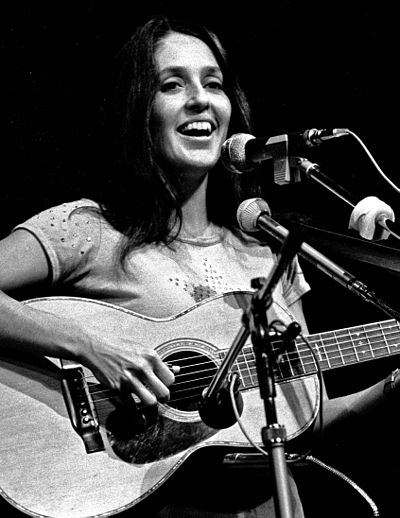


The Genesis of a Folk Icon and Activist
Born on January 9, 1941, in New York City, Joan Chandos Baez emerged as a pivotal figure in the American folk music scene of the early 1960s. Her distinctive, pure soprano voice and her commitment to social justice quickly set her apart. Baez's early career was marked by an almost immediate ascent to prominence.
Her first three albums-'Joan Baez' (1960), 'Joan Baez, Vol. 2' (1961), and 'Joan Baez in Concert' (1962)-all achieved gold record status, a rare feat that underscored her immense popularity and the profound connection audiences felt with her music. While she is a songwriter, Baez is renowned for her interpretive skills, breathing new life into traditional ballads and contemporary compositions. A significant aspect of her early career was her role in popularizing the work of Bob Dylan.
Baez was among the first major artists to record Dylan's songs, effectively introducing his nascent songwriting talent to a broader audience and contributing significantly to his eventual global recognition. This artistic synergy, though marked by personal complexities, became a defining narrative of the era's music scene.
Music as a Catalyst for Societal Transformation
Joan Baez's artistic output is inseparable from her lifelong dedication to activism. Her music has consistently served as a powerful vehicle for protest and advocacy, addressing critical issues such as civil rights, nonviolence, human rights, and environmentalism. Her performance at the 1969 Woodstock Festival, where she delivered fourteen songs, stands as a monumental moment, symbolizing her role as a voice for a generation seeking change.
Baez has consistently used her platform to champion causes, performing at countless rallies, marches, and benefit concerts. Her rendition of 'We Shall Overcome' became an unofficial anthem of the Civil Rights Movement, embodying the struggle for equality and justice. Her unwavering commitment to peaceful resistance and her willingness to confront injustice through her art have made her an enduring symbol of moral courage and a profound inspiration for activists and artists worldwide.
She has demonstrated that artistic expression can be a potent force in shaping public discourse and driving societal progress.
A Vast Repertoire and Enduring Influence
Baez's discography, spanning over 30 albums, showcases an extraordinary breadth of musical exploration. While her roots are firmly planted in folk, her music has evolved to encompass genres such as folk rock, pop, country, and gospel. Her talent for interpretation is a cornerstone of her legacy.
She has recorded songs by an eclectic array of artists, including Woody Guthrie, Pete Seeger, Leonard Cohen, The Beatles, Bob Marley, and Stevie Wonder, as well as more contemporary figures like Ryan Adams, Natalie Merchant, and Joe Henry. Her recordings of songs like 'Diamonds & Rust' (her own composition), Phil Ochs's 'There but for Fortune,' and The Band's 'The Night They Drove Old Dixie Down' are considered definitive by many.
By championing these diverse works, Baez has not only expanded her own musical landscape but has also played a crucial role in preserving and disseminating important musical narratives, solidifying her position as a vital curator and interpreter of American music.
Recognition, Legacy, and Contemporary Relevance
Joan Baez's contributions to music and activism have been widely recognized. Her induction into the Rock and Roll Hall of Fame on April 7, 2017, marked a significant acknowledgment of her profound and lasting impact on the music industry. Beyond formal accolades, her legacy is evident in the generations of musicians and activists she has inspired.
Her career, spanning over six decades, is a testament to her artistic integrity and her unwavering commitment to her principles. In an era where social and political engagement is increasingly vital, Baez's example continues to resonate, reminding us of the power of art to challenge norms, foster empathy, and advocate for a more just and compassionate world. Her enduring presence in the cultural landscape serves as a powerful reminder of the artist's role as both entertainer and conscience.
See also
Frequently Asked Questions
What is Joan Baez known for?+
When was Joan Baez born?+
How did Joan Baez help Bob Dylan?+
Why did Joan Baez perform at Woodstock?+
What kinds of music has Joan Baez recorded?+
Based on content from Wikipedia · Licensed under CC BY-SA 4.0