

The Amazing Han Dynasty!
Images

Zhaoxing, village gate



Establishing Imperial Authority
The Han Dynasty (202 BCE – 220 CE) emerged as the successor to the Qin Dynasty, inheriting a unified empire forged through conquest. Founded by Liu Bang (Emperor Gaozu), the Han consolidated Qin's centralized administrative structures while mitigating its harsh legalism, creating a more enduring imperial model. The dynasty's history is bifurcated into the Western Han (202 BCE – 9 CE), with its capital at Chang'an, and the Eastern Han (25–220 CE), centered in Luoyang.
This division highlights shifts in political power and geographic focus. Initially, the Han emperors grappled with the legacy of the Warring States, managing powerful subordinate kingdoms. Over time, the imperial court implemented reforms to curtail the autonomy of these kingdoms, gradually centralizing power.
This process of state-building was crucial for establishing the Han's long-term dominance and laid the foundation for subsequent Chinese imperial governance.
Emperor Wu's Ambitious Policies and Grand Expansion
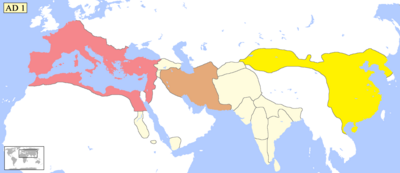
The reign of Emperor Wu (r. 141–87 BCE) represents a pivotal era of expansion and consolidation for the Han Dynasty. Facing persistent threats from the nomadic Xiongnu confederation, Emperor Wu shifted from appeasement policies like the heqin (tributary and royal marriage alliances) to aggressive military campaigns. These efforts significantly weakened the Xiongnu, fractured their federation, and allowed the Han to expand its dominion deep into Central Asia, including the Hexi Corridor and the Tarim Basin.
This territorial expansion was not merely for strategic advantage; it facilitated unprecedented trade and diplomatic relations, extending Han influence as far west as the Arsacid Empire in Mesopotamia. Crucially, this period also saw the introduction of Buddhism into China, marking the beginning of a profound cultural and religious exchange that would shape East Asian civilization for millennia.
Technological and Intellectual Flourishing
The Han Dynasty was a golden age of technological and intellectual advancement. The invention of paper, attributed to Cai Lun around 105 CE (though earlier forms existed), revolutionized literacy, administration, and the dissemination of ideas, replacing cumbersome bamboo slips and silk. Han scholars made significant strides in astronomy, developing sophisticated calendars and seismographs. Metallurgy saw advancements in iron and bronze casting, improving tools and weaponry.
The Han also refined bureaucratic systems, establishing civil service examinations based on Confucian classics. This meritocratic approach, though imperfect, aimed to create a more stable and efficient administration, fostering a shared intellectual and cultural identity across the vast empire and influencing governance models for centuries.
Internal Power Dynamics and the Dynasty's Decline
The Han Dynasty's eventual collapse was precipitated by complex internal power struggles. The influence of consort clans (relatives of empresses) and palace eunuchs grew significantly, leading to factionalism and political instability. The eunuchs, in particular, became deeply entrenched in court politics, even influencing imperial succession, culminating in the violent purge of 189 CE.
This event triggered widespread civil war as regional warlords capitalized on the central government's weakness. The philosophical concept of the 'Mandate of Heaven,' as articulated by scholars like Dong Zhongshu, provided a cosmological framework for dynastic change, suggesting that Heaven withdrew its favor from a failing ruler. By 220 CE, the abdication of the last Han emperor marked the end of the dynasty, ushering in the tumultuous Three Kingdoms period and a fragmentation of imperial authority.
See also
Frequently Asked Questions
What was the Han Dynasty and when did it last?+
Who started the Han Dynasty?+
Why did Emperor Wu expand the Han Empire?+
How did the Han Dynasty change writing?+
What led to the Han Dynasty's collapse?+
Based on content from Wikipedia · Licensed under CC BY-SA 4.0