

Hispanic and Latino Americans
Images

Milwaukee Public School Teachers and Supporters Picket Outside Milwaukee Public Schools Adminstration Building Milwaukee Wisconsin 4-24-18 1155




Navigating Identity
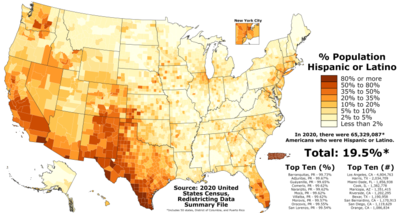
The demographic category of Hispanic and Latino Americans represents the second-largest ethnic group in the United States, comprising approximately 20% of the total population, or over 68 million individuals as of July 2024. These terms are not monolithic; they encompass a vast array of national origins, cultural practices, and racial backgrounds. 'Hispanic' typically refers to people with origins in Spanish-speaking countries, while 'Latino' or 'Latinx' generally includes people from Latin America, which also encompasses Portuguese-speaking Brazil.
This distinction is crucial, as Brazilians, for instance, are Latin American but not Hispanic. The fluidity of these identities is rooted in the multiracial and multiethnic history of Latin America itself, which includes descendants of Indigenous peoples, European colonizers (primarily Spanish and Portuguese), and Africans brought through the transatlantic slave trade, as well as later immigrants from the Middle East and East Asia.
This complex ancestry means that race and ethnicity are often intertwined in unique ways within these communities, challenging simplistic racial classifications and highlighting a rich tapestry of heritage.
Historical Legacies
The historical presence of Hispanic peoples in what is now the United States predates the formation of the U.S. itself. Spain's colonial empire extended across vast territories, including present-day Florida, California, Arizona, New Mexico, Texas, and other Southwestern states, which were part of the Viceroyalty of New Spain. These regions were colonized and settled by Spaniards, who brought their language, religion, and culture.
Following Mexico's independence from Spain in 1821 and subsequent conflicts like the Mexican-American War, these territories were incorporated into the United States. This historical legacy is evident in place names, legal systems, and cultural traditions still present today. Later waves of migration, particularly from Puerto Rico (a U.S. territory), Cuba following the revolution, and various Central and South American nations facing political and economic instability, have continuously reshaped the demographic landscape and cultural contributions of Hispanic and Latino Americans.
Societal Contributions
Hispanic and Latino Americans have made indelible contributions across the entire spectrum of American society. Their influence is deeply embedded in the nation's cultural, economic, and political spheres. Culturally, they have introduced diverse culinary traditions, vibrant musical genres like salsa, cumbia, and reggaeton, and rich artistic expressions that have become integral to the American mosaic.
Economically, they represent a significant and growing segment of the workforce and consumer market, driving innovation and entrepreneurship. Politically, their increasing numbers and engagement are shaping electoral outcomes and policy debates. The Spanish language, spoken by a substantial portion of the population, serves as a vital cultural bridge and influences communication and media within the U.S.
Their resilience, community ties, and advocacy for social justice continue to enrich and challenge the American narrative.
A Spectrum of Origins
The pan-ethnic label 'Hispanic and Latino American' encompasses a wide range of national origins, each with its unique history and cultural nuances. The largest national origin groups in the U.S. are Mexicans, Puerto Ricans, and Cubans. However, significant and growing populations also hail from countries such as El Salvador, the Dominican Republic, Colombia, Guatemala, Honduras, Ecuador, Peru, and Venezuela.
The specific origins of Hispanic and Latino populations vary considerably by region within the United States; for example, Mexican Americans are concentrated in the Southwest, while Puerto Ricans have a strong presence in the Northeast. This diversity means that experiences and cultural expressions can differ significantly, even within the broader Hispanic or Latino identity. Understanding these distinctions is key to appreciating the full scope of this vibrant demographic group.
Demographic Dynamics and Future Trends
The Hispanic and Latino population is not only large but also one of the fastest-growing demographic groups in the United States, second only to Asian Americans in percentage growth in recent years. This sustained growth has significant implications for the nation's future social, economic, and political landscape. As this population continues to expand and diversify, its influence on American culture, language, and institutions will undoubtedly deepen.
The evolving identities and increasing civic participation of Hispanic and Latino Americans are central to understanding contemporary American society and predicting its trajectory. Their story is an ongoing narrative of adaptation, cultural preservation, and profound impact on the nation's identity.
See also
Based on content from Wikipedia · Licensed under CC BY-SA 4.0