

Helium
Images
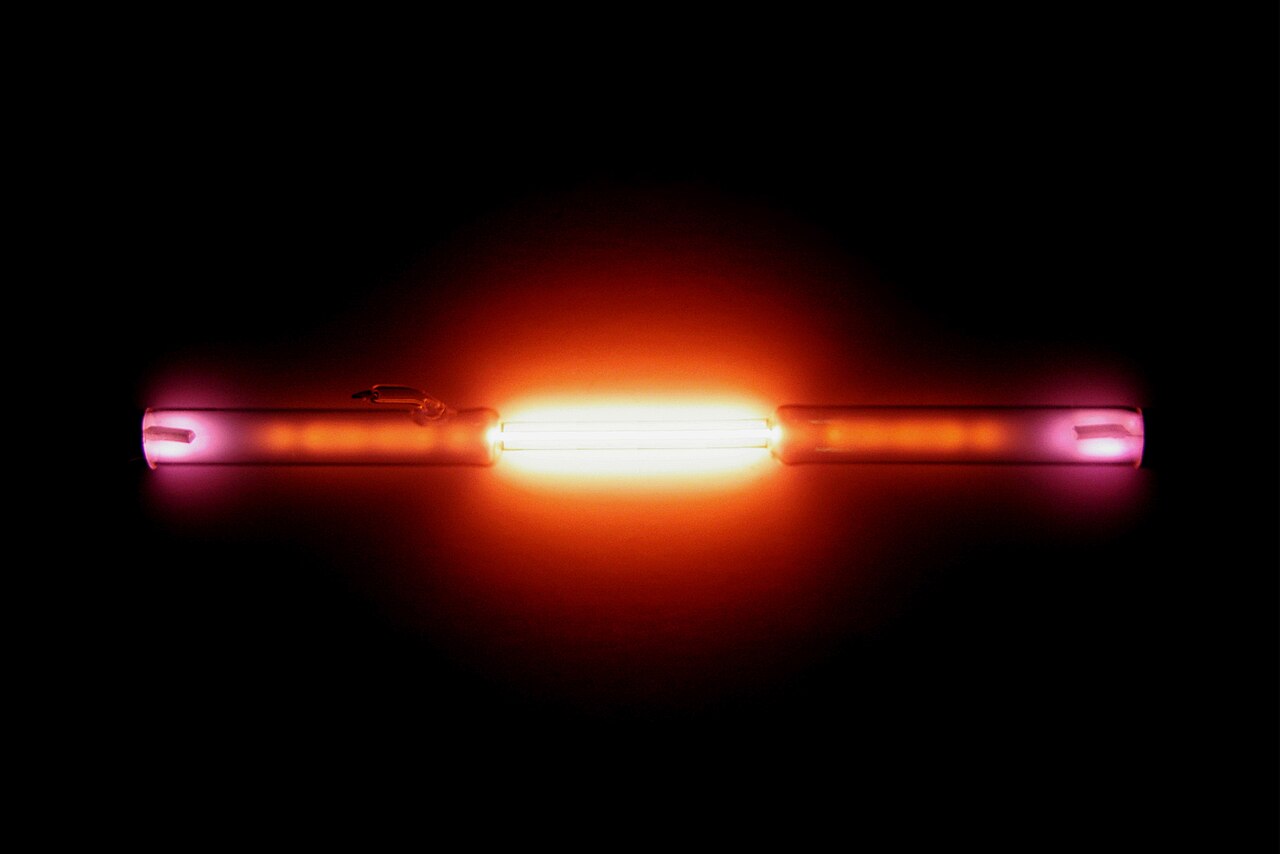
Helium
Cosmic Genesis and Stellar Alchemy
Helium (He, atomic number 2) stands as a cornerstone of cosmic composition, second only to hydrogen in abundance across the observable universe. Its genesis is deeply intertwined with the universe's earliest moments; a significant portion of terrestrial helium originated during Big Bang nucleosynthesis, forming within the first few minutes after the universe's inception. The remaining cosmic helium is continuously produced through nuclear fusion within stars.
In stellar cores, immense gravitational pressure forces hydrogen nuclei (protons) to fuse, creating helium nuclei and releasing vast quantities of energy that power stars. This fusion process, particularly the creation of the exceptionally stable helium-4 isotope, is a primary driver of stellar evolution and the reason for helium's prevalence in celestial bodies like the Sun and gas giants such as Jupiter. The high nuclear binding energy per nucleon in helium-4 relative to the subsequent light elements explains its significant abundance and its role as a product of both stellar fusion and radioactive decay.
The Enigmatic Inertness of Noble Gases
Helium's classification as a noble gas (Group 18) is central to its unique chemical behavior. Possessing a full valence electron shell (1s²), helium exhibits extreme stability and a profound lack of reactivity. This inertness makes it invaluable in applications requiring a non-reactive atmosphere.
In arc welding, helium acts as a shielding gas, preventing oxidation and contamination of the molten metal. It is also critical in semiconductor manufacturing for creating ultra-pure environments necessary for growing silicon crystals. Unlike many other elements, helium does not readily form compounds, a characteristic that simplifies its use in sensitive industrial and scientific processes.
However, this inertness also means that once helium escapes Earth's atmosphere, it is lost to space, as it does not react to form compounds that could trap it, contributing to its status as a finite resource on our planet.
Cryogenic Marvels and Technological Linchpins
Helium's extremely low boiling point, the lowest of all elements (-268.93 °C or -452.07 °F), makes it indispensable for cryogenic applications. Liquid helium is the primary coolant for superconducting magnets, which are essential components in Magnetic Resonance Imaging (MRI) scanners, used extensively in medical diagnostics. The ability of these magnets to generate powerful magnetic fields without electrical resistance relies on maintaining temperatures near absolute zero, a feat achieved using liquid helium.
Beyond medical technology, liquid helium is crucial in particle accelerators, fusion research (like tokamaks), and various scientific instruments that require ultra-low temperatures to operate or to study quantum phenomena such as superfluidity. The unique two-fluid phases of helium-4 (Helium I and Helium II) provide researchers with a unique system to explore quantum mechanics at macroscopic scales.
Terrestrial Scarcity and Extraction Challenges
While abundant in the cosmos, helium is relatively scarce in Earth's atmosphere (about 5.2 parts per million). The vast majority of terrestrial helium is radiogenic, produced by the alpha decay of heavy radioactive elements like uranium and thorium deep within the Earth's crust. These alpha particles, essentially helium nuclei, become trapped in geological formations alongside natural gas deposits. Commercial extraction involves fractional distillation of natural gas at extremely low temperatures to separate helium from other gases.
This process is energy-intensive and relies on the presence of significant helium concentrations in gas fields, primarily found in the United States. Because helium is not replenished on geological timescales once it escapes the atmosphere, it is considered a non-renewable resource. Concerns about dwindling reserves are driving research into more efficient extraction methods and potential alternative applications.
The Ephemeral Voice and Future Prospects
The temporary alteration of vocal timbre upon inhalation of helium is a well-known, albeit minor, application. By decreasing the density of the medium through which sound waves travel in the vocal tract, helium causes a temporary shift towards higher resonant frequencies, resulting in a higher-pitched voice. While this effect is often demonstrated playfully, it highlights helium's unique physical properties.
Looking forward, the diminishing supply of terrestrial helium poses significant challenges for industries reliant on its cryogenic and inert properties. Research is ongoing to explore helium recovery from waste streams, optimize extraction from lower-concentration sources, and potentially develop alternative cooling technologies. The strategic importance of helium underscores the need for careful resource management and continued scientific innovation.
Go deeper
Based on content from Wikipedia · Licensed under CC BY-SA 4.0