

Noble Gas
Images
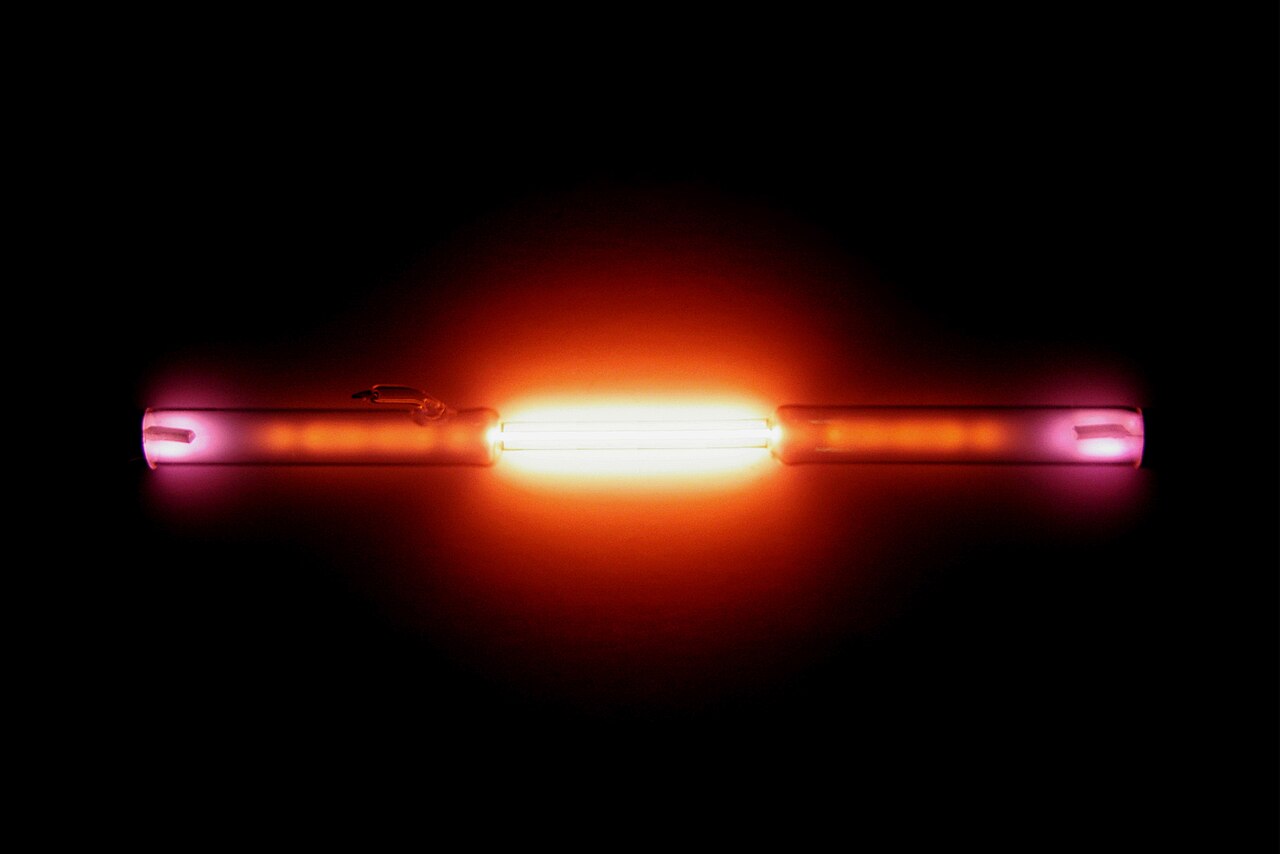
Noble gas


The Enigmatic Stability of Group 18
The noble gases, comprising helium (He), neon (Ne), argon (Ar), krypton (Kr), xenon (Xe), radon (Rn), and the synthetic oganesson (Og), occupy Group 18 of the periodic table. Under standard temperature and pressure (STP), the first six are characterized by their gaseous state, lack of color and odor, monatomic nature, and exceptionally low chemical reactivity. This inertness is a direct consequence of their electron configurations, specifically the complete filling of their outermost valence electron shells (ns²np⁶, except for helium's 1s²).
This stable configuration means they possess high ionization energies and negligible electron affinities, rendering them thermodynamically unfavorable for participating in chemical reactions. Historically termed 'inert gases,' their low intermolecular forces (primarily weak London dispersion forces) result in very low boiling points, all below 165 K (−108 °C). While oganesson's properties are largely theoretical due to its extreme instability (half-life of milliseconds), relativistic effects are predicted to potentially alter its chemical behavior, possibly making it reactive and even solid under STP.
Industrial Production and Natural Occurrence
The industrial-scale production of noble gases (excluding radon) relies heavily on cryogenic air separation. Air is liquefied by cooling and compression, followed by fractional distillation. Each noble gas has a distinct boiling point, allowing for their separation as the liquid air is gradually warmed.
Helium, however, is primarily sourced as a byproduct of natural gas extraction, often found trapped in underground reservoirs. Its abundance on Earth is relatively low compared to other noble gases, largely due to its low molecular weight causing it to escape Earth's atmosphere. Radon, a radioactive element, is typically isolated from the radioactive decay chains of uranium, thorium, or radium found in certain mineral ores.
Its isolation is a more specialized process due to its radioactivity and short half-life, making it less common in industrial applications compared to helium, neon, and argon.
Critical Roles Driven by Inertness and Physical Properties
The very inertness that defines noble gases makes them indispensable in numerous technological and industrial applications where chemical stability is paramount. Argon is widely used as a shielding gas in arc welding processes like TIG and MIG welding, preventing atmospheric contamination of the molten metal. It also serves as a filler gas in incandescent light bulbs, extending filament life by preventing oxidation.
Helium's unique properties, including its low density and non-flammability, make it ideal for inflating balloons, airships (blimps), and weather balloons. Its extremely low boiling point (−269 °C) also makes it an essential cryogenic coolant for superconducting magnets in MRI scanners and particle accelerators. Neon is famous for its use in vibrant lighting displays, producing a characteristic reddish-orange glow when an electric current passes through it. Krypton and xenon find applications in high-intensity discharge lamps, lasers, and specialized photographic flashes due to their unique spectral emissions.
The Frontier of Noble Gas Chemistry and Oganesson
Despite their historical reputation for inertness, a limited number of noble gas compounds have been synthesized, primarily involving the larger, more polarizable elements like krypton and xenon reacting with highly electronegative elements such as fluorine and oxygen. These compounds, like XeF₂, XeF₄, and HXeI, were groundbreaking discoveries that challenged the established understanding of noble gas chemistry. The synthesis of oganesson (Og, element 118) represents the cutting edge of element discovery.
As a superheavy synthetic element, its existence is fleeting, with only a handful of atoms detected. Theoretical calculations suggest that relativistic effects, which become significant for heavy elements, may cause oganesson to deviate from the trends observed in lighter noble gases. It is predicted to potentially be a solid at STP and exhibit some degree of chemical reactivity, blurring the lines of what defines a 'noble' gas and opening new avenues for theoretical chemistry research.
Go deeper
Frequently Asked Questions
What makes noble gases so unreactive?+
How do we get noble gases from the air?+
Why is helium used for balloons and MRI machines?+
Which noble gas is used in welding and light bulbs?+
Are there any compounds made from noble gases?+
Based on content from Wikipedia · Licensed under CC BY-SA 4.0