

Greenland Ice Sheet
Images

Greenland ice sheet


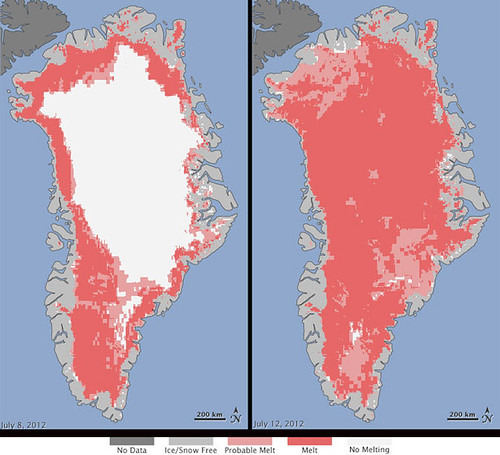

The Greenland Ice Sheet
The Greenland ice sheet is the second-largest ice body in the world, surpassed only by the Antarctic ice sheet. Covering approximately 1.71 million square kilometers, it represents about 80% of Greenland's landmass. Its average thickness is around 1.5 kilometers, but in some central regions, it can exceed 3 kilometers.
This colossal volume of ice exerts significant pressure on the Earth's crust, causing isostatic depression, where the landmass is pushed downwards. The ice sheet is not a static entity but a dynamic system, constantly accumulating snow at higher elevations and losing mass through melting and iceberg calving at its margins. Its sheer scale makes it a dominant feature of the Arctic landscape and a crucial player in global climate regulation.
Chronicles of the Ice
The formation of the Greenland ice sheet began approximately 2.6 million years ago, coinciding with the onset of the Pleistocene epoch and the intensification of Northern Hemisphere glaciation. Over millions of years, persistent cold temperatures and high precipitation allowed snow to accumulate and compact into ice. This process created a vast reservoir of frozen water.
Deep ice cores extracted from the ice sheet provide invaluable paleoclimate data. These cores contain trapped air bubbles, dust particles, and isotopic signatures that reveal detailed records of past atmospheric composition, temperature fluctuations, and volcanic activity, offering a window into Earth's climate history spanning hundreds of thousands of years.
Global Significance
The Greenland ice sheet holds a substantial portion of Earth's freshwater, estimated to be about 8% of the total. If it were to melt entirely, global sea levels would rise by approximately 7 meters (23 feet). This potential for significant sea level rise makes the ice sheet a critical factor in assessing future climate change impacts on coastal populations and ecosystems worldwide.
Furthermore, the ice sheet plays a role in global climate feedbacks. Its bright, reflective surface (albedo) helps cool the planet by reflecting solar radiation. As the ice melts and is replaced by darker land or ocean, more solar energy is absorbed, creating a positive feedback loop that accelerates warming.
Dynamics of Ice Flow and Mass Balance
The Greenland ice sheet is characterized by a slow, continuous flow of ice from its interior towards the coast, driven by gravity. This ice flow is not uniform; it is channeled by subglacial topography and influenced by meltwater lubrication at the bed. The ice sheet's mass balance, the difference between accumulation (snowfall) and ablation (melting and calving), is a key indicator of its health.
In recent decades, accelerated melting and increased iceberg calving rates have led to a net loss of mass from the ice sheet, contributing significantly to observed sea level rise. Understanding these complex dynamics is crucial for accurate climate modeling.
Contemporary Challenges and Future Projections
The Greenland ice sheet is currently experiencing unprecedented rates of melting and mass loss, directly linked to rising global temperatures. This accelerated melt is a stark indicator of anthropogenic climate change. Scientists are closely monitoring its behavior using satellite data, ground-based measurements, and advanced climate models.
Projections suggest that continued warming will lead to further significant ice loss, with potentially irreversible consequences for global sea levels and Arctic ecosystems. The ice sheet serves as a critical sentinel, providing tangible evidence of our planet's changing climate and underscoring the urgency of global mitigation efforts.
Go deeper
Frequently Asked Questions
What is the Greenland ice sheet?+
How does the Greenland ice sheet affect sea level?+
Why is the Greenland ice sheet melting faster now?+
How do scientists learn about past climates from the ice sheet?+
What happens to the land when the ice sheet is so heavy?+
Based on content from Wikipedia · Licensed under CC BY-SA 4.0