

Demetrius I of Macedon
Images

Marble portrait bust of Demetrius I of Macedon (Poliorcetes), Roman copy from 1st century AD of Greek original from 3rd century BC, Naples National Archaeological Museum (25859723352)

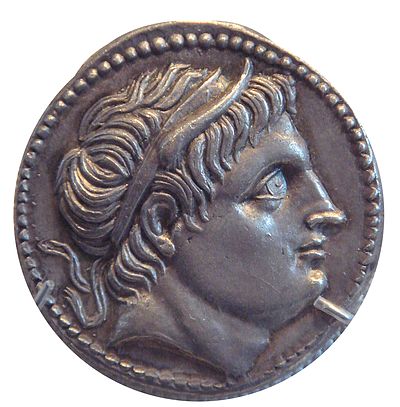


The Legacy of Antigonus and the Rise of a Warrior-Prince
Demetrius I of Macedon, born approximately 336 BCE, emerged from the tumultuous aftermath of Alexander the Great's death as a pivotal figure in the Diadochi wars. As the son of Antigonus I Monophthalmus, one of Alexander's most powerful generals, Demetrius was thrust into a world of constant conflict and political intrigue. His father, Antigonus, sought to establish a unified empire from Alexander's vast territories, and Demetrius was his primary instrument for achieving this goal.
Demetrius was not merely a figurehead; he displayed remarkable military acumen from a young age, demonstrating both personal bravery and strategic insight. His early campaigns, often in partnership with his father, were crucial in consolidating Antigonid power against formidable rivals like Ptolemy, Seleucus, and Lysimachus. This period forged Demetrius into a seasoned commander, renowned for his daring tactics and his ability to command the loyalty of diverse forces, setting the stage for his own independent reign and his legendary engineering feats.
The 'Helepolis'
Demetrius's military genius is perhaps best exemplified by his development and deployment of the 'Helepolis,' a monumental siege engine that earned him the epithet 'Poliorcetes' (The Besieger). This was not a mere battering ram or catapult; it was a self-contained, mobile fortress, a testament to advanced Hellenistic engineering. Standing approximately 130 feet tall and 65 feet wide, it dwarfed contemporary siege equipment and was a terrifying spectacle for defenders.
Constructed from massive timber beams, reinforced with iron plating, and propelled by hundreds of men using complex gearing systems, the Helepolis was designed to overcome the most formidable city walls. It housed multiple levels, each equipped with specialized weaponry: heavy battering rams at the base, projectile launchers like catapults and ballistae on the middle floors, and archers and javelin throwers on the upper decks. Its sheer scale and integrated offensive capabilities represented a significant leap in siege warfare technology, intimidating enemies and often proving decisive in breaking sieges.
Ambition, Conquest, and the Shifting Sands of Power
Demetrius's career was characterized by relentless ambition and a series of dramatic military and political successes, often followed by significant setbacks. His prolonged and ultimately unsuccessful siege of Rhodes (305-304 BCE) showcased both his engineering prowess with the Helepolis and his tenacity, though it also highlighted the limits of his power against a determined and well-supplied city. Following his father's death at the Battle of Ipsus in 301 BCE, Demetrius faced immense pressure from his rivals.
Despite this, he managed to seize control of Athens, where he was hailed as a divine benefactor, and later claimed the throne of Macedon in 294 BCE. His reign as king was marked by further military campaigns, including attempts to reclaim lost territories and assert dominance over Greece. However, his kingdom was unstable, constantly threatened by coalitions of rival kings.
His eventual downfall came through a combination of military defeats and internal dissent, leading to his capture by Seleucus I Nicator and his death in captivity around 283 BCE.
Demetrius's Enduring Significance in History
Demetrius I of Macedon remains a compelling figure for several reasons, offering insights into military innovation, political ambition, and the complex dynamics of the Hellenistic successor states. His engineering achievements, particularly the Helepolis, represent a peak in ancient siege technology and influenced military design for centuries, demonstrating the critical role of innovation in warfare. Furthermore, his life story encapsulates the intense power struggles and shifting alliances that defined the post-Alexander era.
His rise and fall illustrate the precarious nature of power in a fragmented empire, where military might, political acumen, and strategic alliances were constantly tested. Studying Demetrius provides a window into the engineering capabilities, military strategies, and the grand, often tragic, ambitions that shaped the Hellenistic world, a period that profoundly influenced the development of Western civilization.
Beyond the Battlefield
Demetrius's impact extended beyond military conquest into the realm of political ideology and divine kingship. In Athens, after he liberated the city from Macedonian rule and then re-established control, he was not just honored but actively worshipped as a god, alongside his father. This practice of deification, while not entirely new, was particularly pronounced with Demetrius and reflected the evolving relationship between rulers and their subjects in the Hellenistic world, where kings often sought to legitimize their power through divine association.
His reign also saw significant cultural patronage, though his primary focus remained on military expansion and maintaining his kingdom. The ultimate irony of his life is that despite his immense power and engineering genius, he ended his days as a prisoner, a stark reminder of the impermanence of even the greatest fortunes in the ancient world. His legacy is thus a complex tapestry of military brilliance, engineering marvels, political ambition, and the ultimate fragility of power.
See also
Frequently Asked Questions
Who was Demetrius I of Macedon?+
Why was he called "Poliorcetes" (The Besieger)?+
What was the Helepolis and why was it special?+
Did Demetrius ever win a big battle?+
When did Demetrius become king of Macedon?+
Based on content from Wikipedia · Licensed under CC BY-SA 4.0