

Coat of Arms of Spain
Images

Escudo De EspañA (Mazonado)




The Quarterly Division
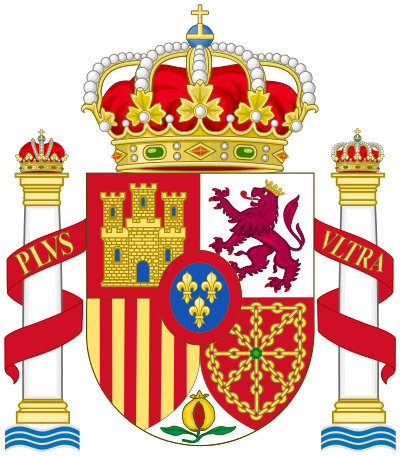
The primary field of the Spanish coat of arms is a quartered shield, a heraldic convention that visually narrates the historical process of Spain's formation. The first quarter, 'Gules a triple-towered castle Or,' represents the Kingdom of Castile, symbolizing its strong fortifications and royal authority. The second quarter, 'Argent a lion rampant Purpure crowned Or,' signifies the Kingdom of León, its rampant lion a potent emblem of regal power and martial prowess.
The third quarter, 'Or, four pallets Gules,' denotes the Crown of Aragon, its distinct red and gold stripes reflecting its historical influence as a major Mediterranean maritime power. The fourth quarter, 'Gules a cross, saltire and orle of chains linked together Or, a centre point Vert,' embodies the Kingdom of Navarre, its unique design featuring chains and a central green field. The inclusion of the green field is a modern interpretation, as traditional representations often omit it.
These four quarters are not merely decorative; they are a deliberate and sophisticated representation of the core medieval kingdoms whose eventual union under the Catholic Monarchs laid the groundwork for modern Spain. The precise heraldic language used to describe each element is crucial, with specific colors (tinctures) and charges carrying centuries of symbolic weight and historical context.
The Enté en Point and Bourbon Inheritance
Nestled at the base of the shield, the 'enté en point' is a crucial element representing the Kingdom of Granada. 'Argent a pomegranate proper seeded Gules, supported, sculpted and leafed in two leaves Vert' depicts a red pomegranate with green leaves and seeds, a symbol of the last Moorish kingdom to fall to the Christian reconquest in 1492. This addition is profoundly significant, marking the completion of the territorial unification of Spain under a single crown.
Overlaid upon these historical arms is an escutcheon, or inescutcheon, representing the dynastic claims of the ruling house. 'Azure bordure Gules, three fleurs-de-lys Or' signifies the House of Bourbon-Anjou, the current royal dynasty. The blue field with three golden fleurs-de-lis is the traditional Bourbon emblem, here presented with a red border, indicating its status as a cadet branch. This layering demonstrates the evolution of Spanish monarchy, where dynastic succession is integrated with the historical patrimony of the kingdoms.
Regal Crests and the Pillars of Hercules
Crowning the shield is the Spanish Royal Crown, a complex assemblage of a golden circlet set with jewels, featuring five visible arches (though the full crown has eight) supporting a monde (a blue orb with a cross) and topped with a red cap. This crown is not merely ornamental; it is a direct symbol of the monarch's authority and the constitutional role of the King as head of state. Flanking the shield are the legendary Pillars of Hercules, represented as two silver columns with golden capitals and bases, standing on wavy blue and white seas.
These columns, traditionally identified with the Rock of Gibraltar and Jbel Musa in Morocco, mark the entrance to the Mediterranean. They are surmounted by the Imperial Crown (representing historical imperial claims) and the Spanish Royal Crown, respectively. Encircling the columns is a red ribbon inscribed with the national motto, 'Plus Ultra' ('Further Beyond'), in gold lettering.
This motto, adopted by Charles V, Holy Roman Emperor and King of Spain, encapsulates Spain's historical drive for exploration and global influence, moving beyond the ancient limits of the Pillars of Hercules.
Modern Relevance and Heraldic Continuity
The current design of the Coat of Arms of Spain was officially approved by law in 1981, replacing an interim version used during the Franco regime. This re-establishment of a historically rooted heraldic symbol underscores the importance of continuity and national identity in post-Franco Spain. The coat of arms serves as a powerful visual anchor, representing national sovereignty and the country's form of government – a constitutional monarchy.
Its presence on the national flag and its use by state institutions, including the Cortes Generales (parliament) and the Supreme Court, reinforce its status as the preeminent symbol of the Spanish state. While the state coat of arms is a unified representation, the existence of variants for the monarch, the heir, and certain institutions like the Senate highlights the nuanced relationship between national symbols and specific governmental or dynastic roles.
The coat of arms is thus a dynamic entity, deeply rooted in history yet continuously relevant in contemporary Spain.
See also
Frequently Asked Questions
What do the four parts of Spain's shield show?+
Why is there a red pomegranate on the shield?+
What does the blue part with three golden fleurs-de-lys mean?+
What is the Spanish Royal Crown on top of the shield?+
What are the Pillars of Hercules on the sides of the shield?+
Based on content from Wikipedia · Licensed under CC BY-SA 4.0