

Black Forest
Images
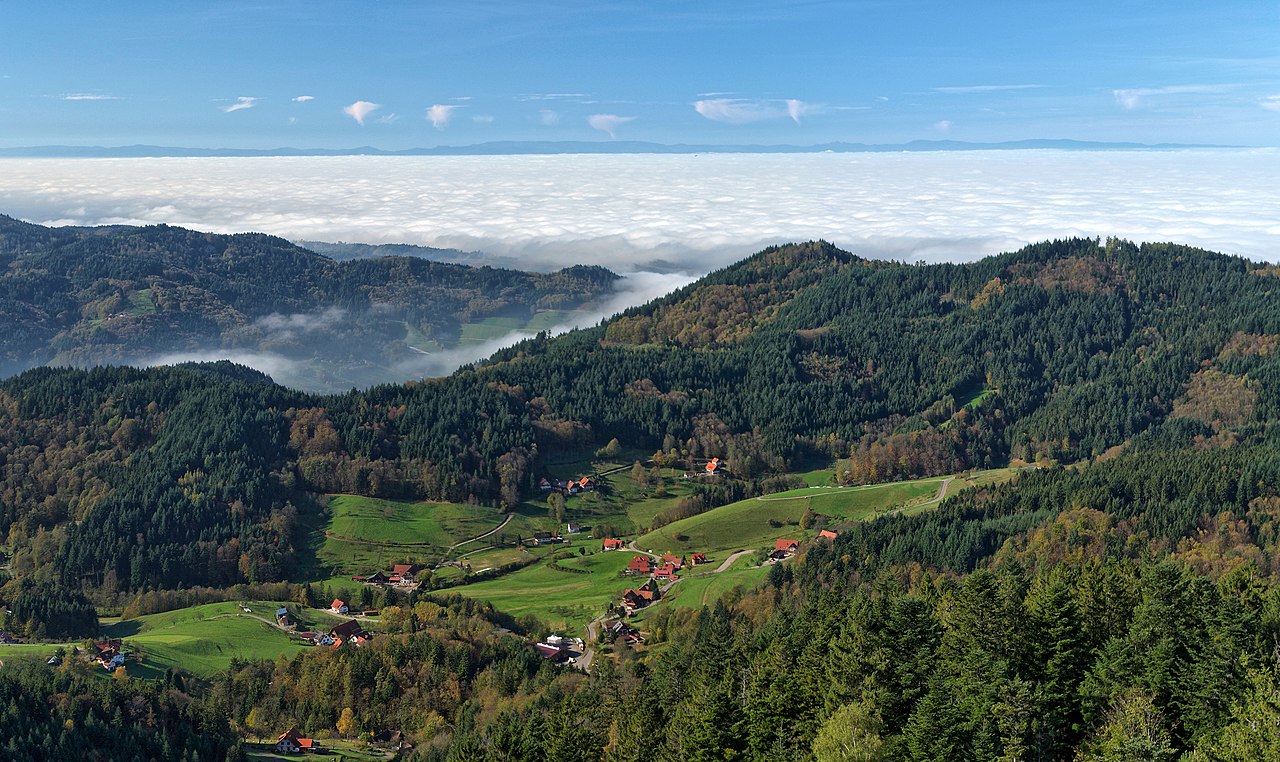
Blick Vom Hohfelsen


Geological Genesis and Hydrological Significance
The Black Forest (Schwarzwald) represents a prominent low mountain range in southwestern Germany, situated within the state of Baden-Württemberg. Its geological underpinnings are rooted in ancient Hercynian orogeny, with subsequent uplift and erosion shaping its characteristic undulating topography. The range is predominantly composed of crystalline rocks and Buntsandstein (Triassic sandstone), contributing to its varied landscapes of steep slopes, deep valleys, and plateaus.
The western and southern boundaries are sharply defined by the Rhine Valley rift, a major tectonic feature. Hydrologically, the Black Forest is of immense importance, serving as the primary watershed for two of Europe's most significant rivers: the Danube, which originates from the confluence of the Brigach and Breg rivers in the eastern foothills, and the Neckar, a major tributary of the Rhine. The highest elevation is reached at the Feldberg, standing at 1,493 meters (4,898 ft), a peak that offers panoramic views extending into the French Vosges and Swiss Alps, underscoring its central European location.
The region's climate is temperate, characterized by ample precipitation, particularly on the western slopes, which supports its dense forest cover and sustains its river systems.
Historical Trajectories
Historically, the Black Forest was a region defined by its natural resources. For centuries, its rich ore deposits, particularly silver and iron, fueled mining industries, making it a significant economic center. The abundant timber resources also led to extensive forestry operations, supplying wood for construction, fuel, and shipbuilding.
This exploitation, however, was often managed unsustainably, leading to periods of deforestation. The region's strategic location, bordering France and Switzerland, also meant it was a site of historical military activity, evidenced by 17th-century fortifications. Over time, the economic focus has shifted dramatically.
While forestry and mining have diminished in importance, the Black Forest has successfully transitioned into a major tourist destination. This shift has preserved much of its natural beauty and cultural heritage, transforming it into an iconic symbol of German identity, particularly through its association with the world-famous Black Forest gâteau and traditional cuckoo clocks, which originated in the region and became global symbols of German craftsmanship.
Economic Dynamics
The contemporary economy of the Black Forest is largely driven by tourism, which accounts for a substantial portion of its economic activity and employment, estimated to support around 300,000 jobs. This sector encompasses a wide range of services, including hospitality, recreation, and cultural tourism, attracting millions of visitors annually who seek its natural landscapes, hiking trails, and spa resorts. Beyond tourism, the region maintains specialized industries that leverage its historical strengths and natural resources.
Advanced manufacturing, particularly in precision engineering and optics, has a strong presence, building on a tradition of intricate craftsmanship exemplified by clockmaking. The forestry sector, while no longer dominant, remains important for sustainable timber production and landscape management. Furthermore, the agricultural sector, particularly dairy farming and fruit cultivation, contributes to the local economy and culinary traditions, including the production of Kirschwasser (cherry brandy), a key ingredient in the Black Forest gâteau.
This diversified economic base allows the region to balance its natural heritage with modern industrial and service-based economies.
Governance, Education, and Sustainable Development
The Black Forest is situated within the federal state of Baden-Württemberg, Germany, and is subject to its administrative and political structures. Governance involves a multi-layered system, with federal, state, and local authorities responsible for regional planning, environmental protection, and infrastructure development. The emphasis on sustainable development is a key aspect of governance, aiming to balance economic growth with the preservation of the region's unique natural and cultural heritage.
Educational institutions play a crucial role in fostering this balance. Universities and vocational schools within Baden-Württemberg offer programs in environmental science, forestry, tourism management, and engineering, preparing a skilled workforce for the region's diverse economic sectors. Research institutions often collaborate with local industries and government bodies on projects related to sustainable resource management, renewable energy, and ecological conservation.
The educational system also plays a part in promoting cultural awareness and preserving traditional crafts, ensuring that the unique identity of the Black Forest is passed down through generations while adapting to contemporary challenges and opportunities.
Go deeper
Frequently Asked Questions
What is the Black Forest and where is it located?+
Why is the Black Forest important for rivers?+
How tall is the highest mountain in the Black Forest?+
What did people do in the Black Forest in the past?+
What can visitors do in the Black Forest today?+
Based on content from Wikipedia · Licensed under CC BY-SA 4.0