

Bishkek
Images

Bishkek

![Transit Center visits Children's Cancer Center and retirement home in Bishkek [Image 1 of 6]](https://live.staticflickr.com/1281/5182290174_c9599eea5f_n.jpg)




Geopolitical and Environmental Setting
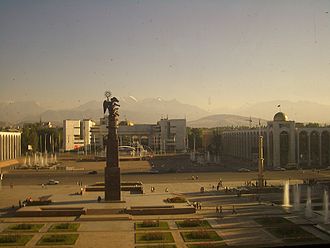
Bishkek occupies a geologically and strategically significant position in Central Asia. Situated at an elevation of approximately 800 meters, it lies at the northern edge of the Kyrgyz Ala-Too Range, an integral part of the formidable Tian Shan mountain system. These mountains, reaching altitudes of nearly 5,000 meters, not only define the city's dramatic southern skyline but also influence its climate, acting as a barrier and source of water.
Northward, the landscape transitions into the vast, fertile Chüy Steppe, a region historically vital for agriculture and nomadic pastoralism, extending into neighboring Kazakhstan. The Chüy River is the primary drainage artery for this area, sustaining its ecological balance and agricultural potential. The city's connectivity is enhanced by a spur line linking it to the crucial Turkestan-Siberia Railway, historically a major artery for trade and transport across Siberia and Central Asia.
This confluence of mountainous terrain, expansive steppe, and vital waterways positions Bishkek as a key node in regional geography and logistics.
Historical Trajectories
The urban fabric of Bishkek is woven from threads of diverse historical epochs. Its origins trace back to 1825 with the establishment of the Pishpek fortress by the Khanate of Kokand, a strategic move to control lucrative caravan routes and assert dominance over Kyrgyz tribes. The mid-19th century marked a significant geopolitical shift with the arrival of Russian forces.
In 1860, Colonel Apollon Zimmermann, with local Kyrgyz consent, dismantled the fortress. A Russian settlement, Pishpek, was subsequently founded in 1868 on the same site, becoming part of the Russian Empire's Turkestan General Governorship. The early 20th century saw further administrative reconfigurations, with Pishpek becoming the capital of the Kara-Kirghiz Autonomous Oblast in 1925.
A pivotal moment arrived in 1926 when the city was renamed Frunze, honoring Mikhail Frunze, a key figure in the Bolshevik Revolution born locally. Frunze ascended to the status of capital for the Kirghiz Soviet Socialist Republic in 1936, solidifying its role during the Soviet era's national delimitation. The post-Soviet era ushered in a return to a modified original name, Bishkek, adopted in 1991, symbolizing national sovereignty and a reassertion of indigenous identity.
Urban Morphology and Environmental Sustainability
Bishkek presents a compelling example of Soviet-era urban planning adapted to a Central Asian context. The city is characterized by a predominantly grid-pattern street layout, facilitating efficient movement and land division. This structured design is punctuated by wide boulevards and monumental public buildings, often clad in marble, reflecting the architectural style prevalent during the Soviet period.
These imposing structures are complemented by numerous residential apartment blocks, typically organized around internal courtyards that offer a degree of privacy and community space. Outside the city center, a significant number of smaller, privately constructed houses contribute to the urban mosaic. A particularly noteworthy feature is the extensive network of narrow irrigation channels flanking most streets.
These channels serve a dual purpose: managing water flow and, crucially, irrigating the thousands of trees that line the avenues. This deliberate integration of green infrastructure provides essential shade during Bishkek's hot summers, mitigating urban heat island effects and enhancing the city's livability. This system underscores a pragmatic approach to environmental management within an urban setting.
Socio-Economic Landscape and Governance
As the capital and largest urban center of Kyrgyzstan, Bishkek functions as the nation's primary political, economic, and cultural nexus. With a population nearing 1.2 million in 2024, it concentrates a significant portion of the country's human capital and economic activity. While detailed industrial breakdowns are not provided, its role as the capital implies dominance in sectors such as public administration, finance, services, and trade.
Its strategic location and railway connectivity facilitate its function as a key logistical and commercial hub for Kyrgyzstan and potentially wider Central Asia. The city is also the administrative heart of the Chüy Region, overseeing regional governance and development initiatives. Bishkek serves as the seat of national government, housing legislative, executive, and judicial branches, making it the focal point for policy formulation and implementation.
Furthermore, it is a center for education and research, attracting students and scholars from across the country and beyond, contributing to its dynamic social and intellectual environment. The city's development trajectory is intrinsically linked to Kyrgyzstan's broader national aspirations and its position within the global geopolitical landscape.
Education and Cultural Identity
Bishkek is the undisputed educational epicenter of Kyrgyzstan. It hosts the nation's most prominent universities and higher education institutions, including the Kyrgyz National University named after Jusup Balasagyn and the Kyrgyz State Technical University named after I. Razzakov.
These institutions are crucial for training the country's future professionals across a wide spectrum of fields, from engineering and medicine to humanities and social sciences. Beyond formal higher education, Bishkek offers a comprehensive system of primary and secondary schools, vocational training centers, and research institutes. The city's cultural landscape is equally rich, reflecting its diverse historical influences.
Museums, theaters, and art galleries showcase both traditional Kyrgyz heritage and contemporary artistic expressions. The preservation and promotion of Kyrgyz language and culture are central to the city's identity, particularly following its renaming in 1991. Bishkek serves as a platform where national identity is celebrated, debated, and evolved, making it a vital center for cultural continuity and innovation in post-Soviet Central Asia.
Go deeper
Frequently Asked Questions
What is Bishkek and where is it located?+
Why is Bishkek called Bishkek now?+
How do the mountains affect life in Bishkek?+
What is special about Bishkek's streets and buildings?+
How does water move through Bishkek?+
Based on content from Wikipedia · Licensed under CC BY-SA 4.0