

Allosaurus
Images

Allosaurus


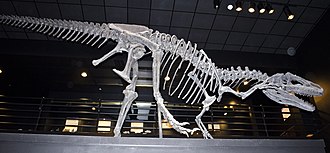


Anatomy and Adaptations of a Jurassic Hunter
Allosaurus, scientifically named Allosaurus fragilis, stands as a prime example of a large theropod dinosaur that thrived during the Late Jurassic period, approximately 150 million years ago. Its skeletal structure reveals a creature exquisitely adapted for predation. Averaging around 28-30 feet (8.5-9 meters) in length and weighing up to 2 tons, it possessed a relatively lightweight but robust build.
The skull was a formidable weapon, featuring a kinetic structure that allowed for a wider gape, and was armed with over 50 serrated teeth, each about 2-4 inches long. These teeth were constantly replaced, ensuring a sharp arsenal throughout its life. Unique cranial crests above the eyes, though possibly ornamental, may have also served to intimidate rivals or attract mates.
Its powerful hind limbs provided locomotion, while its relatively short forelimbs, though not as robust as those of later theropods like T. rex, were equipped with three formidable, sickle-shaped claws, suggesting a role in grappling with prey.
Ecological Niche and Predatory Strategies
As an apex predator, Allosaurus played a critical role in regulating populations within its ecosystem, primarily in what is now North America, particularly within the rich fossil beds of the Morrison Formation. Its diet was varied, consisting of the large herbivorous dinosaurs that shared its environment. Evidence suggests it preyed upon ornithischians like Stegosaurus, known for its defensive plates and tail spikes, and sauropods such as Camarasaurus.
The exact hunting strategies of Allosaurus are a subject of ongoing scientific debate. Some paleontologists propose that it may have hunted in packs, coordinating attacks to bring down larger prey. Others suggest a more solitary approach, ambushing smaller or weaker individuals.
The presence of healed bite marks on Allosaurus fossils, matching those of other Allosaurus individuals, hints at intraspecific conflict, possibly over territory or mates, and perhaps even cannibalism. Its success as a predator was due to a combination of speed, agility, powerful jaws, and sharp claws.
Fossil Discoveries and Scientific Insights
The discovery of Allosaurus fossils has provided invaluable insights into the Late Jurassic world. The Cleveland-Lloyd Dinosaur Quarry in Utah, for instance, is famous for containing a high concentration of Allosaurus remains, leading to theories about a predatory trap or a communal gathering site. Studying these fossils allows scientists to reconstruct not only the dinosaur's physical characteristics but also infer aspects of its behavior and life history.
For example, analysis of bone histology can help estimate growth rates and lifespan, which for Allosaurus is thought to be around 20-30 years. The sheer abundance of Allosaurus fossils compared to other large predators in the Morrison Formation suggests it was a highly successful and widespread species, a testament to its effective predatory adaptations and ecological dominance.
Allosaurus's Place in Dinosaurian Evolution
Allosaurus represents a significant branch in the evolutionary tree of theropod dinosaurs. It belongs to the family Allosauridae, a group that flourished during the Jurassic period. While it predates the more famous Tyrannosaurus rex by tens of millions of years, it shares many theropod characteristics.
Its success highlights the diversification of large predatory dinosaurs during the Jurassic, setting the stage for the even larger and more specialized forms that would emerge in the Cretaceous. Understanding Allosaurus helps us piece together the complex food webs and evolutionary pressures that shaped dinosaurian life over vast geological timescales. Its extinction, like that of all non-avian dinosaurs, remains a profound event in Earth's history, marking the end of an era dominated by these magnificent reptiles.
Go deeper
Frequently Asked Questions
What did Allosaurus look like?+
How big was Allosaurus?+
What did Allosaurus eat?+
Did Allosaurus hunt alone or in groups?+
Where can we find Allosaurus fossils?+
Based on content from Wikipedia · Licensed under CC BY-SA 4.0