

The 12th Century: A Time of Knights and Kingdoms!
Images
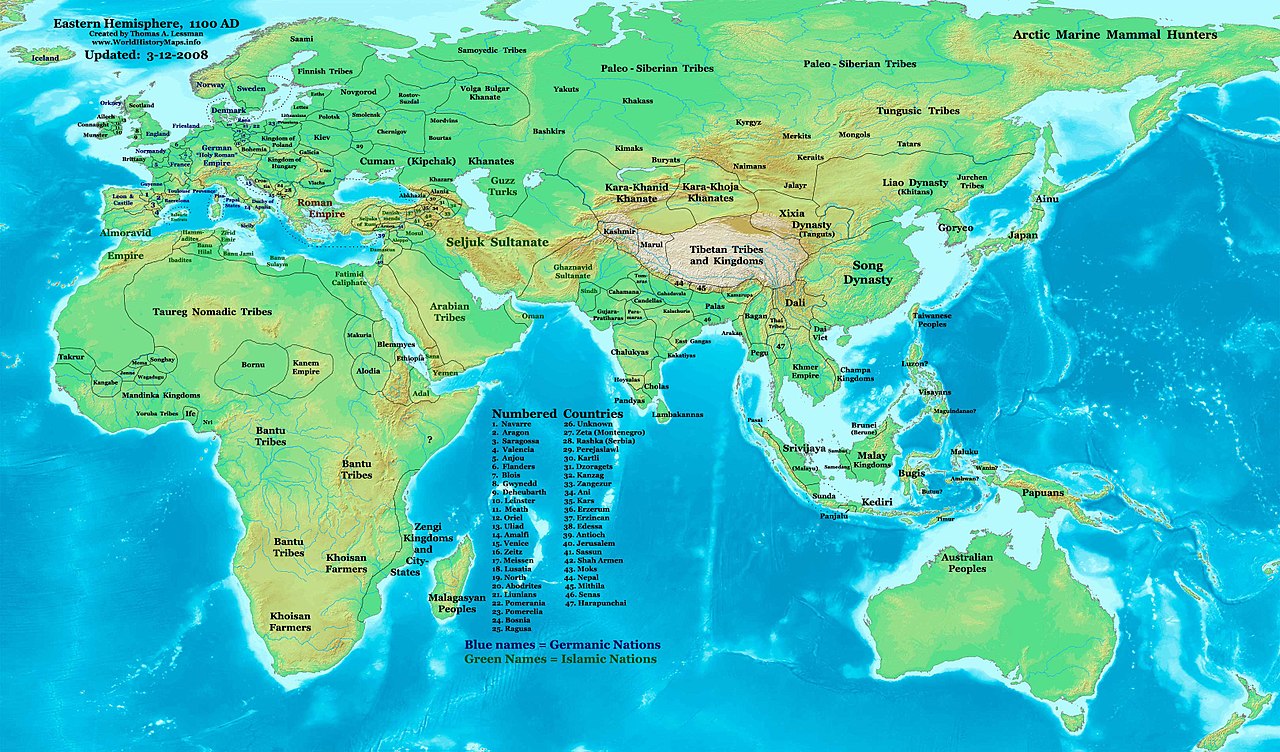
East Hem 1100ad






Foundations of the Era
The 12th century emerged from a complex tapestry of preceding historical developments. The early medieval period had seen the fragmentation of empires, the rise of feudalism in Europe, and the consolidation of new kingdoms. In the Islamic world, the Abbasid Caliphate, though politically weakened, remained a cultural and intellectual beacon, fostering advancements in science, mathematics, and philosophy that had begun centuries earlier.
The Seljuk Turks had expanded their influence across the Middle East, setting the stage for later political realignments. In East Asia, China's Song Dynasty was a powerhouse of innovation, boasting sophisticated bureaucracy, advanced printing, and a thriving economy, yet facing increasing external pressures. The foundations laid by these diverse civilizations-their political structures, intellectual traditions, and economic networks-created the dynamic environment into which the 12th century would unfold, characterized by both continuity and radical change.
The Global Stage
The 12th century was a period of significant global flux. In Europe, it represented the High Middle Ages, a time of increasing population, agricultural innovation, and the flourishing of religious orders like the Cistercians, whose monastic network became a major force in land management and economic development. The 'Golden Age' of Islam continued, with particularly vibrant intellectual and cultural scenes in Al-Andalus (Islamic Spain), fostering advancements in medicine, astronomy, and philosophy.
However, this era also witnessed profound geopolitical shifts. Song Dynasty China experienced a devastating invasion by the Jurchens, leading to the loss of northern territories and the establishment of the Jin Dynasty, creating a political schism that would persist. The Khmer Empire in Cambodia reached its zenith, marked by monumental architectural achievements.
In Egypt, the Fatimid Caliphate, a Shi'a dynasty, was overthrown by the Sunni Ayyubid dynasty, famously led by Saladin, who would become a pivotal figure in the Crusades. The latter part of the century saw the expansion of Muslim rule into the Indian subcontinent through the conquests of the Ghaznavids and the Ghurid Empire, fundamentally altering the region's political and cultural landscape.
Echoes Through Time
The transformations of the 12th century cast long shadows, shaping subsequent historical trajectories. The Cistercian order's influence extended beyond religion, impacting European agriculture, land use, and economic organization for centuries. The intellectual legacy of the Islamic Golden Age, preserved and expanded upon in centers like Cordoba and Baghdad, played a crucial role in transmitting classical knowledge and fostering scientific inquiry that would eventually contribute to the European Renaissance.
The political division of China had lasting implications for regional power dynamics and ethnic relations. The rise of the Ayyubids under Saladin significantly impacted the balance of power in the Levant and the dynamics of the Crusades. The establishment of Muslim rule in parts of India initiated a long period of cultural synthesis and political interaction between Islamic and indigenous Indian traditions.
These developments collectively represent a critical juncture, influencing the religious, political, and cultural makeup of vast regions for centuries to come.
Forces of Change
The 12th century was driven by a confluence of powerful forces and emerging entities rather than solely by individual rulers. The Cistercian monastic movement represented a significant socio-economic and spiritual force in Europe, characterized by disciplined organization and widespread land reclamation. In East Asia, the Jurchen people emerged as a dominant military power, fundamentally reshaping the political map of China.
The Ayyubid dynasty, under the leadership of figures like Saladin, became a formidable political and military entity in the Middle East, challenging Crusader states and consolidating power. The Ghaznavid and Ghurid empires were instrumental in the expansion of Islamic influence into South Asia, initiating a new phase of conquest and cultural exchange. These collective movements and nascent dynasties, rather than singular personalities, were the primary agents of change, their actions and interactions defining the century's transformative character.
The Interconnected World
The events of the 12th century were driven by a complex interplay of causes and resulted in far-reaching consequences. In Europe, the growth of monastic orders like the Cistercians was fueled by a desire for spiritual reform and a need to organize and cultivate vast tracts of land, leading to significant agricultural and economic advancements. In China, the Jurchen invasion was a consequence of long-standing frontier tensions and the military strength of nomadic peoples, resulting in the profound political division of the Song empire and a protracted period of conflict.
The rise of the Ayyubids in Egypt stemmed from the internal weaknesses of the Fatimid state and the external threat of Crusader expansion, leading to a consolidation of power that would define the region's response to the Crusades. The Muslim conquests in India were driven by a combination of military ambition, the desire for resources, and the fragmentation of Indian polities, initiating a long process of cultural and political integration. These interconnected causes and consequences highlight the 12th century as a period where regional developments had global reverberations, influencing trade, migration, and the spread of ideas.
See also
Frequently Asked Questions
What was the 12th century like in Europe?+
Who was Saladin and why did he matter?+
What happened to China’s Song Dynasty in the 12th century?+
What was the Islamic Golden Age?+
What did the Khmer Empire build during its peak?+
Based on content from Wikipedia · Licensed under CC BY-SA 4.0