

Uzbek People
Images

Uzbek people


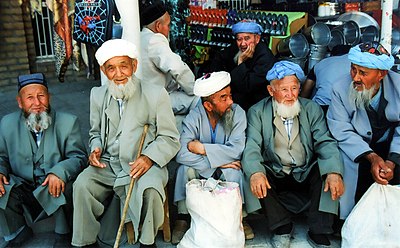


Defining the Uzbek Ethnos
The Uzbek people represent a significant ethno-linguistic group whose identity is a product of millennia of complex interactions in Central Asia. Their origins are not monolithic but rather a synthesis of ancient sedentary Iranian peoples (like the Sogdians and Bactrians) and successive waves of nomadic Turkic and Mongol migrations. The term 'Uzbek' gained prominence in the 15th century with the establishment of the Uzbek Khanate by descendants of the Mongol conqueror Genghis Khan, particularly the Shaybanids.
This period marked a crucial phase in consolidating a distinct Uzbek identity, blending Turkic language and customs with the established cultures of the region. The Uzbek language itself, a member of the Karluk branch of the Turkic language family, reflects this historical layering, incorporating loanwords from Persian, Arabic, and Russian, underscoring the region's role as a historical crossroads.
The Silk Road's Legacy
The historical significance of the Uzbek people is inextricably linked to the Silk Road. For centuries, the territories they inhabited were central hubs along these vital arteries of global commerce. Cities like Samarkand, Bukhara, and Khiva were not merely trading posts but sophisticated centers of learning, art, and urban development.
The wealth generated by the Silk Road fueled the patronage of magnificent architecture, scientific inquiry, and artisanal production. This era fostered a rich tradition of scholarship, particularly in Islamic sciences, and cultivated a sophisticated urban culture characterized by intricate bazaars, madrasahs (religious schools), and mausoleums. The legacy of this period continues to shape Uzbek national identity and its perception on the global stage, emphasizing a heritage of cosmopolitanism and intellectual achievement.
Artisanal Prowess and Culinary Diplomacy
Uzbek culture is globally recognized for its exceptional artistic traditions and its deeply ingrained ethos of hospitality. The textile arts, including the intricate 'suzani' embroidery, vibrant 'ikat' dyeing techniques, and the creation of hand-knotted carpets, represent a sophisticated visual language passed down through generations. These crafts are not merely decorative but serve as important cultural markers, often imbued with symbolic meanings related to fertility, protection, and community.
Complementing this artistic richness is the Uzbek approach to hospitality, or 'mehmonnavozlik.' The national dish, 'plov' (pilaf), is a prime example of culinary diplomacy; its preparation is a communal ritual, and its generous sharing signifies respect and welcome. This cultural emphasis on artistry and hospitality fosters strong social bonds and contributes significantly to Uzbekistan's cultural diplomacy efforts.
The Modern Uzbek Identity
In the contemporary era, the Uzbek people navigate a complex landscape of national identity and diaspora. Following the dissolution of the Soviet Union, Uzbekistan emerged as an independent nation, seeking to define its modern identity while honoring its rich historical and cultural patrimony. This involves balancing the preservation of traditional values with the demands of globalization and modernization.
Beyond Uzbekistan's borders, significant Uzbek diaspora communities exist in neighboring Central Asian countries (such as Afghanistan, Tajikistan, Kyrgyzstan, and Kazakhstan) as well as in Russia and Turkey. These communities often maintain strong cultural and linguistic ties to their homeland, contributing to a broader, transnational Uzbek identity. Understanding the Uzbek people requires appreciating this dynamic interplay between historical legacy, national aspirations, and the experiences of its global diaspora.
See also
Frequently Asked Questions
What makes Uzbek people special?+
How does the Uzbek language have so many different words?+
Why are cities like Samarkand, Bukhara, and Khiva famous?+
What is plov and why do people share it?+
Where do Uzbek people live today?+
Based on content from Wikipedia · Licensed under CC BY-SA 4.0