

Tesla Cybertruck
Images
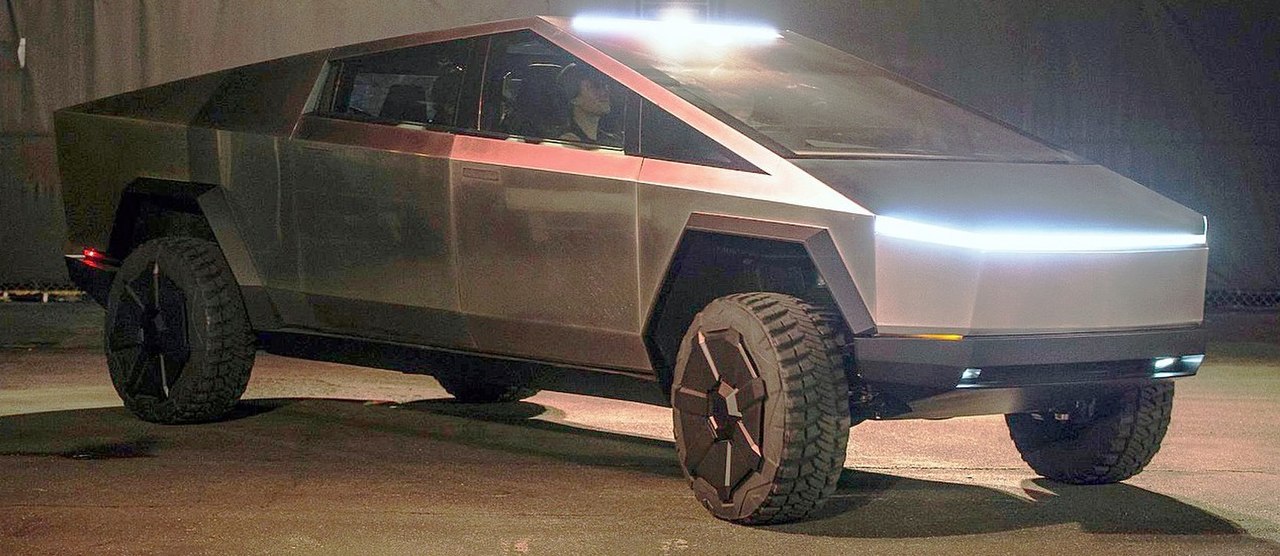
Tesla Cybertruck outside unveil modified by Smnt


Deconstructing the Design
The Tesla Cybertruck represents a radical departure from the established norms of pickup truck design, a segment historically characterized by rugged utility and conventional aesthetics. Unveiled in November 2019, the prototype's angular, faceted silhouette, reminiscent of low-polygon computer graphics, immediately polarized opinions. This design language is intrinsically linked to its primary construction material: unpainted, 30X cold-rolled stainless steel.
Unlike traditional automotive manufacturing that relies on stamped steel or aluminum panels, the Cybertruck's exoskeleton is built from large, flat sheets of this exceptionally hard alloy. This choice dictates the vehicle's geometric form, eschewing curves for sharp lines and planes. The journey from prototype to limited production, which began in November 2023 at Gigafactory Texas after multiple delays, highlights the significant engineering challenges involved in manufacturing with such an unconventional material and design.
These delays underscore the difficulty in scaling production for a vehicle that fundamentally rethinks automotive construction and assembly processes.
Powertrain and Performance
At its core, the Cybertruck is a battery-electric vehicle, aligning with Tesla's broader mission to accelerate the world's transition to sustainable energy. It eschews internal combustion engines in favor of electric motors powered by a substantial battery pack. This electrification provides immediate torque, enabling rapid acceleration that often surprises observers accustomed to the gradual power delivery of gasoline engines.
Tesla offers three distinct powertrain configurations for the 2025 model year: a single-motor rear-wheel-drive 'Long Range' variant, a dual-motor all-wheel-drive model, and the flagship tri-motor 'Cyberbeast' variant. These options cater to a spectrum of performance and range requirements. EPA estimates indicate a maximum range of up to 350 miles for certain configurations, positioning it competitively within the emerging electric truck market, though real-world range can vary significantly with driving conditions and payload.
Material Science and Structural Integrity
The Cybertruck's most defining characteristic is arguably its construction material. The use of 30X cold-rolled stainless steel for its exoskeleton is a bold engineering decision. This alloy is significantly harder and stronger than conventional automotive steel, offering enhanced resistance to dents, scratches, and corrosion.
Tesla promotes this material as a key safety feature, suggesting it can absorb and deflect impact energy more effectively than traditional body panels. The unpainted finish contributes to its distinctive, almost industrial aesthetic, but also presents unique manufacturing challenges, including panel fitment and the potential for visible imperfections. This material choice fundamentally alters the manufacturing process, moving away from traditional body-on-frame or unibody construction towards a more integrated, structural approach where the exterior panels are load-bearing elements.
Market Reception and Future Implications
The Cybertruck's market entry has been met with a complex mix of fascination and skepticism. While its futuristic design and robust construction have garnered significant attention, its production quality and perceived safety have drawn criticism. Sales figures, as of early 2025, have been described as disappointing, suggesting that the radical design and associated challenges may be limiting its appeal to a mainstream audience. The truck is currently sold in key markets including the United States, Mexico, Canada, and South Korea.
Despite these initial hurdles, the Cybertruck serves as a potent symbol of innovation, pushing the boundaries of automotive design, material science, and electric vehicle technology. Its existence forces a re-evaluation of what a pickup truck can be, potentially influencing future designs and manufacturing techniques across the industry, even if its immediate commercial success remains uncertain.
See also
Based on content from Wikipedia · Licensed under CC BY-SA 4.0